

Nanonets
✓ VerifiedTrainable document extraction that learns your invoices, orders and claims without templates and returns structured data by platform or API.
Best For: Operations teams extracting data from invoices, orders, claims and contracts at volume
Nanonets Quick Facts
| Free Plan | Yes, a free start with credits and no card required |
| Top Feature | Template-free learning models for each document type you feed it |
| Main Limitation | Your per-document cost depends on how your workflow blocks are built |
The Verdict: Nanonets
Nanonets is the strongest choice here for a team whose documents repeat: the same invoices, orders and claims arriving every week in layouts a template would struggle to hold. The setup week is real, and the per-document cost only becomes clear once your flow exists. Teams with a one-off pile of mixed paper will get to an answer faster with a simpler tool.
What is Nanonets?
Nanonets is built for the moment a document pile becomes a process. Instead of asking for a template per supplier, it learns each document type from your examples and returns the fields as structured data, through the web platform or the API. In our roundup of the best AI image scanning tools it is the pick for trainable extraction, and its home ground is accounts payable, order management, logistics, healthcare and contract work.
The pricing rewards teams that design their flows with care. A document that passes through a few simple blocks costs very little to read, while a document routed through complex AI blocks costs more, so the same plan can feel cheap or dear depending on how the workflow is built. A fixed-parser API like Mindee is easier to budget, since every page costs the same credit, while Nanonets trades that simplicity for flexibility across odd layouts.
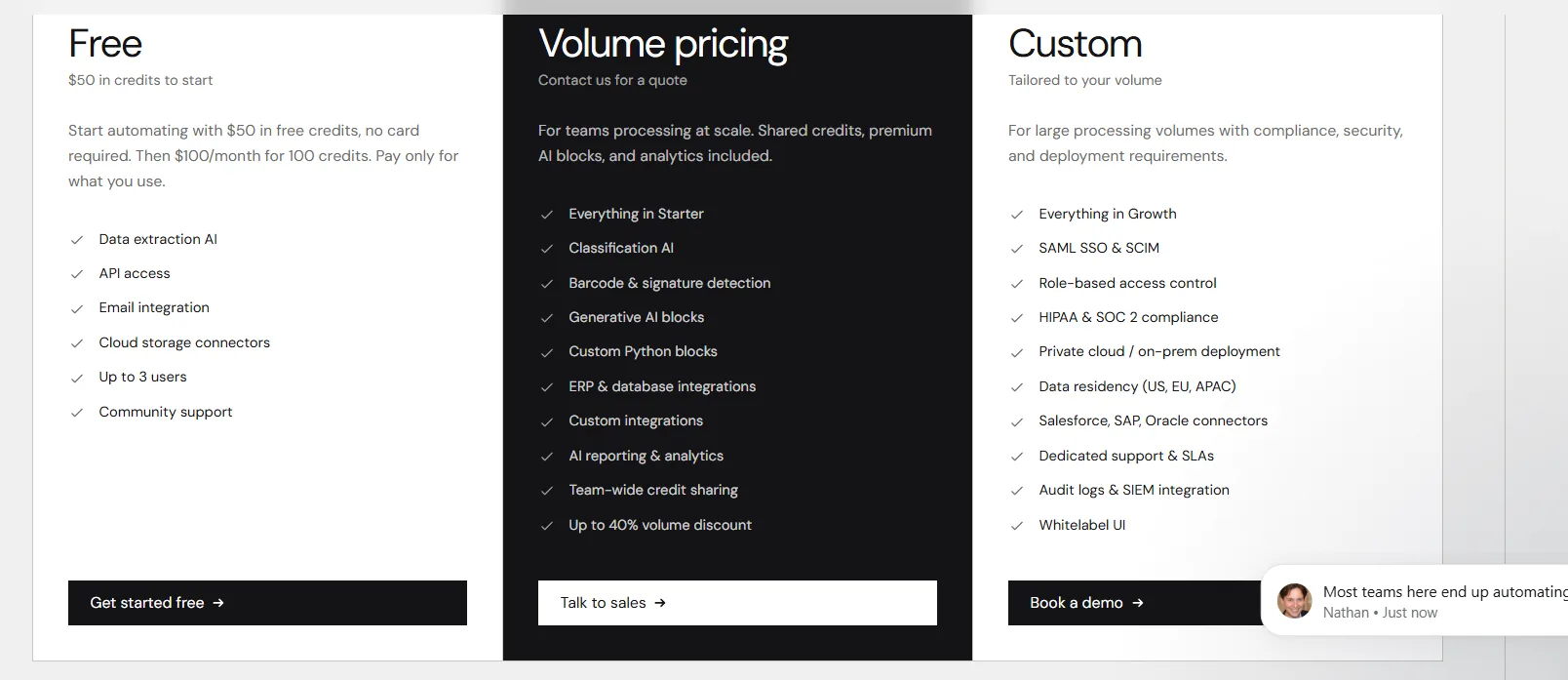
The credit balance itself is friendly: prepaid, shared across the team and documented as never expiring, which suits seasonal workloads. Growth and Enterprise move to quotes, with private cloud and on-prem deployment at the top end for teams whose documents cannot sit in a public cloud.
Who is Nanonets Best For?
Operations teams extracting data from invoices, orders, claims and contracts at volume
Nanonets Key Features
Top Benefits of Nanonets
How to Use Nanonets
- Create a Nanonets account and take the free credits to start
- Upload sample documents of one type, such as invoices
- Mark the fields you want extracted and train the model
- Build the workflow and choose which blocks each document runs through
- Connect email, storage or the API so documents arrive on their own
- Review the extracted data and export or send it to your other systems
Where Nanonets Fits: Use Cases
- Accounts payable teams processing supplier invoices
- Logistics firms reading orders and shipping documents
- Healthcare offices extracting claim data
- Legal and operations teams pulling fields from contracts
Nanonets Pricing & Plans
Nanonets Review Summary
| Performance Score | A |
| Content Quality | Accurate field extraction on trained document types, with review tooling for doubtful fields |
| Interface | A workflow builder that takes setup time and then runs quietly |
| AI Technology | Learning models per document type with block-based workflow automation |
| Purpose | Template-free document data extraction for operations teams |
| Compatibility | Web platform with API, email and storage integrations |
| Pricing Summary | Nanonets starts free with $50 in credits and no card. The paid plan is $100 per month for 100 credits. Workflow blocks price per run at $0.02 for simple, $0.10 for standard AI and $0.30 for complex AI, and a typical invoice flow runs 4 to 6 blocks. Growth and Enterprise are quote based, with volume discounts up to 40 percent on Growth. |
Nanonets Pros & Cons
✅ Pros
- Learns new document layouts without template building
- Free start with credits and no card required
- Credits are prepaid and never expire
- Block pricing lets simple documents stay cheap
- Enterprise deployment can run private cloud or on-prem
❌ Cons
- Per-document cost is hard to predict before the flow is built
- Complex workflows burn credits faster than expected
- Higher tiers are quote based with no public figure
- A small scanning job may never justify the setup time
Alternatives to Nanonets
FAQs
Does Nanonets have a free plan?
▼How does Nanonets pricing work?
▼Do Nanonets credits expire?
▼What documents does Nanonets handle best?
▼Does Nanonets offer an API?
▼Is Nanonets suitable for a small business?
▼More AI Tools You Might Like

Developer-first document API that returns structured JSON from invoices, receipts, passports and…
View Tool ↗
No-code document extraction that turns invoices, receipts, bank statements and tax forms…
View Tool ↗
Free phone scanner inside the Acrobat family that captures paper documents, runs…
View Tool ↗
Google Cloud document processing API with general OCR and prebuilt parsers for…
View Tool ↗
Document extraction and validation platform for lending and insurance paperwork, from bank…
View Tool ↗
Document data extraction API that reads receipts, invoices and bank documents and…
View Tool ↗
Intelligent document processing platform, now Doxis AI.dp, pairing extraction with fraud detection,…
View Tool ↗
Enterprise document platform for accounts payable that extracts invoice data with its…
View Tool ↗