AI vs Machine Learning: What’s the Difference?
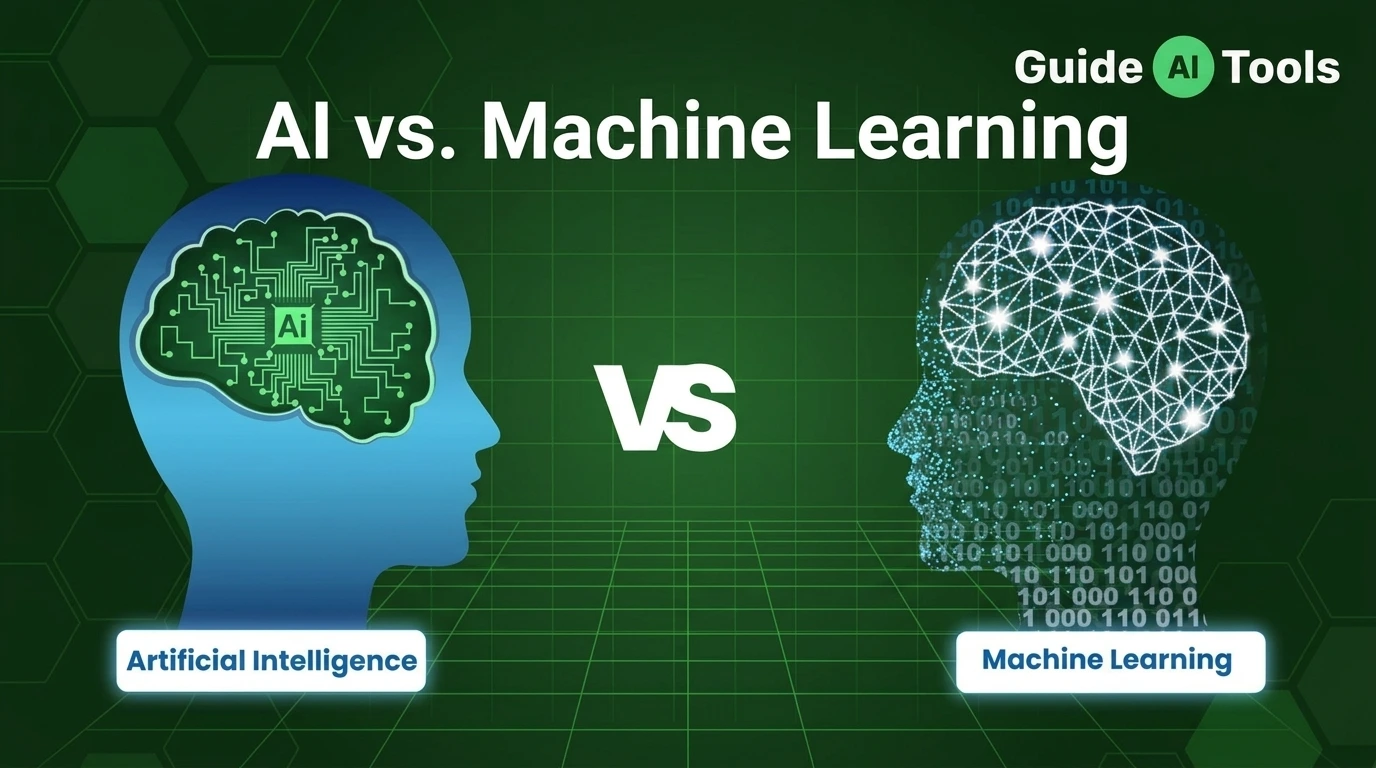
Artificial intelligence is the broader field of building systems that can perform tasks associated with intelligent behavior, while machine learning is one approach within AI that learns patterns from data. Put simply, machine learning is part of AI, but AI is bigger than machine learning. The two terms overlap, but they aren’t interchangeable.
That distinction sounds small.
It isn’t.
If you’ve ever wondered whether ChatGPT, a recommendation engine or a spam filter is “AI” or “machine learning,” the answer can involve both terms. The confusion usually comes from treating them as competing technologies when they’re actually different levels of the same field.
AI vs machine learning at a glance
The easiest way to separate them is to look at their scope.
| Artificial Intelligence | Machine Learning | |
|---|---|---|
| What it is | Broad field of intelligent computer systems | Subset of AI |
| Main focus | Performing tasks associated with intelligent behavior | Learning patterns from data |
| Does it always learn from data? | No | Learning from data is central |
| Methods | Rules, search, planning, ML and other techniques | Learning algorithms and statistical methods |
| Typical outputs | Decisions, recommendations, reasoning, generation or actions | Predictions, classifications and learned outputs |
| Scope | Broad | More specific |
| Example | A rule-based expert system | A spam classifier trained on emails |
Stanford HAI describes machine learning as a branch of AI that enables computers to learn patterns and make decisions from data without being explicitly programmed with rules. Google Cloud likewise places machine learning within the broader AI field.
So the short answer is simple:
AI is the broader concept. ML is one way of building AI systems.
What is artificial intelligence?
Artificial intelligence, or AI, is the broader field concerned with building computer systems that can perform tasks associated with human intelligence, such as perception, language understanding, reasoning, decision-making and problem solving.
That doesn’t mean every AI system works like a human brain.
It means the system is designed to perform a task that would normally require some form of intelligent behavior.
AI can involve several different approaches. Machine learning is one of them.
Other approaches can include rules, search, planning, knowledge representation and optimization.
For example, a simple expert system could use predefined rules:
If condition A is true, perform action B.
That system can be considered an AI application without learning new rules from a training dataset.
This is one of the easiest ways to see why AI and ML aren’t synonyms.
For the broader definition, see our guide to What Is Artificial Intelligence?.
What is machine learning?
Machine learning is a subset of AI in which algorithms learn patterns from data and use those patterns to make predictions or decisions on new data.
Instead of writing every rule by hand, developers provide data and choose a learning approach suited to the problem.
Take spam detection.
You could manually create rules for suspicious words, senders or links. That approach becomes difficult to maintain as spam changes.
A machine learning model can instead be trained using examples of spam and legitimate emails. During training, it learns patterns that help distinguish one category from the other.
The trained model can then examine a new email and produce a prediction.
That’s machine learning.
Our dedicated What Is Machine Learning? guide goes deeper into the training process, learning types and examples.
How are AI and machine learning related?
Think of AI as the larger box.
Machine learning sits inside it.
Artificial Intelligence
        |
        └── Machine Learning
                |
                └── Deep Learning
This relationship is also reflected in explanations from IBM and Google Cloud. Deep learning is a specialized form of machine learning, while machine learning sits within the broader AI field.
That hierarchy matters because people often use all three terms as if they mean the same thing.
They don’t.
AI describes the broader field. ML describes a particular way of creating systems that learn from data. Deep learning describes a particular family of ML methods based on multilayer neural networks.
What is the main difference between AI and machine learning?
The biggest difference is scope.
Google Cloud also explains the distinction between AI and machine learning by treating AI as the broader field and machine learning as a specific approach that learns from data.
AI describes the larger goal of creating systems capable of intelligent behavior.
Machine learning describes a specific approach where a system learns useful patterns from data.
There are several practical differences worth understanding.
AI has a broader scope
AI can include systems based on rules, search, planning, machine learning and other techniques.
Machine learning has a narrower focus. Its defining feature is learning from data.
ML depends on a learning process
An ML model needs some form of data or experience from which it can learn.
An AI system doesn’t necessarily need to learn from a dataset.
A rule-based system can still fall within the wider AI field.
Their goals can differ
An AI system might be built to:
- Understand language
- Plan actions
- Solve a problem
- Recommend something
- Recognize objects
- Generate content
- Control an autonomous system
An ML model might be trained to:
- Classify an email
- Predict a price
- Detect fraud
- Recommend a product
- Recognize an image
Google Cloud makes a similar distinction by describing AI as the broader concept and ML as an application that extracts knowledge from data.
Can AI work without machine learning?
Yes. AI can exist without machine learning.
A classic example is a rule-based expert system.
Imagine a troubleshooting system for a machine. It could contain rules such as:
If temperature is high and pressure is low, check the cooling system.
The system doesn’t need to train on thousands of examples to follow that instruction.
It simply applies the rules it was given.
That is different from a machine learning system, where the rules or relationships used for prediction are learned from data rather than manually specified for every case.
Modern AI systems often combine several approaches, so the boundary isn’t always visible when you’re using the final product.
A voice assistant, for example, may involve speech recognition, machine learning, language models, search, databases and software that carries out actions.
Calling the whole product “AI” is reasonable.
Calling every individual component “machine learning” isn’t.
What are some examples of AI that aren’t necessarily machine learning?
This is where the distinction becomes easier to see.
Rule-based expert systems
A system can use manually written rules to make decisions within a defined domain.
Search and planning
An AI system can search through possible actions or paths to find a suitable solution.
Knowledge-based systems
A system can use structured knowledge and logical rules to answer questions or reach conclusions.
Machine learning systems
These learn patterns from data and make predictions or decisions based on what they learned.
The exact boundary depends on how a system is designed, and modern applications can combine several of these approaches.
That’s why it’s better to ask which part of the system uses ML rather than assuming that every AI feature is an ML model.
What are some examples of machine learning?
Machine learning shows up in plenty of systems you probably already use.
Spam filters
A model can learn patterns associated with unwanted messages and classify new emails.
Recommendation systems
Streaming platforms and online stores can use patterns in user behavior to predict what content or products might be relevant.
Fraud detection
Financial systems can analyze transaction patterns and flag activity that looks unusual.
Image recognition
ML models can learn visual patterns and classify or identify objects in images.
Speech recognition
ML models can process spoken audio and convert it into text.
Stanford HAI lists spam filtering, recommendation systems, image recognition, voice assistants and fraud detection among common machine learning applications.
AI vs machine learning: a real-world example
Let’s take a recommendation system.
You open a streaming service and receive a list of films you might enjoy.
From the user’s point of view, that’s an AI-powered recommendation feature.
But several things can sit underneath it.
A machine learning model may study patterns in viewing history, ratings or other available signals. It can then estimate which items are likely to be relevant.
The wider AI application can include the interface, business rules, retrieval system and other software around that model.
So:
AI describes the broader intelligent application.
ML can be one of the components making the prediction possible.
This is a useful distinction because real AI products are often systems made from several technologies rather than one model doing everything.
AI vs machine learning vs deep learning
The next source of confusion is deep learning.
Deep learning isn’t a competitor to machine learning.
It’s a specialized part of it.
| Technology | Relationship | Main idea |
|---|---|---|
| Artificial Intelligence | Broadest | Build systems capable of intelligent tasks |
| Machine Learning | Subset of AI | Learn patterns from data |
| Deep Learning | Subset of ML | Use multilayer neural networks to learn complex patterns |
Deep learning is particularly useful for areas involving complex data such as images, audio and language. Google Cloud and IBM both describe deep learning as a subset of machine learning.
So when someone says “deep learning,” they’re talking about a more specific technique.
When they say “machine learning,” the category is wider.
When they say “AI,” they’re talking about the broadest field.
Is generative AI the same as machine learning?
No.
Generative AI is not simply another name for machine learning.
Modern generative AI systems commonly rely on machine learning and deep learning models to generate new content such as text, images, audio, video and code.
The relationship can be simplified like this:
Artificial Intelligence
        |
        └── Machine Learning
                |
                └── Deep Learning
                        |
                        └── Many modern generative AI systems
The exact architecture varies by system, so this diagram is a conceptual hierarchy rather than a description of every AI model.
IBM identifies machine learning and deep learning as key technologies underlying modern generative AI systems.
AI vs machine learning in everyday technology
Here’s how the distinction looks across familiar applications.
| Application | AI role | Possible ML role |
|---|---|---|
| Voice assistant | Understands requests and performs tasks | Speech and language models |
| Recommendation engine | Provides personalized recommendations | Learns patterns from user behavior |
| Spam filter | Classifies unwanted messages | Learns patterns associated with spam |
| Fraud detection | Helps identify suspicious activity | Learns transaction patterns |
| Image recognition | Interprets visual information | Learns visual features and categories |
| Chatbot | Interacts with users | ML models process and generate responses |
The word “possible” matters here.
A real system can contain multiple components, and its architecture may change over time.
It’s not always accurate to reduce a complete product to one technology.
What is the difference in data requirements?
Machine learning depends heavily on data because the model needs examples or experience from which it can learn.
AI as a broader field doesn’t have one universal data requirement.
A rule-based AI system can operate from explicitly written rules.
A machine learning system needs a learning signal.
That signal can take different forms.
Supervised learning can use labeled examples.
Unsupervised learning can work with unlabeled data to identify structure.
Self-supervised systems can create learning signals from the data itself.
Reinforcement learning can learn through rewards and interaction.
So saying “AI needs data” is too broad.
Saying “machine learning learns from data or experience” is much closer to the core distinction. Stanford HAI and IBM both frame ML around learning patterns from data.
AI vs machine learning: which is better?
Neither is “better.”
They aren’t competing products.
AI is the broader field, while ML is one approach used within that field.
If you’re talking about an intelligent system as a whole, AI is usually the appropriate term.
If you’re talking specifically about a model that learns patterns from data, machine learning is the more precise term.
The useful question isn’t:
Which one should I choose?
It’s:
What problem am I trying to solve, and what technology does that problem require?
That shift makes the terminology much less confusing.
Should you learn AI or machine learning first?
For a beginner, start with the broader AI concepts and then move into machine learning.
A sensible path is:
AI fundamentals → Machine Learning → Deep Learning → Specialized AI
You don’t need to become an ML engineer to understand AI.
If your goal is using AI tools, learning the basic relationship between AI, ML and deep learning is often enough to make technical claims and product descriptions much easier to understand.
If you’re planning to build models, work with data or pursue an ML-focused technical role, then a deeper study of statistics, algorithms, Python and machine learning frameworks makes sense.
The right path depends on what you want to do with the technology.
FAQs
Is machine learning a type of AI?
Yes. Machine learning is a subset of artificial intelligence. It focuses on systems that learn patterns from data and use those patterns to make predictions or decisions.
Is AI the same as machine learning?
No. AI is the broader field. Machine learning is one approach within AI.
What is the main difference between AI and machine learning?
AI covers the broader goal of building systems capable of intelligent behavior. Machine learning focuses specifically on learning patterns from data.
Can AI work without machine learning?
Yes. Rule-based systems and some other AI approaches can operate without training a machine learning model.
Is deep learning part of AI or machine learning?
Deep learning is a subset of machine learning, which itself is a subset of AI.
Is generative AI the same as machine learning?
No. Modern generative AI commonly uses machine learning and deep learning, but generative AI refers to systems that create new content rather than to the broader learning method itself.
Does every AI system use machine learning?
No. AI can use rules, search, planning and other approaches. Many modern AI systems do use ML, but the terms are not interchangeable.
Is ChatGPT AI or machine learning?
ChatGPT is an AI application built using machine learning, including large language model technology. Calling it AI is correct at the product level, while machine learning describes an important part of the technology behind it.
Which is better, AI or machine learning?
Neither. Machine learning is part of AI, so they describe different scopes rather than competing technologies.
What should I learn first, AI or machine learning?
Start with basic AI concepts, then learn machine learning if you want to understand how systems learn from data. From there, you can move into deep learning or other specialized areas.
Final Thoughts
The easiest way to remember the difference is surprisingly simple:
AI is the bigger field. Machine learning is part of it.
AI covers the wider goal of building systems that can perform tasks associated with intelligent behavior. Machine learning focuses on a particular way of doing that, by learning patterns from data and using those patterns to produce useful predictions or decisions.
Once that relationship clicks, deep learning and generative AI become easier to place too.
And that’s really the point of understanding the terminology. You don’t need to memorize dozens of definitions. You just need to know which concept sits where, what problem it solves and how the pieces fit together.

Related Blog Posts