What Is Artificial Intelligence? Definition, Types and Examples
You probably use artificial intelligence every day without thinking about it. AI can recognize a face, filter spam, recommend a video, translate text, understand speech or help answer a question. At its core, AI is a field of computer science focused on systems that can perform tasks associated with human intelligence, including learning, perception, language, reasoning and decision-making.
The interesting part is that AI doesn’t always look like AI.
There may be no robot, no dramatic interface and no obvious “AI” button. Sometimes it’s simply a model working quietly in the background.
That makes the subject easier to misunderstand than you’d expect.
AI doesn’t mean a computer has a human mind. It means a computer system can perform particular tasks in ways that can resemble parts of human intelligence.
What is artificial intelligence in simple words?
Artificial intelligence is technology that enables computers or machines to perform tasks that normally involve abilities such as learning, perception, language understanding, reasoning or decision-making. Stanford HAI’s definition of artificial intelligence describes AI as computer systems capable of tasks associated with human intelligence.
That’s the simple definition.
A better mental model is this: AI gives computers ways to handle problems that can be difficult to solve with fixed instructions alone.
Think about teaching a computer to identify cats in photographs.
You could try to write rules describing every possible cat. Fur color. Shape. Ears. Eyes. Size.
That gets messy fast.
With machine learning, developers can instead train a model using many examples. The model learns patterns from those examples and can then use those patterns when it encounters new data.
Machine learning is one branch of AI in which systems learn patterns from data and use those patterns to make predictions or decisions.
But AI is broader than machine learning.
Some AI approaches rely on explicitly defined rules, logical reasoning, search techniques or other methods rather than learning from large datasets.
How does artificial intelligence work?
There isn’t one universal recipe for building an AI system. A spam filter, an image recognition model and a language model can work quite differently.
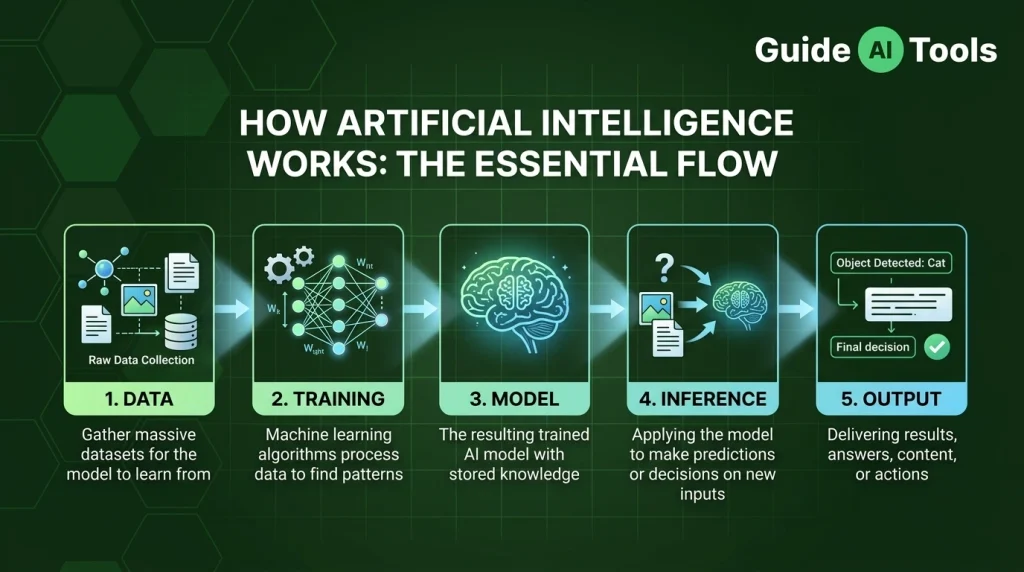
Still, many modern AI systems can be understood through a basic sequence:
Data → Training → Model → Inference → Output
Data
An AI system needs information to work with.
That might be text, photographs, audio recordings, video, sensor readings, financial transactions, documents or other data.
The quality of that information matters. A model trained with incomplete, misleading or poorly prepared data can produce poor results even when the underlying technology is sophisticated.
Training
Training is the stage where a machine learning model processes examples and adjusts its internal parameters to perform a particular task.
In supervised learning, those examples have known labels or answers. The model learns a relationship between the input and the expected output.
Model
After training, the model contains learned patterns represented through its parameters and computational structure.
You can think of the model as the part of the system that has learned how to turn certain inputs into useful outputs.
Stanford HAI describes AI models as computational representations that can be used for tasks such as prediction, classification and generation.
Inference
Training isn’t the end.
Once a model is ready, it can process new information. This stage is called inference.
For example, a spam detection model can be trained using large collections of emails. When a new message arrives, the model evaluates its characteristics and predicts whether it resembles spam.
Output
The final result depends on what the system was designed to do.
It could be a prediction, classification, recommendation, generated paragraph, image, transcription, score or action.
NASA describes AI capabilities in areas including perception, learning, planning, communication, decision-making and physical action.
What technologies make AI possible?
AI is not one single technology.
It’s a broad field that brings together several areas of computing and statistics. Machine learning, deep learning, neural networks, natural language processing and computer vision are some of the most familiar.
| Technology | What it does | Example |
|---|---|---|
| Artificial intelligence | Broad field covering intelligent computer systems | Virtual assistant |
| Machine learning | Learns patterns from data | Fraud detection |
| Deep learning | Uses multilayer neural networks | Image recognition |
| Neural networks | Processes patterns through connected computational layers | Speech recognition |
| NLP | Works with human language | Translation |
| Computer vision | Processes images and video | Object detection |
| Generative AI | Creates new content | Text or image generation |
Machine learning
Machine learning is a subset of AI focused on learning patterns from data.
Instead of developers writing every rule manually, a model can learn from examples and use those learned patterns on new inputs.
That approach powers systems used for recommendation, classification, forecasting, fraud detection and many other tasks.
Deep learning
Deep learning is a subset of machine learning that uses multilayer neural networks.
It has become particularly useful for complex tasks involving language, speech, images and other large datasets.
Neural networks
Artificial neural networks contain connected computational units arranged in layers.
Their design is loosely inspired by biological neural systems, but an artificial neural network isn’t a digital copy of a human brain. It’s a mathematical and computational model used to process patterns.
Natural language processing
Natural language processing, or NLP, deals with human language.
Translation, speech recognition, text analysis, sentiment analysis and conversational systems are common examples.
If you’re interested in practical applications, you can explore GuideAITools’ AI Speech Recognition category.
Computer vision
Computer vision allows computers to process and interpret visual information such as photographs and video.
Face recognition, object detection, medical image analysis and optical character recognition are examples.
For practical image applications, GuideAITools also covers AI Image Generator tools.
What is the difference between AI, machine learning and deep learning?
This is where many beginner explanations start to blur together.
The relationship is easier to remember as a hierarchy:
AI → Machine Learning → Deep Learning
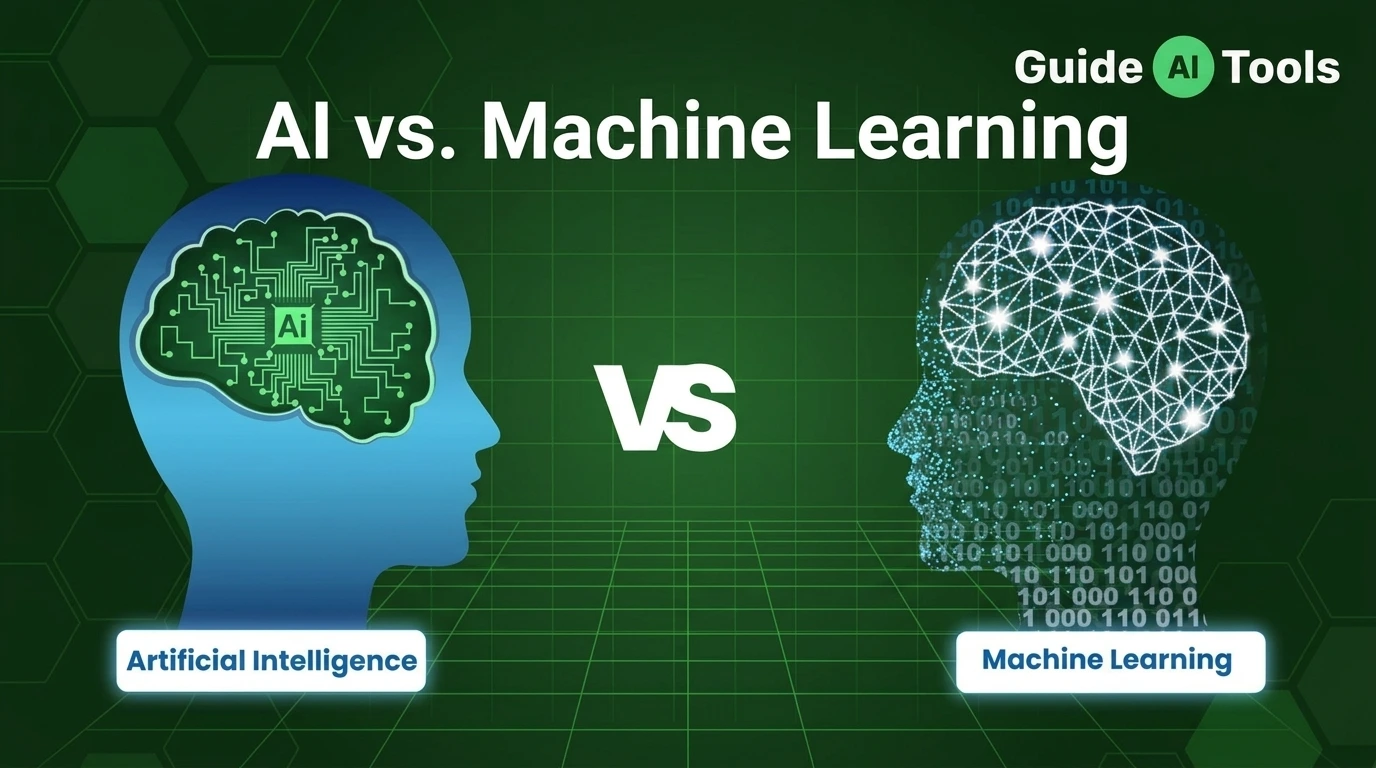
AI is the broad field. Machine learning is a subset of AI. Deep learning is a subset of machine learning.
| Term | Relationship | Simple example |
|---|---|---|
| AI | Broad field | Chess-playing system |
| Machine learning | Subset of AI | Fraud detection |
| Deep learning | Subset of ML | Image recognition |
| Neural network | Model architecture used in many ML systems | Speech recognition |
Not every AI system uses machine learning.
A rule-based expert system can use programmed knowledge and logical rules without learning from examples. That’s one reason the statement “AI is machine learning” is too narrow.
NASA also distinguishes machine learning and deep learning within the broader AI field.
If you’re curious about how people interact with modern AI systems, our guide to prompt engineering is a useful next step.
What are the types of artificial intelligence?
AI can be classified in more than one way.
That’s where some explanations become confusing. They put narrow AI, machine learning, NLP and generative AI into one list even though those terms describe different things.
A cleaner approach is to separate AI by capability and by functionality.
AI types by capability
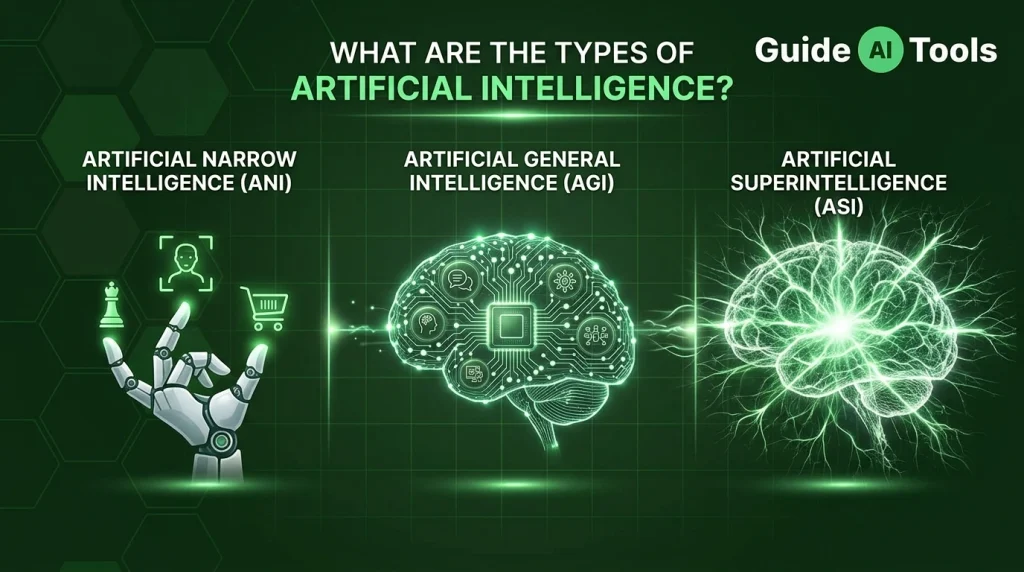
Artificial Narrow Intelligence
Artificial Narrow Intelligence, often called ANI, refers to AI designed for specific tasks or limited ranges of tasks.
This is the form of AI we use today.
A recommendation system can suggest content. A speech recognition system can turn spoken words into text. An image model can identify objects. A language model can generate and analyze text.
A system can be extremely capable within its intended task without having broad human intelligence.
Google Cloud distinguishes narrow AI from hypothetical AGI and ASI in its current explanation of artificial general intelligence.
Artificial General Intelligence
Artificial General Intelligence, or AGI, describes a hypothetical system with broad intellectual abilities across many different tasks.
The idea is much wider than building a system that performs one task extremely well.
AGI remains a research concept rather than an established technology. There is also no universally accepted test that settles whether a system has achieved AGI.
Artificial Superintelligence
Artificial Superintelligence, or ASI, refers to a hypothetical form of AI that would exceed human intellectual capabilities across broad areas.
ASI is theoretical.
It should not be presented as a current AI product or technology.
AI types by functionality
Another classification looks at how an AI system operates.
Reactive machines
Reactive systems respond to current inputs without retaining useful information from previous experiences.
IBM’s Deep Blue chess system is often used as a classic example of this category.
Limited memory
Limited-memory systems can use information from previous observations or training data when producing an output.
Many modern AI systems are discussed in this category, although the exact meaning of “memory” can differ between systems.
Theory of mind
Theory-of-mind AI describes a proposed system capable of understanding other people’s beliefs, intentions and emotional states in a richer way.
It isn’t an established general AI capability today.
Self-aware AI
Self-aware AI refers to a hypothetical system with consciousness or awareness of itself.
There is no established self-aware AI system.
Why these AI classifications matter
You’ll sometimes see generative AI, NLP and computer vision listed beside ANI and AGI as if they’re all the same kind of category.
They’re not.
ANI and AGI describe the breadth of intelligence.
NLP and computer vision describe areas of AI capability.
Generative AI describes systems designed to produce new content.
Keeping those ideas separate makes the whole subject much easier to follow.
What is generative AI?
Generative AI is a form of AI that creates new content from prompts or other inputs.
That content can include:
- Text
- Images
- Audio
- Video
- Code
Modern generative AI systems can use deep learning and foundation models to create content in response to user instructions.
ChatGPT is one example of a generative AI application. Image generators are another.
But generative AI isn’t the same as artificial intelligence as a whole.
It’s one area within the much larger AI field.
Modern generative systems often rely on foundation models, which are trained on broad datasets and can later be adapted for different tasks.
You can see how this technology is being applied through GuideAITools’ AI Writing Tools and AI Video Generator categories.
What are foundation models?
A foundation model is a large AI model trained on broad and diverse data that can serve as a base for multiple downstream applications.
Instead of training a completely separate model for every task, developers can adapt an existing foundation model for different uses.
This approach is one reason modern AI products can handle such a wide range of tasks.
Stanford HAI describes foundation models as models trained on broad data that can serve as a base for many downstream applications.
What is an LLM?
A large language model, or LLM, is an AI model designed primarily to work with language.
LLMs can process text and generate responses, summarize information, translate languages, answer questions, write code and perform other language-related tasks.
Many current LLMs use transformer-based architectures.
An LLM isn’t synonymous with AI.
It’s one kind of AI model.
That distinction becomes useful when you compare language models with image generators, speech systems, recommendation engines and computer vision models.
For a practical introduction to one of the best-known AI applications, see how to use ChatGPT.
What is multimodal AI?
Multimodal AI refers to systems that can process, understand or generate more than one type of information, such as text, images, audio and video.
A multimodal system could receive a photograph and a written question, then produce a text response.
Another system might accept spoken instructions alongside visual information.
The basic idea is simple. Human communication doesn’t arrive in only one format, so AI systems that can work across several modalities can handle more varied inputs.
What is an AI agent?
An AI agent is a system designed to pursue a goal by interpreting instructions, planning steps, using tools, making decisions and responding to feedback.
That makes an agent different from a basic chatbot.
A chatbot may answer a question.
An agent can potentially interpret a task, decide what actions are needed, call an API, interact with a browser or code environment, inspect the result and continue working.
Stanford HAI describes agentic AI in terms of goals, planning, tool use, decision-making, feedback and adaptation.
The label alone doesn’t tell you how capable an agent really is.
When comparing AI agents, look at the tools they can access, the actions they can perform and the level of human oversight involved.
How does AI learn from data?
There are several major approaches to machine learning.
Supervised learning
The model receives labeled examples.
Suppose you have thousands of images marked “cat” or “dog.” The model studies those examples and learns patterns that help it classify new images.
Unsupervised learning
The model works with unlabeled data and looks for useful structures or groupings.
Clustering is a common example.
Reinforcement learning
An agent takes actions and receives feedback, often represented through rewards or penalties.
The learning process encourages actions that lead to better results.
Self-supervised learning
The training signal comes from the data itself rather than requiring every example to be manually labeled by a person.
This approach has become particularly important in the training of large-scale AI models.
IBM’s current machine learning material covers supervised, unsupervised, semi-supervised, self-supervised and reinforcement learning.
What are real-world examples of artificial intelligence?
AI isn’t limited to humanoid robots.
You’ve probably interacted with it already.
Google Maps can use AI and machine learning techniques for navigation and prediction. Recommendation systems can suggest videos, music or products based on patterns in user behavior. Spam filters classify incoming messages. Voice systems process speech and language.
Other examples include:
| Example | AI capability |
|---|---|
| Spam filtering | Classification |
| Recommendation engines | Prediction and personalization |
| Voice assistants | Speech recognition and NLP |
| Translation | NLP |
| Face recognition | Computer vision |
| Fraud detection | Pattern recognition |
| Medical imaging | Computer vision and decision support |
| Chatbots | Language processing and generation |
| Navigation | Prediction and optimization |
| AI image generators | Generative AI |
Google Cloud identifies navigation, recommendation systems, spam filtering and virtual assistants among common everyday uses of AI.
Where is artificial intelligence used?
AI is used across many industries, although the technology and amount of human oversight vary from one application to another.
Healthcare
AI can assist with medical image analysis, scientific research, clinical decision support and other healthcare tasks.
These systems require careful validation because errors can have serious consequences.
Finance
Financial institutions can use machine learning for fraud detection, risk analysis, forecasting and customer support.
Education
AI can support personalized learning, tutoring, language practice and administrative work.
GuideAITools also has an AI Education Assistant category for practical education-focused tools.
Transportation
AI is used for navigation, traffic prediction, driver assistance and research into autonomous systems.
Manufacturing
Manufacturers can use AI for quality inspection, predictive maintenance, forecasting and process monitoring.
Retail
Recommendation systems, demand forecasting, customer service and inventory planning are common applications.
Cybersecurity
AI can help identify unusual patterns, classify threats and support security teams.
Marketing
Marketing teams use AI for content creation, audience analysis, customer segmentation, campaign support and automation.
GuideAITools also covers AI Marketing Tools for practical applications in this area.
Scientific research
AI can process large datasets, identify patterns and assist researchers with tasks that would be difficult to perform manually at the same scale.
NASA uses AI and machine learning in areas including Earth science, imagery, space missions and scientific research.
What are the benefits of artificial intelligence?
The benefits depend on the system, the quality of its data and how it is deployed.
A well-designed AI system can process large amounts of information quickly, identify patterns, automate repetitive work and provide decision support.
AI can also help with tasks that are dangerous, expensive or difficult to perform manually.
But the value isn’t always about replacing people.
Often, the more useful setup is a person working with an AI system.
Consider fraud detection. An AI model can flag unusual transactions, while a human analyst investigates the cases that need judgment.
The model handles pattern detection.
The person handles context.
That division can be much more useful than asking AI to make every decision by itself.
What are the risks and limitations of AI?
AI can produce impressive results and still fail in ways that aren’t obvious at first.
AI hallucinations
An AI hallucination is an incorrect, misleading or fabricated output presented as factual.
This issue is particularly relevant to language models.
Stanford HAI defines hallucinations as incorrect or misleading outputs that can be presented as factual.
That’s why important information should be checked against reliable sources.
Bias
AI systems can reproduce or amplify patterns found in their training data or development process.
If the underlying data is incomplete or biased, the output can reflect those problems.
Privacy
AI systems may process personal information, conversations, photographs, business documents or other sensitive material.
How that information is collected, stored and used matters.
Security
AI systems can introduce new security concerns.
Malicious inputs may manipulate model behavior. AI-generated content can also be used in scams, impersonation and misinformation.
Stanford HAI’s current AI terminology includes concepts such as prompt injection, responsible AI, security and human-in-the-loop systems.
Lack of explainability
Some complex models are difficult to interpret.
A system may provide a prediction without offering a simple explanation that a person can independently verify.
Data quality
More data isn’t automatically better.
Poor, outdated or irrelevant data can lead to poor results.
Model drift
A model can become less effective when real-world conditions change from the conditions represented in its training data.
Stanford HAI describes model drift as degradation in model performance caused by changes in real-world data.
Does AI think like a human?
Not in the ordinary sense of the phrase.
AI systems can perform tasks associated with human intelligence, including language processing, pattern recognition, prediction and some forms of reasoning.
That doesn’t establish that they have a human mind or human subjective experience.
A language model can generate a convincing explanation of sadness without evidence that it experiences sadness.
A computer vision model can identify a face without seeing the world through human perception.
This distinction matters when people start discussing AGI or machine consciousness.
The useful question is not “Does this sound human?”
Ask instead:
What can the system actually demonstrate?
Does AI have consciousness or emotions?
There is no established evidence that current AI systems are conscious in the human sense.
An AI can recognize emotional language, classify expressions or generate a response that sounds empathetic.
Those abilities aren’t the same as having subjective emotional experiences.
If an AI produces a sentence that sounds frightened, that tells us something about its output. It doesn’t by itself establish that the system is experiencing fear.
A short history of artificial intelligence
The history of AI didn’t begin with chatbots.
Its roots include mathematical logic, computing theory, formal reasoning and early work on artificial neurons.
In 1950, Alan Turing published “Computing Machinery and Intelligence,” asking whether machines could exhibit intelligent behavior and proposing what became known as the imitation game, commonly called the Turing Test.
The phrase “artificial intelligence” appeared in John McCarthy’s 1955 proposal for a research project. Stanford HAI describes McCarthy’s formulation around the science and engineering of making intelligent machines.
The Dartmouth workshop followed in 1956 and is widely recognized as a formative event in the establishment of AI as an academic research field.
Early AI research explored mathematical proofs, games, symbolic reasoning and language.
Then came periods when expectations ran ahead of what computers and algorithms could actually deliver.
Funding and interest declined during periods known as AI winters.
Progress picked up again as researchers gained access to larger datasets, better algorithms and much more computing power.
Deep learning became especially influential during the 2010s.
In 2017, researchers introduced the transformer architecture, which later became an important foundation for many modern language models and generative AI systems.
The 2020s brought generative AI into mainstream use, with systems capable of producing text, images, audio, video and code.
For current developments, see our AI Trends 2026 coverage.
Will AI replace human jobs?
There isn’t a simple yes or no answer.
AI can automate individual tasks, but most occupations contain many different tasks.
Take customer service.
A role might involve reading messages, searching for information, resolving unusual cases, handling sensitive conversations and making judgments. AI may automate some of these tasks without replacing everything a human does.
The impact also differs by industry and occupation.
Some tasks may become more automated. Some jobs may change. New work can emerge around AI development, evaluation, deployment, governance and oversight.
A more useful question is:
Which tasks can AI perform reliably, and which still require human judgment?
That gives you a clearer way to think about the effect of AI on work than assuming every occupation will either disappear or remain unchanged.
What is AGI?
Artificial General Intelligence, or AGI, describes a hypothetical AI system with broad capabilities across many different domains.
Unlike narrow AI, an AGI system would not be designed around only one limited task.
It would be expected to learn, reason and adapt across a wide range of situations.
The difficult part is defining exactly what counts as “general intelligence.”
There is no universally accepted test for AGI, and no confirmed AGI system currently exists. Stanford HAI and Google Cloud both describe AGI as a concept involving broad capabilities rather than an established current technology.
So when a company or researcher claims that a system has reached AGI, look at the evidence behind the claim and the definition being used.
What is artificial superintelligence?
Artificial Superintelligence, or ASI, describes a hypothetical form of AI that would exceed human intellectual capabilities across broad areas.
ASI isn’t an established current technology.
It belongs to discussions about possible future AI systems, their capabilities, safety and governance.
It shouldn’t be confused with today’s specialized AI, even when a particular system performs a task extremely well.
What is the future of artificial intelligence?
The future of AI isn’t simply about making chatbots larger.
Several areas are receiving attention.
Multimodal systems can work with multiple forms of information. AI agents can handle multi-step tasks and interact with external tools. Foundation models can support many applications. Smaller models can bring useful AI capabilities to devices and specialized environments.
AI is also becoming more involved in scientific research, software development, education, business operations and creative work.
At the same time, reliability, privacy, security, evaluation and governance are becoming harder to ignore.
Stanford HAI’s current AI terminology includes agentic AI, foundation models, multimodal AI, RAG, reasoning models, responsible AI, human-in-the-loop systems and model drift.
That list tells you something useful about where AI has moved. The conversation is no longer just about whether computers can generate text. It’s increasingly about what these systems can do, what information they can access and how much autonomy they should have.
What is RAG in AI?
Retrieval-Augmented Generation, or RAG, is a technique that lets a language model retrieve information from an external source before generating an answer.
That source could be a company’s internal documents, a database or another information repository.
The point is simple.
Instead of relying only on information encoded during model training, the system can retrieve relevant information when a user asks a question.
Stanford HAI defines RAG as a technique in which language models retrieve external information before generating a response.
RAG can be useful when answers depend on private documents or information that changes regularly.
What is responsible AI?
Responsible AI refers to practices and principles intended to address issues such as safety, fairness, privacy, accountability and human oversight when AI systems are developed and deployed.
It’s not a single button or feature.
A responsible AI workflow can include data checks, model evaluation, security testing, monitoring, documentation and human review.
The right safeguards depend on the application.
An AI system used for entertainment doesn’t create the same risks as one used to support decisions in healthcare, finance or employment.
Why are AI tools different from artificial intelligence?
This distinction becomes useful once you start exploring AI products.
Artificial intelligence is the broader field.
An AI tool is a product built using one or more AI techniques.
A writing assistant might use a language model. An image generator might use a generative model. A speech recognition platform might use machine learning to convert spoken language into text.
So two products can both be called AI tools while solving completely different problems.
GuideAITools groups these products into practical categories, including AI Coding Tools, AI Voice Assistants, AI Research Assistants and other specialized AI tool categories.
That difference is worth keeping in mind when you’re choosing an AI product. Start with the task you need to solve, then look at the technology behind it.
FAQs
What is artificial intelligence in one sentence?
Artificial intelligence is a field of computer science focused on building systems that can perform tasks associated with human intelligence, including learning, perception, language processing, reasoning and decision-making.
What does AI stand for?
AI stands for artificial intelligence.
What is the main purpose of AI?
AI can be used to perform or assist with tasks involving prediction, classification, perception, language processing, reasoning, decision support, content generation and problem solving.
Is AI the same as machine learning?
No. Machine learning is a subset of artificial intelligence. AI also includes approaches that don’t rely on machine learning.
What is the difference between AI and deep learning?
AI is the broader field. Deep learning is a machine learning approach that uses multilayer neural networks.
Is ChatGPT artificial intelligence?
Yes. ChatGPT is an example of a generative AI application that uses language models to process prompts and generate responses.
What are the main types of AI?
AI can be classified in several ways. By capability, common categories include narrow AI, AGI and ASI. By functionality, classifications can include reactive machines and limited-memory systems, while theory-of-mind and self-aware AI remain hypothetical concepts.
Is AGI available today?
No confirmed AGI system currently exists. AGI remains a research concept, and there is no universally accepted test for determining whether a system has achieved it.
What is generative AI?
Generative AI refers to AI systems that create new content such as text, images, audio, video or code from prompts or other inputs.
How does AI learn?
Many AI systems learn patterns from training data. Depending on the approach, the data can be labeled, unlabeled or combined with feedback such as rewards.
What are examples of AI?
Examples include spam filters, recommendation systems, speech recognition, translation, fraud detection, computer vision, navigation systems, chatbots and generative AI tools.
Does AI think like humans?
AI can perform tasks associated with human intelligence, but that doesn’t demonstrate that current AI systems possess a human mind, consciousness or subjective experience.
Does AI have emotions?
There is no established evidence that current AI systems experience emotions. They can recognize emotional language and generate responses that sound emotional.
What are the biggest risks of AI?
Major concerns include inaccurate outputs, bias, privacy problems, security risks, misuse, lack of explainability and overreliance on automated systems.
What is an AI hallucination?
An AI hallucination is an incorrect, misleading or fabricated output that an AI system presents as factual.
What is an AI agent?
An AI agent is a system designed to pursue goals by interpreting instructions, planning actions, using tools, making decisions and responding to feedback.
The simple way to remember artificial intelligence
If you remember only one thing, remember this:
AI is the broad field.
Machine learning is one approach within AI. Deep learning is a machine learning approach based on multilayer neural networks. NLP deals with human language. Computer vision deals with visual information. Generative AI creates new content. AI agents can combine models with tools and actions to work toward a goal.
These terms overlap, but they don’t mean the same thing.
That’s where many explanations go wrong. They pile every modern AI term into one definition and leave the reader with a vocabulary list instead of an understanding.
A better way to think about AI is to ask four questions:
What information does the system receive?
What patterns or knowledge does it use?
What can it produce or do with new information?
Where does a person still need to check the result?
Once you can answer those questions, artificial intelligence becomes much less mysterious.
And that’s probably the most useful definition of AI you can take away: computers performing tasks that involve capabilities we associate with human intelligence, using methods that range from programmed rules to machine learning and modern generative models.

Related Blog Posts