What Is Deep Learning? How It Works, Types and Examples
Deep learning is a specialized branch of machine learning that uses neural networks with multiple layers to learn complex patterns from data. It sits inside machine learning, which sits inside artificial intelligence. Deep learning is behind many systems used for image recognition, speech processing, language models, generative AI and other demanding tasks.
The word “deep” can make it sound harder than it is.
The basic idea is fairly simple. A deep learning model receives data, passes it through layers of mathematical operations, compares its output with what it should produce during training, and adjusts its internal parameters so future outputs can improve.
That’s the foundation.
What is deep learning?
Deep learning is a type of machine learning that uses multilayer neural networks to learn complex patterns and representations from data. Unlike many traditional machine learning approaches, deep learning can learn useful features from the input itself instead of relying as heavily on manually selected features.
The relationship is easiest to remember like this:
Artificial Intelligence
        ↓
Machine Learning
        ↓
Deep Learning
        ↓
Deep Neural Networks
Artificial intelligence is the broadest field. Machine learning is one way of building AI systems by learning from data. Deep learning is a specialized machine learning approach built around neural networks with multiple layers.
If you’re starting from the beginning, our guide to What Is Machine Learning? explains the broader ML concept first.
Stanford HAI defines deep learning as a subset of machine learning that uses large multilayer neural networks to automatically learn complex patterns from data.
Why is it called “deep” learning?
The word “deep” refers to the depth of the neural network, meaning the number of computational layers through which information passes.
A simple neural network might have an input layer, one or a small number of intermediate layers and an output layer. Deep learning models use multiple hidden layers to build increasingly complex representations of the input.
There isn’t one universal layer count that makes a model “deep.”
What matters is the layered structure and the ability of those layers to build increasingly useful representations.
Imagine an image recognition system.
An early layer may respond to simple visual patterns such as edges. Later layers can combine those patterns into shapes, and deeper parts of the network can represent more complex structures.
Google Cloud uses a similar image example, explaining how different layers can learn edges, shapes and eventually objects.
The deeper layers don’t simply repeat the work of the earlier layers. They can build on what earlier layers have already represented.
External source
For the formal definition, you can also refer to Stanford HAI’s definition of deep learning.
How does deep learning work?
Deep learning works by passing data through a neural network, calculating an output and adjusting the network’s parameters during training so it becomes better at the task.
A simplified process looks like this:
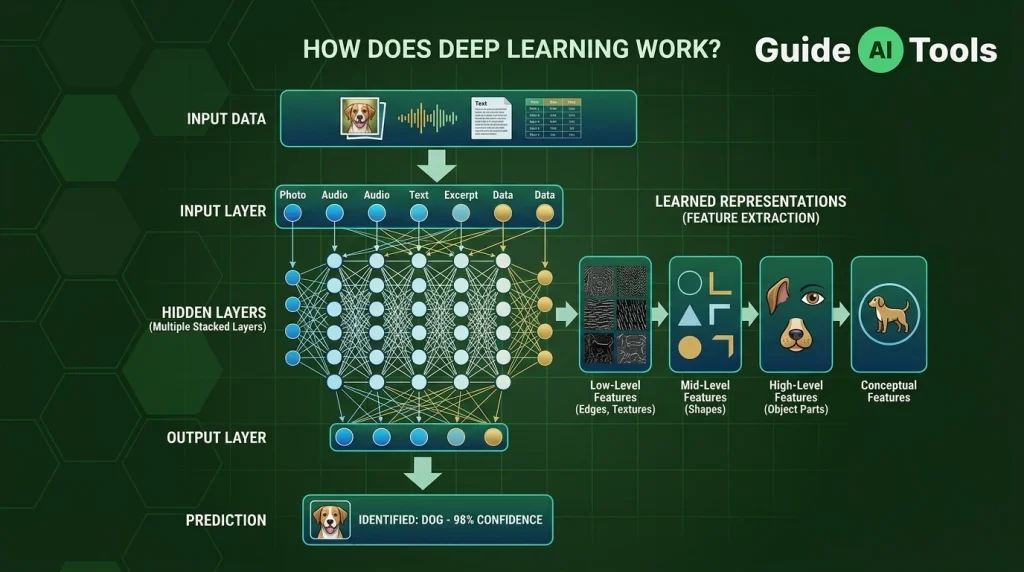
The individual steps are more interesting than the diagram suggests.
Data enters the network
The first step is getting data into a form the model can process.
For an image model, the input might represent pixel values.
For a speech model, it could be numerical representations of audio.
For a language model, text is converted into numerical representations called tokens or embeddings before the neural network processes it.
The model doesn’t see a photograph, sentence or recording in the same way you do. It works with numerical representations.
The network processes the input
The input moves through layers of interconnected nodes.
Each connection has a weight. The network also uses biases and activation functions as part of its computations.
These values influence how strongly different inputs contribute to the next stage of processing.
As information moves through the network, each layer performs mathematical operations and passes its result forward.
IBM describes these networks as interconnected layers of artificial neurons or nodes, with weights, biases and activation functions contributing to the model’s output.
The model produces an output
Eventually, the information reaches the output layer.
For an image classifier, the output might represent probabilities for different categories.
For a speech recognition system, it might represent a sequence of words.
For a generative model, the output could be newly generated content.
At this point, the model may still be wrong.
That’s expected during training.
The model measures its error
During training, the model’s output is compared with the desired result when an appropriate training signal is available.
A loss function measures how far the prediction is from the target.
A high loss means the model’s current parameters are producing an undesirable result for that example or batch.
The training process then uses that information to update the model.
Backpropagation adjusts the model
Backpropagation helps determine how changes in the network’s parameters contributed to the error.
An optimizer can then adjust parameters such as weights to reduce the loss.
This process happens again and again across many training examples.
The model isn’t being handed a finished list of rules.
It is gradually adjusting its parameters through training.
Google Cloud describes this process in terms of adjusting weights based on model performance and using backpropagation during training.
Training eventually produces a usable model
After enough training, the model can become useful at the task it was designed for.
But good training performance isn’t enough.
The model also needs to work on data it hasn’t seen before.
That’s called generalization.
A model that simply memorizes its training examples isn’t particularly useful in the real world.
What are neural networks in deep learning?
Neural networks are computational models made from connected layers of artificial neurons, also called nodes.
Each node performs mathematical operations on its inputs and passes the result forward.
A typical network can be thought of as having three broad parts:
| Layer | Main role |
|---|---|
| Input layer | Receives the numerical representation of the input |
| Hidden layers | Process information and learn internal representations |
| Output layer | Produces the final prediction or result |
The hidden layers are where much of the representation learning takes place.
A network processing an image might learn progressively more useful visual patterns as information moves through those layers.
Stanford HAI describes neural networks as interconnected layers of artificial neurons that process information using operations such as weights and activation functions.
The brain analogy is useful for getting the basic idea, but don’t take it literally.
Artificial neurons aren’t biological neurons. Deep learning is based on mathematical computation.
What is representation learning?
Representation learning is one of the reasons deep learning became so useful.
The basic idea is that a model can learn useful ways of representing information rather than requiring a person to specify every useful feature beforehand.
Consider an image.
A human might describe it as:
“A photograph containing a dog.”
The neural network starts with numerical information representing the image.
Through its layers, it can learn increasingly useful patterns.
Pixels
  ↓
Edges and simple patterns
  ↓
Shapes
  ↓
Parts of objects
  ↓
Higher-level visual representation
  ↓
Prediction
The exact representations depend on the model and task. This isn’t a fixed recipe where every deep learning network learns the same sequence.
The useful point is that different layers can learn increasingly abstract representations.
Stanford HAI specifically describes deep learning as automatically learning increasingly abstract representations from data.
This is one major difference from older machine learning workflows where people often had to spend considerable effort deciding which features the model should use.
What happens during deep learning training?
Training is the stage where the network’s parameters are adjusted.
A simplified training loop looks like this:
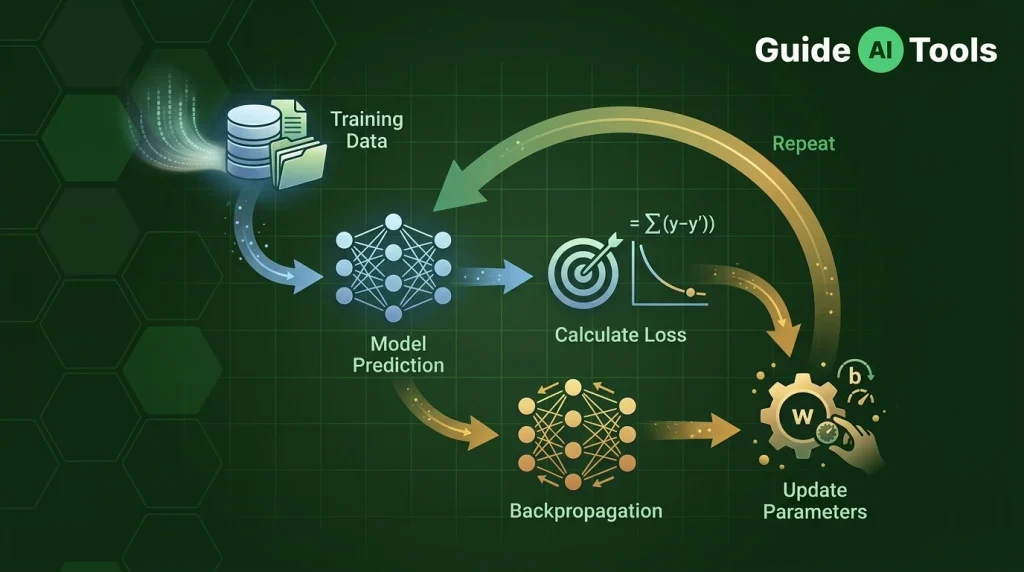
One pass through part of the training data is commonly called a batch, while an epoch generally refers to one complete pass through the training dataset.
The actual process can be much more complicated, especially for large models, but the basic principle remains the same.
The model makes an output.
The training process measures how good that output is.
Parameters are adjusted.
The model tries again.
This can happen across huge numbers of examples and many training iterations.
What happens during inference?
Inference is different from training.
During inference, a trained model receives new input and produces an output using the parameters it has already learned.
Imagine a deep learning model trained on thousands of cat and dog images.
During training, it learns patterns associated with the two categories.
Later, you provide a new photograph.
The model processes the image and produces its prediction.
That prediction happens during inference.
IBM describes inference as the process through which a trained model applies patterns learned during training to real-world inputs.
This distinction matters because people sometimes assume that a model learns permanently every time they use it.
That’s not necessarily true.
Training and inference are separate processes.
What are the main types of deep learning architectures?
Deep learning isn’t one single architecture.
Different neural network designs are suited to different kinds of data and problems.
| Architecture | Common applications | Basic idea |
|---|---|---|
| Feedforward neural networks | Prediction and classification | Information moves forward through layers |
| Convolutional neural networks | Computer vision | Convolution operations capture spatial patterns |
| Recurrent neural networks | Sequential data | Processes information across sequences |
| LSTM and GRU networks | Sequence modeling | Designed to handle longer dependencies |
| Transformers | Language and multimodal systems | Uses attention mechanisms to process relationships |
| Autoencoders | Representation learning | Encodes and reconstructs information |
| GANs | Generative modeling | Uses generator and discriminator networks |
These categories shouldn’t be treated as mutually exclusive boxes.
Modern systems can combine different techniques, and newer architectures have changed how many tasks are approached.
Convolutional neural networks
CNNs became closely associated with computer vision because convolution operations are well suited to extracting spatial patterns from images.
A convolutional layer can examine local regions of an image and learn filters that respond to useful visual features.
As the information moves through the network, later layers can work with increasingly complex patterns.
IBM explains how convolution filters can process portions of an image and how successive layers can build feature maps.
Recurrent neural networks
RNNs were designed to work with sequential information.
They have been used for tasks involving text, speech and other sequences.
LSTM and GRU architectures were developed to address some limitations of basic recurrent networks when handling longer dependencies.
Transformers
Transformers changed modern language processing by using attention mechanisms to model relationships within sequences.
They now sit behind many large language and generative AI systems.
Stanford HAI identifies transformers as an important neural network architecture for analyzing and generating sequences such as language.
We won’t turn this section into a transformer tutorial. That deserves its own topic.
What is the difference between machine learning and deep learning?
Deep learning is a subset of machine learning.
The difference is mainly about the techniques used and how models learn representations.
| Machine Learning | Deep Learning |
|---|---|
| Broader field | Specialized part of ML |
| Includes many algorithm families | Uses multilayer neural networks |
| Feature engineering can play a larger role | Can learn representations automatically |
| Can work well with smaller datasets for some tasks | Often benefits from large datasets |
| Often requires less computing power | Frequently requires substantial computing resources |
| Can be easier to interpret for some models | Many models are harder to interpret |
| Useful across structured and other data | Particularly effective for many complex unstructured-data tasks |
This isn’t a contest.
A decision tree can be a better choice than a deep neural network for a particular structured-data problem.
Deep learning becomes especially useful when the problem involves complex patterns in data such as images, audio, language or video.
Google Cloud describes deep learning as a subset of machine learning and notes its particular usefulness for complex pattern recognition tasks.
For the broader comparison, see AI vs Machine Learning.
Why does deep learning need so much computing power?
Deep learning models can contain very large numbers of parameters.
Training them involves repeating mathematical operations across many examples and many iterations.
That can create a substantial computational workload.
GPUs are particularly useful because they can perform large numbers of mathematical operations in parallel.
This became a major factor in the growth of practical deep learning.
IBM notes that advances in high-performance GPUs helped make large-scale deep learning much faster and more practical during the late 2000s and early 2010s.
Still, don’t assume every deep learning model needs a massive GPU cluster.
Small models can run on ordinary hardware.
The computing requirement depends on the model, dataset, task and training setup.
Does deep learning require a lot of data?
Often, yes.
But “deep learning always needs massive datasets” would be too broad.
Large neural networks can have many parameters, so they often benefit from substantial training data.
The type and quality of the data matter too.
Modern techniques have also changed the picture.
Self-supervised learning can create useful training signals from unlabeled data. Pretrained models can be adapted to new tasks rather than training an entire network from scratch.
Transfer learning can also allow a model trained on one large dataset to be adapted for another task.
IBM notes that the large data requirements of deep learning helped drive research into self-supervised learning and other approaches that reduce dependence on manually labeled examples.
So the better question isn’t:
“How much data does deep learning need?”
It’s:
“How much useful data does this particular task and model need?”
What is deep learning used for?
Deep learning has become useful across a wide range of applications.
Computer vision
Deep learning models can classify images, detect objects, segment visual scenes and analyze video.
This is one reason modern image recognition systems can handle visual patterns that would be difficult to describe through manually written rules.
Natural language processing
Deep learning powers many language tasks, including translation, classification, summarization and text generation.
Large language models are built using deep learning techniques and neural network architectures.
Stanford HAI describes LLMs as AI systems using deep learning and neural networks with large numbers of parameters.
Speech recognition
Deep learning can process audio and help convert spoken language into text.
This technology appears in transcription systems, voice assistants and other speech applications.
GuideAITools also has an AI speech recognition category covering tools built for these workflows.
Generative AI
Deep learning is closely tied to modern generative AI.
Models can generate:
- Text
- Images
- Audio
- Video
- Code
The exact architecture varies by system.
Some modern generative systems use transformers, while image generation can involve architectures such as diffusion models.
Recommendations
Deep learning can also be used to identify complex patterns in user behavior and support recommendation systems.
Robotics
Deep learning can help robots interpret images, audio and sensor information and make predictions that support navigation or control.
Stanford HAI lists areas including speech recognition, image recognition and autonomous systems among deep learning applications.
How is deep learning connected to generative AI and LLMs?
The relationship is worth understanding because the terms are often mixed together.
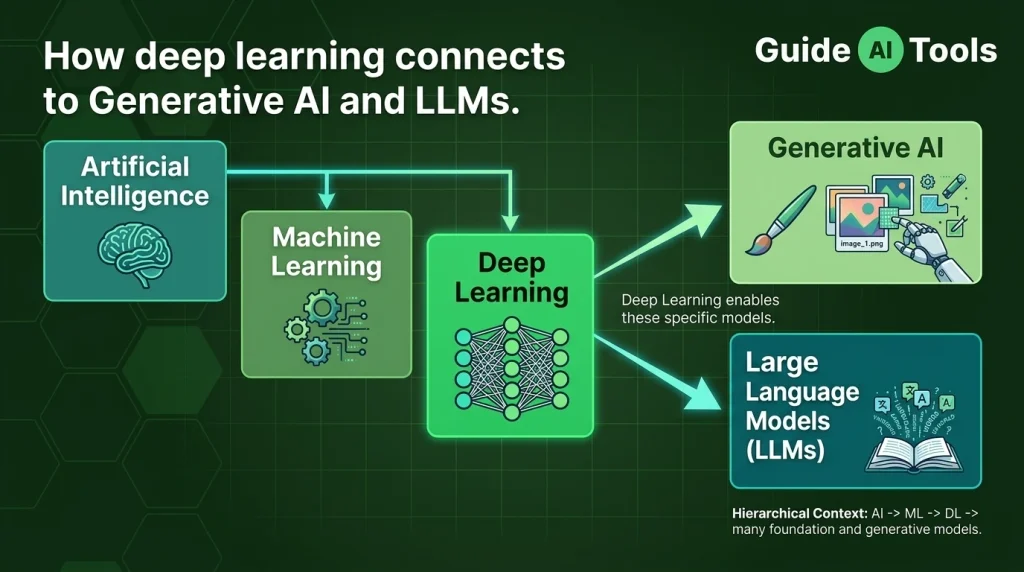
Large language models are built using deep learning techniques. Stanford HAI describes LLMs as systems trained on large amounts of text that use deep learning and neural networks to process and generate language.
Generative AI is the application category focused on producing new content.
Deep learning is the underlying learning approach used by many of those systems.
So:
Deep learning is not the same thing as generative AI.
A deep learning model can perform classification or recognition without generating new content.
And generative AI systems can be built using different model architectures depending on the type of content being generated.
For language models specifically, our Large Language Models guide covers that topic in greater detail.
What are the advantages of deep learning?
Deep learning is useful because it can learn complex representations from data and apply them to difficult prediction or generation tasks.
Some of its main strengths include:
- Learning features automatically
- Handling complex patterns
- Working with images, audio and text
- Scaling to large datasets
- Supporting end-to-end learning in many applications
- Adapting to different types of tasks through different architectures
One of the biggest practical advantages is representation learning.
Instead of asking a developer to manually define every visual or linguistic feature, a deep neural network can learn useful representations as part of training.
That’s a major reason deep learning became so effective for complex unstructured data.
What are the limitations of deep learning?
Deep learning has impressive capabilities, but it comes with trade-offs.
Computing costs
Training large models can require significant computing resources.
Data requirements
Many deep learning applications benefit from large, representative datasets.
Training time
Large models can take substantial time to train, depending on the architecture, hardware and dataset.
Interpretability
A model may produce an accurate result without giving a simple human-readable explanation for why it produced that result.
This is one reason deep learning models are sometimes described as black boxes. IBM discusses this interpretability challenge directly.
Overfitting
A model can become too closely fitted to its training data and perform poorly on new examples.
Maintenance
Real-world data changes.
A model trained under one set of conditions may need monitoring, evaluation or retraining when those conditions change.
So deep learning isn’t simply:
Bigger model = better answer.
The task, data, evaluation method and deployment environment all matter.
Is deep learning better than traditional machine learning?
Not automatically.
Deep learning is particularly useful for many complex problems involving images, audio, language and other unstructured data.
Traditional machine learning can still be a sensible choice for many structured-data problems, especially when datasets are smaller, interpretability matters or the problem doesn’t justify the added complexity of a deep neural network.
The right choice depends on the task.
That’s a more useful way to think about the comparison than trying to name one universal winner.
Is deep learning the same as neural networks?
No.
Neural networks are the foundation of deep learning, but the terms aren’t perfect synonyms.
A neural network can be relatively simple.
Deep learning generally refers to neural networks with multiple layers that can learn complex hierarchical representations.
Stanford HAI describes neural networks as computational models made from interconnected layers of artificial neurons and identifies them as the foundation of deep learning.
Your dedicated What Is a Neural Network? page should go deeper into neurons, weights, layers and activation functions.
FAQs
What is deep learning in simple words?
Deep learning is a type of machine learning that uses neural networks with multiple layers to learn complex patterns from data.
Is deep learning a type of machine learning?
Yes. Deep learning is a specialized subset of machine learning based on multilayer neural networks.
How does deep learning work?
A deep learning model processes input through multiple neural network layers. During training, its parameters are adjusted based on the model’s errors so it can improve its predictions or outputs.
Why is it called deep learning?
The word “deep” refers to the depth of the neural network, particularly the presence of multiple computational layers between the input and output.
What are neural networks in deep learning?
Neural networks are computational models made from interconnected artificial neurons or nodes. Deep learning uses networks with multiple layers to learn complex representations from data.
Does deep learning require a lot of data?
Many deep learning models benefit from large datasets, but there isn’t one fixed amount of data required for every task. Pretraining, transfer learning and self-supervised learning can change the amount of labeled data needed.
Why does deep learning use GPUs?
GPUs can perform many mathematical operations in parallel, making them useful for the large computational workloads involved in training and running many deep learning models.
What is backpropagation in deep learning?
Backpropagation is a training method used to calculate how model parameters contributed to an error, allowing an optimization process to adjust those parameters.
What is the difference between machine learning and deep learning?
Machine learning is the broader field. Deep learning is a subset of machine learning that uses multilayer neural networks and can learn complex representations directly from data.
Is ChatGPT based on deep learning?
Yes. Large language models such as those used by ChatGPT are based on deep learning and neural network architectures. The exact architecture and training methods depend on the specific model.
Is generative AI the same as deep learning?
No. Generative AI refers to systems that create new content, while deep learning is a machine learning approach. Many modern generative AI systems use deep learning.
What are examples of deep learning?
Examples include image recognition, speech recognition, language models, machine translation, recommendation systems, autonomous systems and generative AI applications.
What are the disadvantages of deep learning?
Common challenges include high computing requirements, data needs, training costs, interpretability issues, overfitting and the complexity of deploying and maintaining large models.
Final Thoughts
Deep learning is easier to understand when you place it in the right part of the AI family tree.
AI is the broad field. Machine learning is a major branch of AI. Deep learning is a specialized branch of machine learning built around multilayer neural networks.
What makes deep learning stand out is its ability to learn useful representations from complex data. That’s why the same general approach can appear in image recognition, speech systems, language models and generative AI, even though the architectures and training methods can differ considerably.
And there is an important catch.
Deep learning isn’t automatically the right answer for every problem. It can demand substantial data, computing resources and engineering effort. For some tasks, a simpler machine learning model may be easier to train, explain and maintain.
Once you understand that trade-off, terms such as neural networks, transformers, LLMs and generative AI start to make much more sense.

Related Blog Posts