

Hume AI
✓ VerifiedHume AI creates expressive speech with voice cloning, emotional TTS, voice design and real-time conversational voice technology.
Best For: Expressive voice cloning, conversational AI and emotionally natural speech
The Verdict: Hume AI
Hume AI is a strong choice if you care about expressive voice cloning rather than simply converting text into speech. The combination of custom voice cloning, voice design, acting instructions, voice conversion and real-time EVI gives it more range than a basic TTS service.
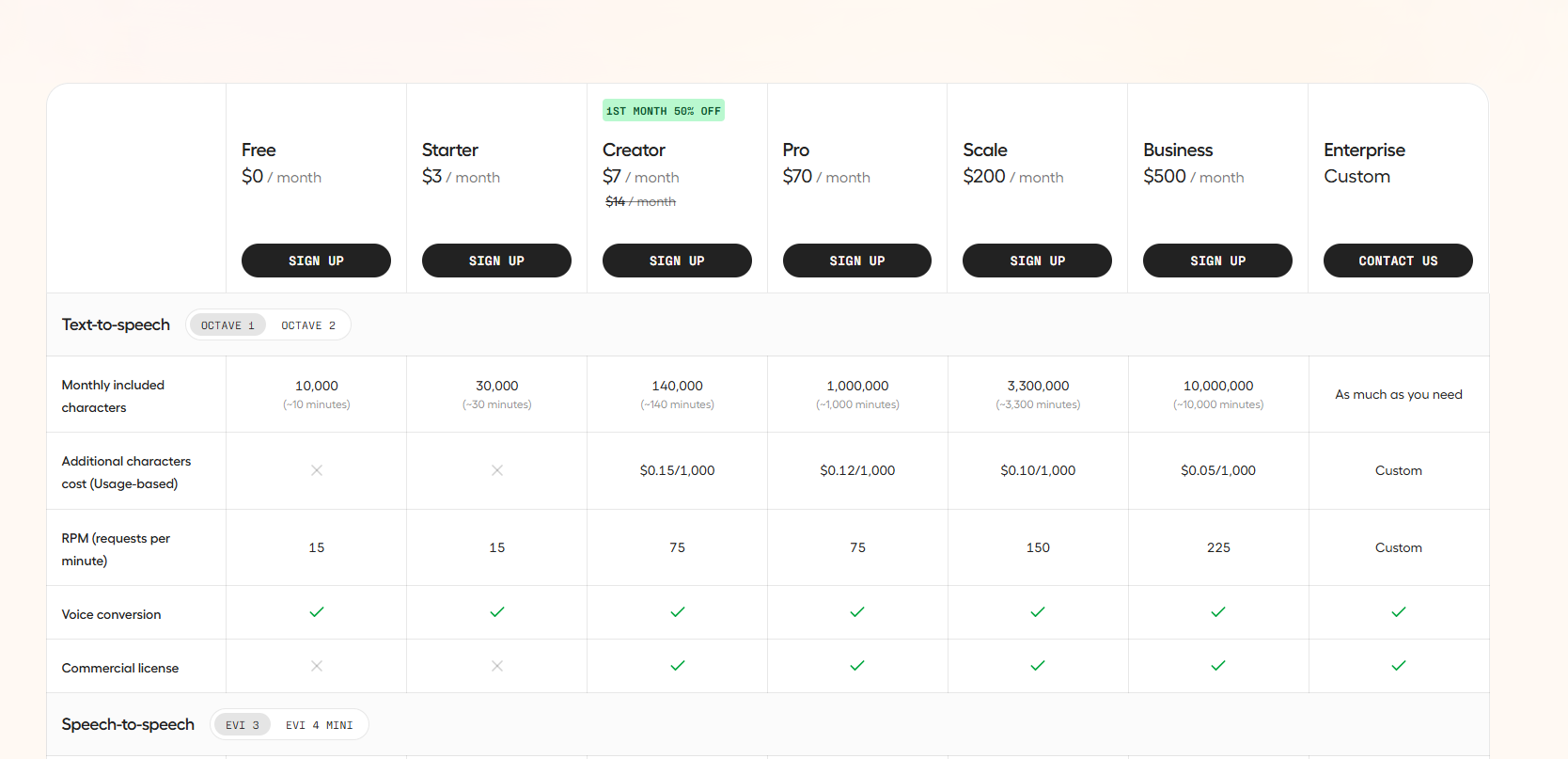
The main limitation is that the pricing model becomes more involved as usage grows. The Free plan is useful for testing, but larger workloads move through included character and EVI allowances before overage charges apply. Creator currently costs $7 for the first month and $14 afterward, while higher tiers reach $70, $200 and $500 per month. For developers building conversational products or creators who need expressive custom voices, though, Hume's feature set makes a strong case.
What is Hume AI?
Hume AI is a voice technology platform that creates expressive speech, custom voice clones and real-time conversational voice experiences. Its main voice products are Octave for text-to-speech and the Empathic Voice Interface for spoken interaction.
Octave can create a voice from an audio sample or design one from a natural-language description. The system can control tone, pacing, emphasis and emotional delivery, while custom voices can be reused across supported TTS and EVI workflows. Hume also provides voice conversion, which changes an existing recording into another voice while preserving its timing and delivery.
The platform works for both creators and developers. You can experiment through Hume's web playgrounds, or connect Octave and EVI to an application using its developer APIs and SDKs. Octave 2 currently supports 11 languages and is designed for lower-latency speech generation.
Who is Hume AI Best For?
Expressive voice cloning, conversational AI and emotionally natural speech
Hume AI Key Features
Hume AI Pricing & Plans
Hume AI Review Summary
| Performance Score | A |
| Content Quality | Hume combines voice cloning, expressive speech generation, voice conversion and conversational voice technology in one platform. |
| Interface | The web platform provides voice libraries, cloning, design and playground tools, while developers can manage voices through APIs. |
| AI Technology | Hume's Octave speech-language model uses language and speech understanding to control pronunciation, pitch, tempo, emotion and delivery. |
| Purpose | Hume is designed for expressive voice generation, custom voice creation and real-time conversational applications. |
| Compatibility | Web, API |
| Pricing Summary | Hume has a Free plan, Starter at $3 per month, Creator at $7 for the first month then $14, Pro at $70, Scale at $200 and Business at $500 per month. |
Hume AI Pros & Cons
✅ Pros
- Voice cloning is available even on the free plan
- Can create a clone from a short voice recording
- Strong control over tone, emotion and speaking style
- Octave understands context when generating speech
- Supports real-time voice applications through EVI
- Voice conversion can preserve the original timing and delivery
- Octave 2 supports multiple languages
- Provides both no-code playgrounds and developer APIs
- Custom voices can be reused across supported Hume products
- Enterprise plans include advanced security and compliance options
❌ Cons
- Free usage has monthly character and EVI limits
- Creator pricing increases after the first discounted month
- Octave 2 voice design is currently limited compared with its multilingual TTS support
- Advanced usage can become expensive at higher volumes
- Some newer voice features are still in preview
- The platform is more useful for developers and voice applications than simple one-off narration
FAQs
What is Hume AI used for?
▼Is Hume AI free to use?
▼What platforms does Hume AI support?
▼Who is Hume AI best for?
▼Does Hume AI offer a free trial?
▼How much does Hume AI cost?
▼Can Hume AI clone a voice?
▼Does Hume AI support emotional voice generation?
▼How many languages does Hume AI support?
▼Can Hume AI convert an existing voice recording?
▼Does Hume AI have an API?
▼Can I use a Hume voice clone commercially?
▼Does Hume AI support real-time voice conversations?
▼Can I use my Hume voice clone with EVI?
▼More AI Tools You Might Like

VoxCPM2 is an open-source voice generation model for voice design, controllable voice…
View Tool ↗
Qwen3 TTS is a browser-based voice platform for text to speech, voice…
View Tool ↗
MiniMax Audio creates natural speech and cloned voices with multilingual TTS, voice…
View Tool ↗
VoiceKeep is an AI voice platform for voice cloning, audiobooks, multi-voice conversations…
View Tool ↗
WellSaid creates professional AI voiceovers with licensed voice actors, custom voice models,…
View Tool ↗
Synthesys creates, clones and transforms AI voices for voiceovers, dubbing, avatars, ads…
View Tool ↗
Inworld AI creates real-time voices with voice cloning, multilingual speech, voice design…
View Tool ↗
Fish Audio creates expressive AI voices with voice cloning, text to speech,…
View Tool ↗