What Is Machine Learning? How It Works, Types and Examples
Machine learning is a branch of artificial intelligence that lets computers learn patterns from data and use those patterns to make predictions or decisions. Instead of giving a computer a rule for every possible situation, developers train a model with examples and let the model adjust its behavior based on what it learns.
That sounds technical.
The basic idea isn’t.
Think about an email inbox trying to separate spam from legitimate messages. Nobody has to write a separate rule for every spam email that will ever arrive. A machine learning system can study examples, identify useful patterns and apply what it learned to new messages.
That’s the part that makes machine learning different from ordinary rule-based programming.
What is machine learning?
Machine learning is a subset of artificial intelligence that focuses on building systems that learn patterns from data and use those patterns to make predictions, classifications or other decisions. Stanford HAI similarly defines machine learning around computers learning patterns from data and using those patterns to make decisions or improve performance.
A traditional program usually follows instructions written by a developer:
Rules + Data → Output
A machine learning system follows a different path:
Data + Learning Algorithm → Trained Model
The trained model can then process new information.
For example, suppose you want a system that identifies whether an email is spam.
With traditional programming, you might create rules based on words, senders or links. With machine learning, you can provide many examples of spam and legitimate emails, then train a model to identify patterns associated with each category.
The model doesn’t memorize one universal rule for spam. It learns relationships in the examples it receives.
Stanford HAI describes machine learning as the part of AI concerned with improving a computer system’s perception, knowledge, decisions or actions through experience or data.
How is machine learning related to AI?
The relationship is easier to understand as a hierarchy:
Artificial Intelligence
        ↓
Machine Learning
        ↓
Deep Learning
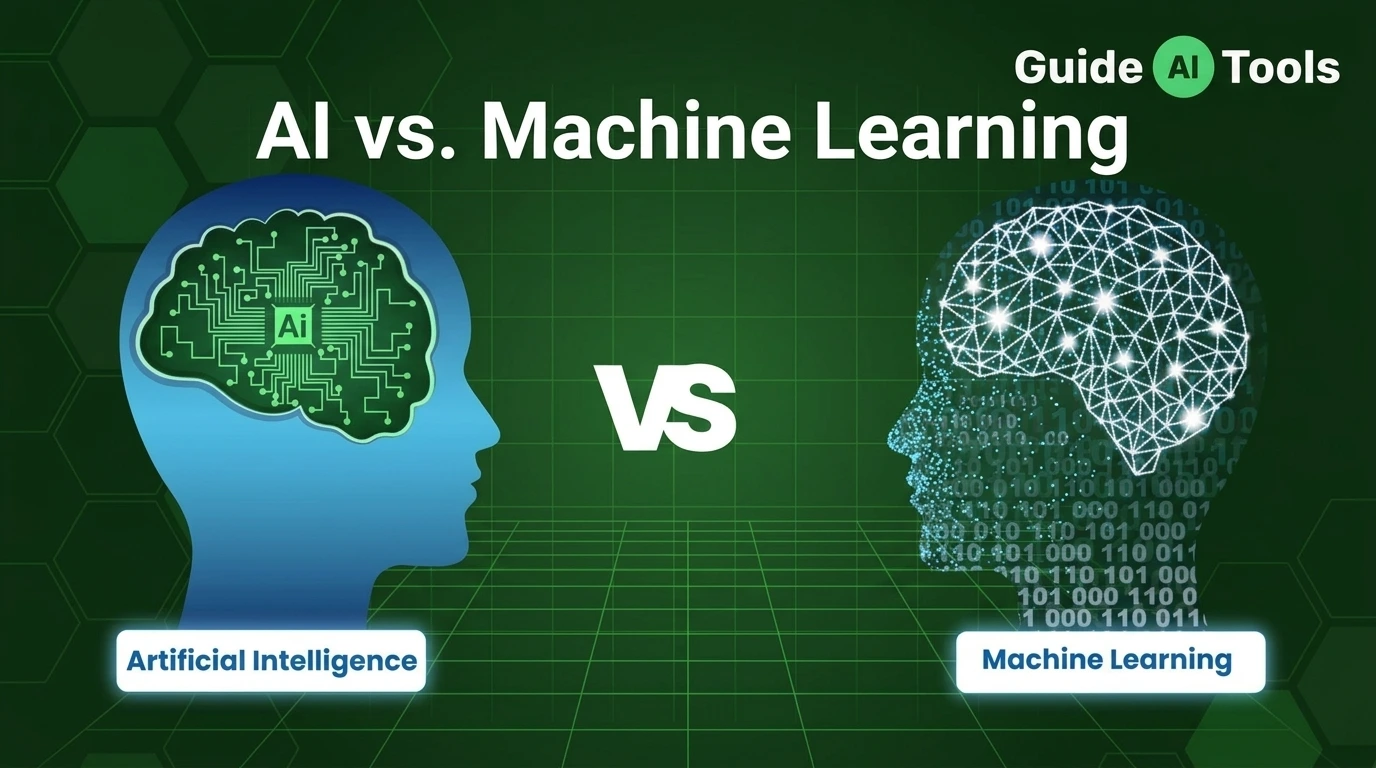
AI is the broader field. Machine learning is one way of building AI systems. Deep learning is a specialized approach within machine learning that uses multilayer neural networks.
So, AI and machine learning aren’t interchangeable terms.
A machine learning system is AI, but an AI system doesn’t have to use machine learning.
IBM gives a simple example of this distinction. A rules-based system can make decisions using explicitly programmed instructions without learning from data.
How does machine learning work?
Machine learning usually follows a cycle of collecting data, preparing it, training a model, evaluating the result and then using the trained model to make predictions.
A simplified version looks like this:
Data → Algorithm → Training → Model → Evaluation → Prediction
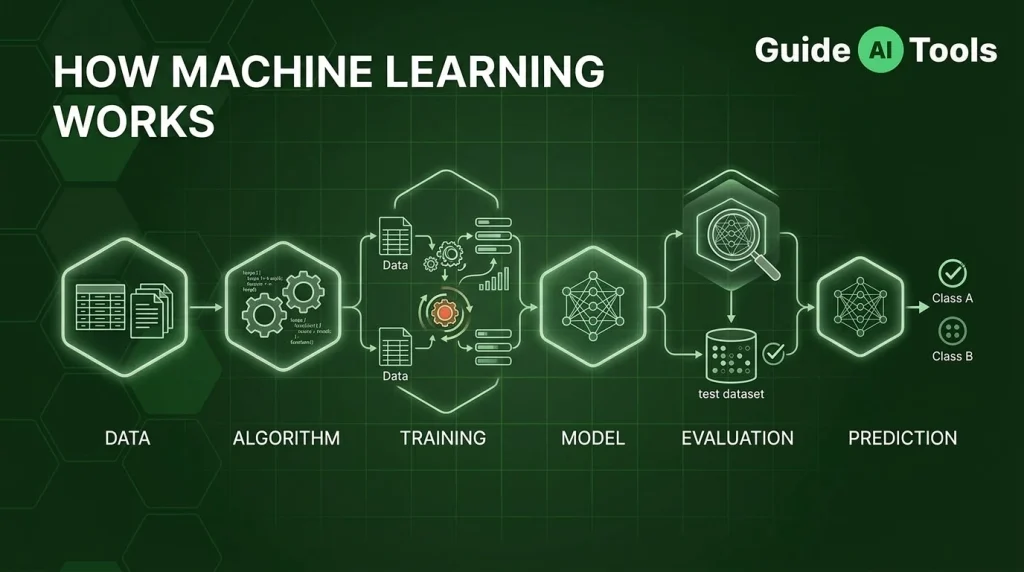
Let’s break that down.
1. Collect the data
Every machine learning project starts with information.
The data depends on the problem.
A spam filter might use emails. A recommendation system might use viewing or purchasing behavior. An image model might use photographs with relevant labels.
The data can contain features that help the model identify useful relationships.
For an email, those features could include words, sender information, links or other measurable characteristics.
2. Prepare the data
Raw data isn’t always ready for training.
It may contain missing values, duplicates, inconsistent formats or irrelevant information. Data preparation can involve cleaning, transforming and organizing the dataset before training begins.
This step gets overlooked in simple explanations.
It shouldn’t be.
A sophisticated algorithm can’t automatically turn poor data into reliable knowledge. The quality and suitability of training data can strongly affect the resulting model.
3. Choose a learning method
The right method depends on the problem.
If you have examples with known answers, supervised learning may be appropriate.
If you’re looking for hidden groups or structures without predefined labels, unsupervised learning may make more sense.
Other situations call for self-supervised learning or reinforcement learning.
The learning method determines how the model will extract useful information from the data.
4. Train the model
Training is where the model learns from examples.
Suppose we’re training a spam classifier.
The model receives an email and produces a prediction. During supervised training, that prediction can be compared with the known answer.
If the prediction is wrong, the training process adjusts the model so that future predictions can improve.
Modern ML training often uses a loss function to measure error and optimization methods such as gradient descent to adjust model parameters. Google Cloud describes this process as fitting a model to training data, measuring errors and adjusting parameters to reduce those errors.
That cycle happens repeatedly.
The model sees examples.
It produces outputs.
The training process measures error.
Parameters are adjusted.
Then the model tries again.
5. Evaluate the model
A model that performs well on training data isn’t automatically useful.
We need to know how it handles information it hasn’t seen before.
That’s where evaluation comes in.
Depending on the task, developers may use separate training, validation and test data.
A model can look excellent during training but perform poorly on new examples. This problem is commonly associated with overfitting.
The goal isn’t to memorize the training dataset.
The goal is to generalize.
6. Use the trained model
Once a model has been trained and evaluated, it can process new input.
This stage is commonly called inference.
Imagine our spam filter has already learned from thousands of emails. A new email arrives tomorrow.
The trained model examines it and predicts whether it belongs to the spam category.
That prediction is inference.
AWS documentation similarly describes ML models as systems that use patterns extracted from input data to generate predictions, with evaluation used to measure model quality.
What does a machine learning model actually learn?
This is where the word “learn” can be misleading.
A machine learning model doesn’t learn in exactly the same way a person does.
It learns mathematical relationships within data.
Those relationships are represented through model parameters, weights, statistical patterns or other internal representations, depending on the type of model.
Consider a simple house price example.
You give a model information about many houses:
| Feature | Example |
|---|---|
| Size | 2,000 sq ft |
| Bedrooms | 4 |
| Location | City center |
| Age | 8 years |
| Price | $350,000 |
After seeing many examples, a supervised learning model can learn relationships between those inputs and the target value.
The resulting model can then estimate a price for a new house.
It doesn’t need a developer to manually write:
“Every extra bedroom adds exactly this amount.”
The learning process estimates useful relationships from the training examples.
What are the main types of machine learning?
Machine learning isn’t one single method. Different approaches are useful for different kinds of problems.
Supervised learning
Supervised learning uses training examples that include known answers, often called labels.
For example, you could give a model thousands of emails marked:
Spam
or
Not spam
The model learns the relationship between the input features and those labels.
Common supervised learning tasks include classification and regression.
Classification predicts a category.
Regression predicts a numerical value.
MathWorks uses spam detection as an example of classification and continuous values such as temperature as examples of regression.
Common uses include:
- Spam detection
- Fraud detection
- Image classification
- Sales forecasting
- Medical prediction
Unsupervised learning
Unsupervised learning works with data where predefined labels aren’t provided.
The goal can be to find structure or relationships inside the dataset.
Imagine an online store with thousands of customers.
You don’t tell the algorithm which customers belong together.
Instead, it can analyze purchasing behavior and identify groups with similar patterns.
This is where clustering techniques such as K-means can be useful.
The model isn’t being told what the groups should be.
It’s looking for structure in the data.
Semi-supervised learning
Semi-supervised learning uses a combination of labeled and unlabeled data.
This can be useful when labeling every example would require a lot of human effort.
For instance, imagine having 100,000 images but only 5,000 have been manually labeled.
A semi-supervised approach can use information from both sets.
The exact methods vary, but the basic idea is simple:
Some examples have labels. Many don’t. The model uses both.
Self-supervised learning
Self-supervised learning creates learning signals from the data itself rather than requiring humans to label every example.
This approach has become particularly significant for large models.
For example, a language model can be trained to predict missing or subsequent parts of text using the text itself as the source of the learning signal.
Stanford HAI distinguishes self-supervised learning from traditional supervised learning by describing how the system constructs its own prediction tasks from data.
Reinforcement learning
Reinforcement learning works through interaction, actions and rewards.
Instead of receiving a correct answer for every step, an agent tries actions and receives feedback about the results.
A game-playing system is an easy example.
An action might produce a positive reward.
Another action might produce a negative result.
Over many interactions, the system learns which actions are more useful for achieving its goal.
Stanford HAI describes reinforcement learning in terms of learning action sequences that optimize total rewards.
What are common machine learning algorithms?
An algorithm is the method used to learn from data. A model is the result of applying a learning process to a particular dataset and task.
That distinction matters.
Some common machine learning algorithms and techniques include:
| Algorithm or technique | Common use |
|---|---|
| Linear regression | Predicting numerical values |
| Logistic regression | Classification |
| Decision trees | Classification and prediction |
| Random forests | Classification and regression |
| Support vector machines | Classification and regression |
| K-means | Clustering |
| Neural networks | Complex pattern learning |
| Gradient descent | Model optimization |
You don’t need to know the mathematics behind each one to understand machine learning.
The important point is that different algorithms are suited to different problems and data.
What is the difference between machine learning and deep learning?
Deep learning is a specialized form of machine learning that uses neural networks with multiple layers.
Machine learning can use many different approaches, including decision trees, regression models and clustering methods.
Deep learning relies on multilayer neural networks to learn increasingly complex representations from data.
For example, a traditional ML system might depend more heavily on selected features, while a deep learning system can learn useful representations directly from large datasets.
Google Cloud describes deep learning as a subset of machine learning and explains its connection to neural networks.
The relationship is:
| Concept | Meaning |
|---|---|
| Artificial Intelligence | Broad field of intelligent computer systems |
| Machine Learning | AI approach that learns patterns from data |
| Deep Learning | ML approach based on multilayer neural networks |
Your broader guide on how AI works covers the larger AI process, while this page focuses specifically on machine learning.
What data does machine learning use?
Machine learning can work with many forms of data.
Examples include:
- Text
- Images
- Audio
- Video
- Numbers
- Customer records
- Sensor readings
- Transaction data
The type of data depends on the task.
A speech recognition model works with audio.
A recommendation system can work with user behavior.
A computer vision model works with images or video.
A fraud detection system may examine transaction patterns.
Data can also contain different roles.
Features are pieces of information used as inputs.
Labels represent known target answers in supervised learning.
For a spam filter, words and sender information could be features, while “spam” or “not spam” could be the label.
Why does data quality matter in machine learning?
Machine learning models depend heavily on the data used to train them.
Poor data can create poor results.
Imagine training a model to recognize dogs using thousands of images, but almost every dog image was taken outdoors while almost every non-dog image was taken indoors.
The model might accidentally learn that background scenery is useful for identifying dogs.
That’s not what you wanted.
It learned a pattern.
Just not the right one.
This is why data preparation, representative examples and careful evaluation matter.
Google Cloud notes that larger and more varied datasets can improve performance when the training data is high quality, while IBM emphasizes that training data should adequately represent the real-world problem the model will face.
More data isn’t automatically better.
Relevant data beats sheer volume.
What are some real-world examples of machine learning?
Machine learning is already used across many everyday systems.
Spam filtering
Email providers can classify incoming messages based on patterns learned from examples.
Recommendation systems
Streaming services, online stores and other platforms can use behavioral data to recommend content or products.
Fraud detection
Financial systems can identify transactions that differ from learned patterns and flag them for review.
Image recognition
ML models can classify images or identify objects within them.
Speech recognition
Speech systems can convert spoken language into text and support applications such as transcription and voice interfaces.
Forecasting
Businesses can use ML models to estimate future demand or other measurable outcomes based on historical patterns.
Stanford HAI lists spam filters, recommendation systems, image recognition, voice assistants and fraud detection among common machine learning applications.
If you’re interested in the tools built around these technologies, GuideAITools also has an AI tools directory covering different categories and use cases.
What are the benefits of machine learning?
Machine learning is useful when a problem involves patterns that would be difficult to capture through manually written rules.
It can help organizations:
- Analyze large datasets
- Find patterns
- Make predictions
- Classify information
- Personalize recommendations
- Detect unusual activity
- Automate certain decisions
- Support forecasting
The value isn’t simply that a machine can process lots of information.
It’s that a trained model can turn patterns in that information into useful predictions or classifications.
Oracle describes ML around automatic pattern discovery, prediction, categorization and analysis of large volumes of data.
What are the limitations of machine learning?
Machine learning has clear limitations.
A model can produce a confident prediction and still be wrong.
It can also perform well on training examples but struggle with unfamiliar data.
Common problems include:
Overfitting
The model becomes too closely fitted to its training data and doesn’t generalize well to new examples.
Underfitting
The model is too simple to capture useful patterns in the data.
Biased data
If training data reflects unwanted biases, a model can reproduce or amplify those patterns.
Poor data
Missing, inaccurate or irrelevant information can reduce model quality.
Limited context
A model may recognize statistical relationships without understanding the broader context in the human sense.
Maintenance
Real-world data changes.
A model that worked well six months ago may need monitoring, updating or retraining when the environment changes.
This is one reason machine learning isn’t simply a case of “train it once and forget about it.” Modern ML workflows can include data preparation, training, evaluation, deployment and ongoing management. AWS describes these as parts of the wider ML lifecycle.
Is machine learning the same as AI?
No. Machine learning is a subset of AI.
AI is the broader field concerned with systems that perform tasks associated with intelligent behavior.
Machine learning is one approach used to build such systems by learning patterns from data.
A useful shortcut is:
AI is the broader field. ML is one way to build AI systems.
Not every AI system has to learn from data.
Some AI systems can use explicitly programmed rules.
IBM and Google Cloud both make this distinction in their current explanations of AI and ML.
For the broader definition, see what is artificial intelligence.
Does machine learning learn every time you use it?
Usually, no.
A common misunderstanding is that a deployed ML model automatically retrains itself every time someone sends it new information.
Training and inference are different stages.
During training, the model’s parameters are adjusted using data.
During inference, the trained model processes new input and produces an output.
A production system can be designed to retrain periodically or update its model using new data, but that is a separate engineering process. It isn’t something that automatically happens for every prediction.
What is machine learning used for?
Machine learning is used wherever patterns in data can help produce useful predictions, classifications or decisions.
| Area | Example |
|---|---|
| Finance | Fraud detection |
| Retail | Product recommendations |
| Healthcare | Medical image analysis |
| Marketing | Customer segmentation |
| Technology | Search and speech systems |
| Manufacturing | Predictive maintenance |
| Transportation | Demand and route forecasting |
| Security | Anomaly detection |
| Education | Learning personalization |
| Media | Content recommendations |
The specific model and data depend on the problem.
There isn’t one machine learning method that works equally well for every task.
What is the future of machine learning?
Machine learning is becoming part of larger AI systems rather than remaining a standalone technique.
It already supports areas such as generative AI, speech systems, computer vision, recommendation engines and other AI applications. IBM describes ML as the backbone of many current AI systems, including large language models and generative AI tools.
At the same time, ML development is becoming more focused on the full lifecycle: preparing data, training models, evaluating them, deploying them and monitoring their performance.
The next step isn’t simply bigger models.
For many applications, useful progress can also come from better data, better evaluation, specialized models and more reliable deployment.
Frequently Asked Questions
What is machine learning in simple words?
Machine learning is a way of building computer systems that learn patterns from data and use those patterns to make predictions or decisions.
How does machine learning work?
Machine learning systems receive data, use an algorithm to train a model, evaluate its performance and then use the trained model to process new information.
What are the main types of machine learning?
The main learning approaches include supervised learning, unsupervised learning, semi-supervised learning, self-supervised learning and reinforcement learning.
Does machine learning require labeled data?
No. Supervised learning uses labeled data, but unsupervised and self-supervised approaches can learn from data without manually labeling every example.
What is an ML model?
An ML model is the learned system produced through a training process. It captures patterns or relationships from data and can use them to make predictions on new inputs.
What is the difference between machine learning and deep learning?
Deep learning is a specialized type of machine learning based on multilayer neural networks. Machine learning also includes many methods that don’t use deep neural networks.
What are examples of machine learning?
Examples include spam filtering, recommendation systems, fraud detection, image recognition, speech recognition and forecasting.
Is machine learning the same as AI?
No. Machine learning is a subset of artificial intelligence. AI is the broader field, while ML is one approach used to create systems that learn from data.
Can machine learning make mistakes?
Yes. ML models can produce incorrect predictions because of poor data, bias, overfitting, underfitting or situations that differ from their training data.
Does more training data always make machine learning better?
No. More useful, relevant and representative data can help, but simply increasing the amount of data doesn’t guarantee better performance. Data quality matters too.
Final Thoughts
Machine learning is easier to understand once you stop thinking of “learning” as something human-like.
A machine learning system receives data, finds patterns through a chosen learning process, adjusts its model during training and then uses what it learned to make predictions on new information.
That’s the core idea.
From spam filters and recommendation systems to speech recognition, fraud detection and modern generative AI, the same basic relationship keeps appearing: data goes in, a model learns useful patterns, and the trained model produces an output.
Machine learning isn’t every part of AI.
It is one of the central ways modern AI systems learn from data. And once that distinction is clear, topics such as deep learning, neural networks and generative AI become much easier to understand.

Related Blog Posts