How Does AI Work? A Simple Guide to Artificial Intelligence
Artificial intelligence works by converting raw information into numbers, pushing those numbers through mathematical models, and returning calculated outputs like predictions, classifications, or generated text. The system extracts statistical patterns from historical training data, freezes those calculations into numerical values, and applies them to new prompts during inference.
Sounds simple enough on paper.
Honestly, most people get this wrong. They picture an electronic brain sitting in a server rack, pondering thoughts like a human.
That is not what is happening. Modern AI is linear algebra, probability, and compute clusters chewing through matrix multiplications. According to Stanford HAI’s AI definitions
, foundation models and deep learning architectures rely on structured statistical training rather than conscious reasoning.
If you want the baseline definitions before looking under the hood, check our guide on what is artificial intelligence
. If you want to know what actually happens when code hits silicon, keep reading.
The core comparison table
| Stage | What Happens | Example |
| Input | System receives raw information | Photo or text string |
| Processing | Data gets cleaned and formatted | Tokenization or resizing |
| Model | Learned mathematical patterns apply | Neural network layers |
| Inference | Model processes new input | Predicts a category |
| Output | System returns a result | Classification score |
| Evaluation | Result is measured against benchmarks | Accuracy check |
| Monitoring | System is observed after deployment | Drift detection |
How does AI work step by step?
Building an AI system is an engineering pipeline. You do not just write code and watch it think. You guide data through a strict factory line.
Problem → Data → Preparation → Model → Training → Validation → Inference → Output → Monitoring
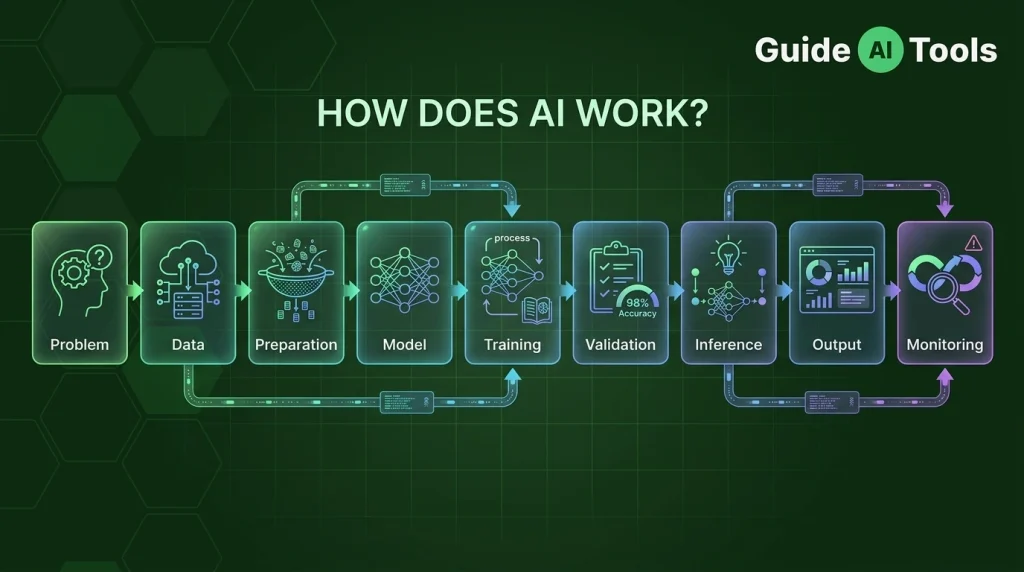
Not every project follows this exact sequence. Simple rule-based systems skip machine learning entirely. Still, this lifecycle represents the operational standard for modern software.
Step 1: Define the problem
Models do not solve open-ended questions. They solve narrow mathematical goals.
You might want to catch credit card fraud before a swipe clears. Or you need to transcribe messy boardroom audio.
Every engineering choice hinges on this first question. A vision system processing warehouse camera feeds needs a completely different setup than a tool analyzing tax documents.
Step 2: Collect data
Data is the fuel. Without it, algorithms are just empty math equations.
Systems need thousands or billions of examples depending on what you want them to do. NASA’s explanation of AI
notes that machine learning relies on massive datasets to train computers for classification and prediction.
More data does not solve bad design. Feeding a model noisy, biased, or messy data breaks performance every single time.
Step 3: Prepare the data
Raw data is always messy. Files have missing fields, corrupt text strings, and skewed formatting.
Engineers spend most of their working hours normalizing numbers, converting plain text into token vectors, and resizing image resolutions. Skip this stage and your model learns garbage patterns.
Step 4: Choose an approach
Now you choose how the system processes patterns. Simple problems only need deterministic decision trees.
Complex visual or linguistic tasks demand deep neural networks, transformer blocks, or diffusion setups. The problem profile dictates the architectural approach.
Step 5: Train the model
Training is a grueling math workout.
The loop is simple: forward pass, error measurement, backpropagation, and parameter tweak. Your computer feeds an example forward through the network layers.
A loss function calculates how far off the prediction was from reality. Calculus chain rules push adjustments backward through every connection.
Step 6: Validate and test
Engineers never judge a model using the same data it learned from.
Validation datasets help tune hyperparameters during development. Testing datasets measure real-world performance on unseen data before anything goes live.
Step 7: Deploy the model
Once testing clears, the model moves to production servers.
The compiled software artifact becomes available behind secure APIs so applications can query its logic in real time.
Step 8: Run inference
This is the operational phase.
New input enters the trained model. The system applies its frozen weights to calculate responses without altering its base parameters.
Step 9: Monitor and improve
Real-world conditions change. User behavior shifts.
Teams track error spikes, latency, and performance drift to decide when a model needs retraining.
What are the main components of an AI system?
An AI platform is not just one file. It is a stack of moving parts working together.
| Component | Role |
| Data | Provides historical examples and grounding information |
| Algorithm | The mathematical recipe guiding how patterns get extracted |
| Model | The compiled software artifact storing learned mathematical patterns |
| Parameters | Internal numerical values tweaked during model training runs |
| Compute | Silicon processors like GPUs and TPUs handling matrix math |
| Training | The optimization loop that calibrates weights against loss scores |
| Inference | Applying frozen weights to calculate responses for live users |
| Evaluation | Testing holdout data to catch overfitting before deployment |
| Monitoring | Watching error spikes, latency, and performance drift post-launch |
How does AI learn from data?
What does learning mean here? It is purely numerical optimization.
The software tweaks internal variables until its outputs line up with a set goal. Nothing is waking up. The machine simply reduces an error score.
Supervised learning
This method uses labeled examples with known answers.
You hand the system thousands of emails labeled spam or clean. It makes a guess, checks the actual label, sees its mistake, and adjusts its internal numbers.
Unsupervised learning
What if you have no labels?
Unsupervised algorithms look for hidden shapes and clusters in raw datasets on their own. An online store might feed raw buying habits into a clustering model to group shoppers with matching tastes.
Reinforcement learning
Here, an autonomous software agent lives inside a simulation.
It tries an action, observes the result, and picks up numerical rewards or penalties. Over millions of attempts, its policy favors actions that score points.
Self-supervised learning
This approach changed the whole playing field for modern systems.
Instead of paying humans to tag billions of sentences, the system hides words from itself and tries to guess them. It trains on raw internet text by predicting masked tokens.
What happens inside an AI model?
When you pass data into an operational model, the system executes a deterministic sequence of mathematical transformations.
First, unstructured inputs turn into numerical tensors. Text splits into token IDs. Images become pixel arrays.
Next, embedding projections position those tokens across high-dimensional semantic spaces. The values pass through sequential neural layers, multiplying against established weights.
Attention mechanisms measure correlation across input strings, letting the system balance context dynamically. Finally, the terminal layer calculates probability distributions to deliver the output.
AI doesn’t learn every time you use it
A common misunderstanding is that every AI response changes the model. Usually, it doesn’t work that way. A deployed model can generate outputs from its existing learned parameters without changing those parameters after every interaction. Model updating requires a separate training or adaptation process.
How do neural networks work?
Neural networks process information in layered stages. Input layers ingest numbers. Hidden layers extract patterns. Output layers deliver the decision.
Deep learning just means stacking dozens or hundreds of hidden layers. Each node multiplies inputs by its assigned weight, adds a bias, and runs the total through an activation function.
It borrows inspiration from brain biology, but it is not human thought. It is multidimensional calculus.
How does machine learning work?
Machine learning models learn patterns from historical training data and apply those patterns to new inputs through inference.
Consider a fraud detection system. A bank gathers three years of transaction records.
The data pipeline strips corrupt rows and scales figures. Engineers train a classifier on the records.
When a new transaction arrives at checkout, the model executes inference in milliseconds and returns an anomaly score.
If you want to explore software development workflows, our guide on AI coding tools
covers products built around these models.
How does generative AI work?
Generative artificial intelligence produces original content by calculating the mathematical likelihood of elements occurring in sequence based on training patterns. Modern large language models operate autoregressively, predicting one discrete token at a time.
The system appends the newly selected token to its working context and runs the inference pass again until it hits a stopping condition. For audio workflows, our catalog of AI speech recognition
tools covers platforms handling multi-accent vocal speech.
Image generators rely on diffusion architectures. They start with pure digital noise and clean it step by step until a coherent visual emerges.
If you want to test visual systems, explore our directory of AI image generators
How does ChatGPT work?
ChatGPT functions as an applied software application constructed on top of advanced generative foundation models. When you provide a prompt, the system tokenizes your text string and passes the vectors through stacked transformer layers.
Self-attention heads calculate contextual associations across the conversational thread. The model samples candidate tokens sequentially, streams the response to your screen, and handles optional retrieval tools when active.
For practical tips on prompt structures, read our guide on how to use ChatGPT
What role do GPUs and data centers play in AI?
Standard computer processors handle sequential tasks one by one. AI workloads need massive parallel processing, which makes GPUs and TPUs a requirement.
Thousands of smaller cores calculate tensor multiplications simultaneously without choking memory bandwidth. Training requires massive compute clusters to adjust billions of parameter weights across iterative loops.
Inference also needs compute, but the task runs on frozen parameters distributed across server infrastructure to handle live user demand.
Why does AI make mistakes?
AI can write with supreme confidence and be completely wrong. That is because language models hunt for plausible wording, not factual reality.
- Gaps in training data leave the model blind to niche topics.
- Embedded bias reflects skewed internet sources rather than objective truth.
- Overfitting makes a model memorize training sets while failing on live queries.
- Data drift happens when real-world human behavior shifts after training ends.
- Prompt ambiguity forces the model to guess your missing requirements.
- Hallucinations occur when probabilistic token matching outputs plausible fiction.
Does AI actually understand what it is doing?
No. AI systems do not possess consciousness, sentience, intentionality, or lived experience.
When a neural network reviews a medical scan, it does not see the image with visual awareness. It converts pixel grids into numerical arrays and flags activation patterns matching historical labels.
An AI system writing about human emotion calculates the most statistically coherent arrangement of vocabulary based on human writing samples. It processes functional semantics, not subjective experience.
Traditional software vs AI
Both traditional applications and machine learning platforms take inputs and return outputs, but their underlying architectures differ fundamentally.
| Feature | Traditional Rule-Based Software | Modern Machine Learning Systems |
| Logic Construction | Explicitly handcoded by engineers via deterministic rules | Synthesized automatically by algorithms learning patterns |
| Edge-Case Handling | Requires manual code revisions for unexpected situations | Generalizes probabilistically based on semantic boundaries |
| Operational Output | Deterministic: identical inputs yield identical pathways | Probabilistic: outputs represent statistical likelihoods |
| Maintenance Model | Maintained by refactoring source code | Maintained by refreshing training pipelines and weights |
| Ideal Problem Types | Strict transactional logic and accounting ledgers | Natural language processing and visual perception |
Where is AI used?
Because the input-processing-output pipeline is versatile, machine learning frameworks drive critical workflows across industries. Healthcare models analyze radiology scans. Finance engines score point-of-sale transactions.
Education platforms evaluate student problem-solving patterns. If you want to explore specialized assistance, our directory of AI writing tools
covers products built for content creators.
The underlying technology changes, but the general pattern remains familiar: input, processing, model behavior, and output.
FAQs
How does AI work in simple terms?
AI ingests input data, processes that data through mathematical patterns learned during training, and calculates an output like a text response or category score.
How does AI learn from data?
Machine learning models learn by adjusting parameters during training so their outputs become better aligned with target benchmarks.
What is the difference between training and inference?
Training adjusts a model’s parameters using data and optimization loops. Inference uses the trained model with frozen parameters to process new information and produce outputs.
Does AI learn by itself?
AI doesn’t automatically learn every time it is used. Learning requires a separate training, fine-tuning, or adaptation process.
What data does AI use?
AI can use structured spreadsheets, unstructured text documents, raw audio waveforms, pixel matrices, video frames, and time-series telemetry.
How does machine learning work?
Machine learning trains models on data so they can identify patterns and make predictions or decisions about new information.
How does generative AI work?
Generative AI uses trained models to create new content from prompts by predicting token sequences or denoising latent spaces.
Does AI learn every time I use it?
Not necessarily. A deployed model doesn’t automatically update its underlying parameters after every user interaction.
Why does AI sometimes give wrong answers?
AI can make mistakes because of poor data, incomplete information, bias, ambiguous inputs, and limitations in probabilistic token matching.
Does AI need the internet to work?
Not always. Some AI models can run locally on hardware with adequate GPU power, while others depend on cloud servers and live retrieval tools.
The bottom-line mental model
Strip away the marketing jargon and the core machine is clear. You have an operational goal. You gather clean data. You choose an algorithm to train a model.
You freeze the resulting parameters, deploy the model to live hardware, and execute low-latency inference on incoming prompts. It is not magical thinking.
AI is applied statistics running at massive computational scale. Once you view it through that engineering lens, you can build, prompt, and evaluate these systems with absolute clarity.

Related Blog Posts