What Is Reinforcement Learning? A Clear Guide to How AI Learns by Trial and Error
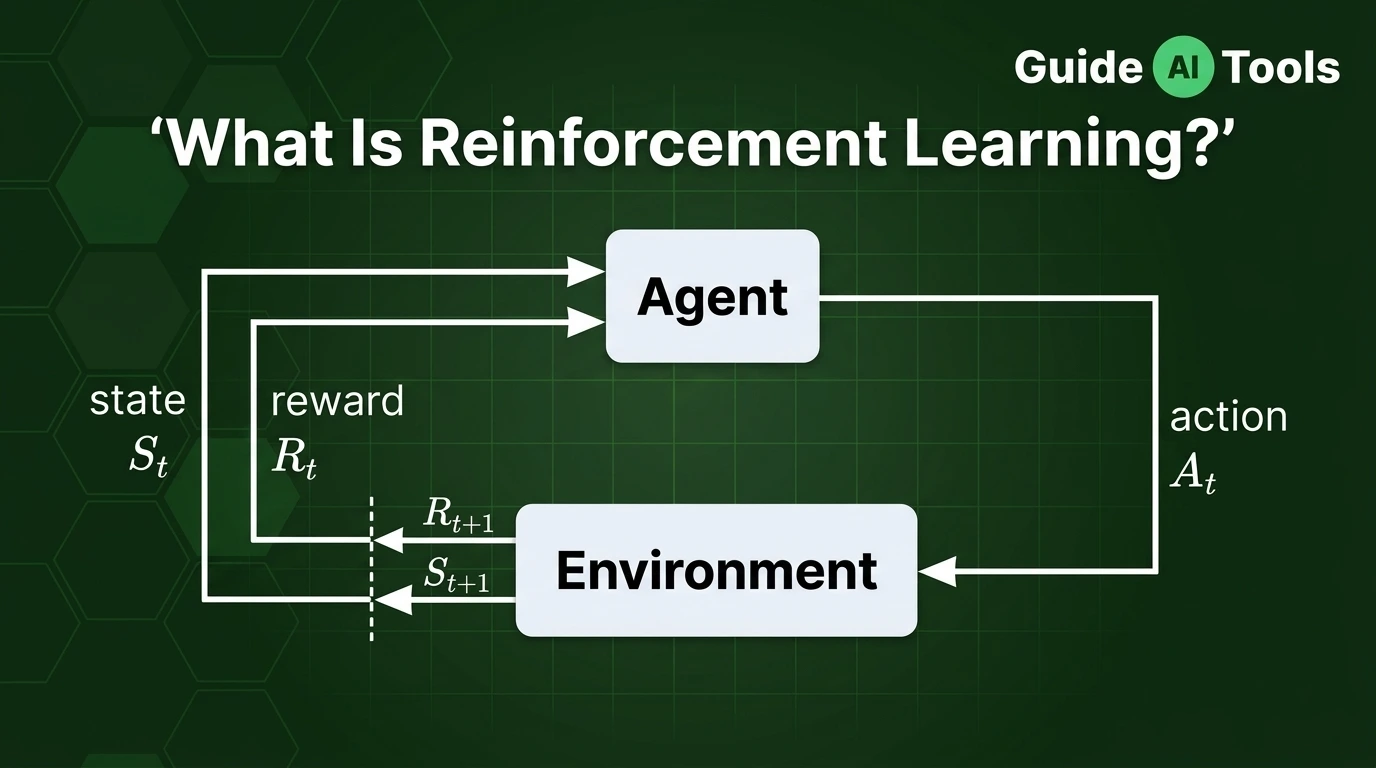
Reinforcement learning is a machine learning framework where an autonomous agent learns to make decisions by interacting with an environment through trial and error. Instead of training on static labeled answers, the agent receives feedback as positive rewards or negative penalties to maximize its cumulative long-term score.
A dog does not learn to sit because someone explains the structural grammar of command language. It learns because sitting gets a biscuit and ignoring the owner gets nothing.
Reinforcement learning works almost the same way, except the dog is a piece of software.
Look, most computer science textbooks wrap this concept in dense calculus and matrix notation. In my practical testing, the simplest way to understand it is that no teacher gives the model an answer key.
The software has to figure things out through direct consequences. If you want a wider look at how this fits into AI paradigms, read our breakdown of types of machine learning.
How Reinforcement Learning Actually Works
Let us use one simple scenario: a navigation engine inside a food delivery app trying to find the fastest route through a city.
The routing algorithm acts as the agent. The city roads, traffic lights, and weather form the environment. The current intersection and clock time represent the state. Turning left, turning right, or staying straight are the actions.
When the driver arrives early, the system gets a positive reward score. When the driver gets stuck in avoidable school zone traffic, the system receives a negative penalty.
Over thousands of deliveries, the software updates its internal policy rules to prefer routes that yield the highest total reward.
- Observe the current environment state.
- Select an action based on current policy rules.
- Execute the action inside the environment.
- Receive a numerical reward or penalty signal.
- Update policy rules to improve future decisions.
- Move to the next state and repeat the cycle.
The Core Components of Reinforcement Learning
Understanding how the feedback loop functions requires defining the eight foundational components that drive every decision.
| Term | Plain-English Meaning | Delivery App Scenario Example |
| Agent | The active decision-making software system | The delivery route calculation engine |
| Environment | Everything outside the control of the agent | City streets, traffic density, and construction zones |
| State | The exact current condition of the environment | Driver located at main street intersection at 5 PM |
| Action | A choice available to the agent at a given state | Turning onto the bypass road instead of downtown |
| Reward | Feedback signal evaluating the immediate outcome | +10 points for early arrival, -5 for traffic delay |
| Policy | The underlying strategy used to pick actions | Rule set determining route selection strategy |
| Value Function | Expected long-term return from a current state | Estimated total delivery efficiency score for a route |
| Episode | One full trial run from start to finish | Single delivery trip from restaurant pickup to customer door |
Exploration vs Exploitation: The Core Trade-off
Imagine you have a favorite local restaurant where the food is always good. Do you keep going there every Friday, or do you try a new spot that might be terrible or might be the best meal of your life?
That dilemma is the exploration vs exploitation trade-off.
Exploitation means sticking to known routes that have yielded decent rewards in past runs. Exploration means testing unfamiliar roads to see if a faster shortcut exists.
If an agent only exploits, it stays stuck in mediocre habits. If it only explores, it wastes time making bad choices over and over.
Balancing these two priorities is one of the hardest parts of building real AI software.
Reinforcement Learning vs Supervised and Unsupervised Learning
Is reinforcement learning supervised or unsupervised? Reinforcement learning is a distinct, standalone third machine learning paradigm.
Supervised models learn from human-labeled answer keys. Unsupervised models search for hidden patterns inside static unlabeled data. Reinforcement learning relies on interaction, feedback signals, and trial-and-error discovery.
| Aspect | Supervised Learning | Unsupervised Learning | Reinforcement Learning |
| Data Source | Static pre-labeled dataset | Static unlabeled dataset | Dynamic interaction with an environment |
| Feedback Type | Immediate correct target answer | No feedback provided | Delayed reward or penalty score |
| Core Goal | Predict predefined targets | Discover hidden data structures | Maximize long-term cumulative reward |
| Learning Method | Historical input-output mapping | Pattern and cluster identification | Continuous trial-and-error loop |
To see how these paradigms connect at a foundational level, explore our guide on what is machine learning. You can also read detailed breakdowns in our guides on supervised learning and unsupervised learning.
Types of Reinforcement Learning Algorithms
Engineers divide algorithms into two main families: model-based approaches that build an internal map of the environment, and model-free approaches that learn purely through trial outcomes.
- Q-learning is a model-free approach that calculates optimal quality scores for every state-action pair.
- SARSA evaluates actions by strictly following the current policy rather than assuming optimal future choices.
- Policy Gradient methods optimize action probabilities directly without keeping large value lookup tables.
- Actor-Critic models split the workload between one network that chooses actions and another that evaluates them.
- Deep Q-Networks combine deep learning layers with Q-learning to process complex visual or high-dimensional environments.
If you want to understand how deep neural layers process inputs, check out our explainer on what is deep learning.
Real-World Examples of Reinforcement Learning
Beyond academic labs, this training style powers some of the most impressive software achievements of the last decade.
DeepMind’s AlphaGo research proved that a reinforcement learning system could defeat world-class human Go champions by playing millions of self-play games.
Industrial fulfillment centers use autonomous warehouse robots that learn how to pack and sort packages without colliding. Autonomous vehicle systems use simulated environments to practice merging onto busy freeways safely.
Modern recommendation feeds and gaming bots also use these feedback loops to adjust their behavior based on real-time user engagement.
Reinforcement Learning From Human Feedback (RLHF): Why This Matters Today
Modern conversational models like ChatGPT, Claude, and Gemini would feel robotic and unhelpful without a specialized variation called RLHF.
Base language models learn by predicting missing words across raw web pages. But knowing how to complete a sentence does not make an AI safe or helpful in conversation.
With RLHF, human evaluators rank different responses produced by the AI. A separate reward model learns what humans prefer from those rankings.
The primary AI model is then fine-tuned against that reward model using reinforcement learning. You can explore how these techniques power complex software systems in our guide to AI agents.
FAQs
What is reinforcement learning in simple terms?
Reinforcement learning is a machine learning method where software learns by trying actions, receiving rewards for good outcomes, and getting penalties for mistakes.
Is reinforcement learning supervised or unsupervised?
Reinforcement learning is neither supervised nor unsupervised, standing as its own third category based on dynamic environment feedback rather than static datasets.
How does reinforcement learning work?
An agent observes an environment state, takes an action, receives a reward or penalty, and updates its strategy to improve future decisions.
What is an example of reinforcement learning?
Classic examples include game-playing AI systems like AlphaGo, autonomous warehouse sorting robots, and delivery app routing engines.
What is the difference between reinforcement learning and deep learning?
Deep learning is a neural network architecture, while reinforcement learning is a decision-making framework that can use neural networks to handle complex environments.
What is RLHF (reinforcement learning from human feedback)?
RLHF is a fine-tuning technique where human preference rankings train a reward model, which then guides a large language model to produce helpful and safe answers.
Why is it called reinforcement learning?
It takes its name from behavioral psychology, where positive and negative feedback signals reinforce desirable actions while discouraging bad choices.
Building Smarter Autonomous Systems
Reinforcement learning remains one of the most exciting areas in software development because it solves problems where static training datasets simply do not exist.
Success comes down to designing accurate reward functions and balancing exploration against known safe actions.

Related Blog Posts