What Is Supervised Learning? How It Works and Examples
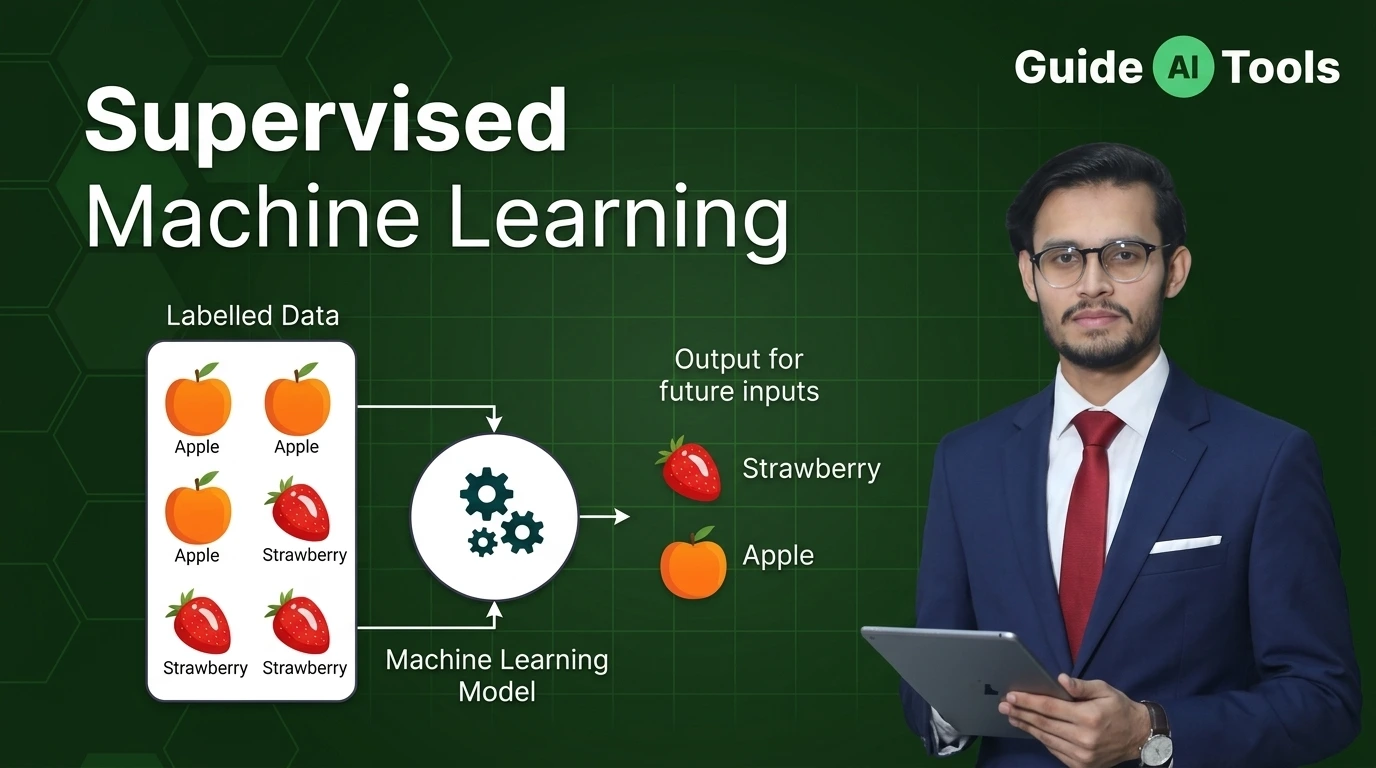
Supervised learning is a type of machine learning where a model trains on examples that include both inputs and known correct outputs. It learns the relationship between those inputs and targets, measures its prediction errors during training, and then uses the learned pattern to make predictions on new data it has never seen before.
The word “supervised” can be misleading. Nobody has to sit beside the model and correct every prediction.
The supervision usually comes from the known answer attached to each training example.
That distinction matters. A supervised model is not useful because it can remember yesterday’s answers. It is useful when the relationship it learned still works tomorrow.
If you are new to the broader topic, start with what machine learning is and then come back here for the deeper training process.
What Is Supervised Learning in Simple Terms?
Supervised learning means learning from examples that already contain the answer.
Suppose you want to build a spam filter. You give the model thousands of emails where each message is already marked “spam” or “not spam.”
The email is the input.
The spam label is the known target.
The model studies patterns across those examples, makes predictions during training, compares them with the actual labels, and changes its internal parameters when its predictions are wrong.
Later, you give it a new email with no label.
Now the answer key is gone.
The model has to predict.
The label acts like an answer key during training, but the real test starts when that answer is no longer available.
That is the basic idea behind supervised learning.
Stanford HAI’s definition of supervised learning describes the same structure: input examples are paired with correct outputs so the model can learn how inputs relate to answers.
Why Is It Called Supervised Learning?
It is called supervised learning because training includes a supervisory signal.
That signal is usually the known target associated with each example.
You can think of the training process like this:
Input features X -> model -> prediction
Known target y -> comparison
Prediction error -> learning signal
The model then updates its parameters, or fits itself more closely to the data, depending on the algorithm being used.
A neural network may adjust weights through optimization.
A decision tree may choose splits that better separate target values.
Different algorithm. Same supervised setup.
The supervision comes from the known target, not necessarily from a human watching the model learn.
Humans may create labels, but that is only one source.
A sales database can provide whether a lead converted.
A sensor can provide the measured temperature.
A hospital record can contain a confirmed diagnosis.
A property database can provide the actual sale price.
The target already exists. The model learns from it.
How Does Supervised Learning Work?
Supervised learning works by repeatedly comparing predictions with known outcomes and using the error to improve the model.
The exact training mechanics change between algorithms, but the workflow usually looks like this.
1. Define the target
Start with the question you want the model to answer.
Do you want to predict whether a customer will cancel?
Estimate a house price?
Classify an image?
Forecast next month’s sales?
A vague target creates a vague model.
2. Collect labeled examples
Each training example needs input information plus a known outcome.
For churn prediction, that could mean customer usage, plan type, support history, contract length, and whether the customer later canceled.
3. Prepare the features
Raw data is rarely ready as-is.
Teams may clean missing values, encode categories, remove irrelevant fields, scale numerical values, or create better features from existing data.
This is where a lot of real model quality gets decided.
4. Split the data
A common setup separates data into training, validation, and test sets.
The training set teaches the model.
The validation set helps with model selection and tuning.
The test set gives a final check on data the model did not train on.
Using the test set repeatedly during tuning defeats much of its purpose.
5. Train the model
The model receives input features and generates a prediction.
That prediction is compared with the known target.
A loss function measures how far the prediction is from the desired result.
The training algorithm then tries to reduce that loss.
6. Validate and tune
A model can fit the training set well and still perform badly elsewhere.
Validation helps reveal that problem before deployment.
7. Test on unseen data
Now evaluate the final model on held-back examples.
This step matters far more than a flashy training score.
8. Use the model for inference
Once deployed, the model receives new inputs and produces predictions using what it learned during training.
The parameters normally do not change during ordinary inference.
If you want more context on the broader training and prediction flow, see how AI works.
Features, Labels and Ground Truth Explained
A supervised dataset contains inputs and known outputs, but the terminology can get confusing fast.
Here is the clean version.
| Term | Meaning | House Price Example |
|---|---|---|
| Feature | Input information used by the model | House size |
| Feature | Another input | Bedrooms |
| Target | The value the model is trying to predict | Sale price |
| Label | Known target attached to a training example | $350,000 |
| Ground truth | Reference answer treated as correct | Actual recorded sale price |
| Prediction | Model’s estimated output | $342,000 |
You will often see features written as X and the target written as y.
That notation is useful, but the concept matters more than the letters.
Features describe the case. The target tells the model what outcome it should learn to predict.
One nuance gets missed often: labels are not always categories.
“Spam” is a category.
“$350,000” is not.
In regression, the target may be price, temperature, revenue, demand, time, or another continuous number.
Classification vs Regression
The two main supervised learning tasks are classification and regression.
Classification predicts a category.
Regression predicts a numerical value.
| Task | Output | Example |
|---|---|---|
| Classification | Category | Spam or not spam |
| Classification | Category | Fraud or legitimate |
| Classification | Category | Churn or stay |
| Regression | Number | House price |
| Regression | Number | Monthly sales |
| Regression | Number | Delivery time |
Binary and multiclass classification
Binary classification chooses between two classes, such as fraud or legitimate.
Multiclass classification chooses among more than two categories, such as identifying whether an image shows a cat, dog, horse, or bird.
Regression predicts continuous values
Regression is used when the output is numerical.
A house price model may predict $342,000.
A demand model may predict 12,450 units.
A delivery model may predict 18.7 minutes.
One naming trap catches beginners all the time.
Logistic regression has “regression” in the name, but it is commonly used for classification.
Common Supervised Learning Algorithms
Supervised learning is a training setup, not one specific algorithm.
That distinction is easy to miss.
| Algorithm | Common Use |
|---|---|
| Linear regression | Numerical prediction |
| Logistic regression | Classification |
| Decision tree | Classification or regression |
| Random forest | Classification or regression |
| Support vector machine | Classification or regression |
| k-nearest neighbors | Classification or regression |
| Neural network | Complex classification or regression |
Linear regression is often a strong baseline when the relationship between variables is reasonably simple.
Decision trees are easy to inspect but can overfit if allowed to grow without control.
Random forests combine many trees and often perform better on tabular data.
Support vector machines can work well on certain high-dimensional datasets.
k-nearest neighbors makes predictions based on nearby examples.
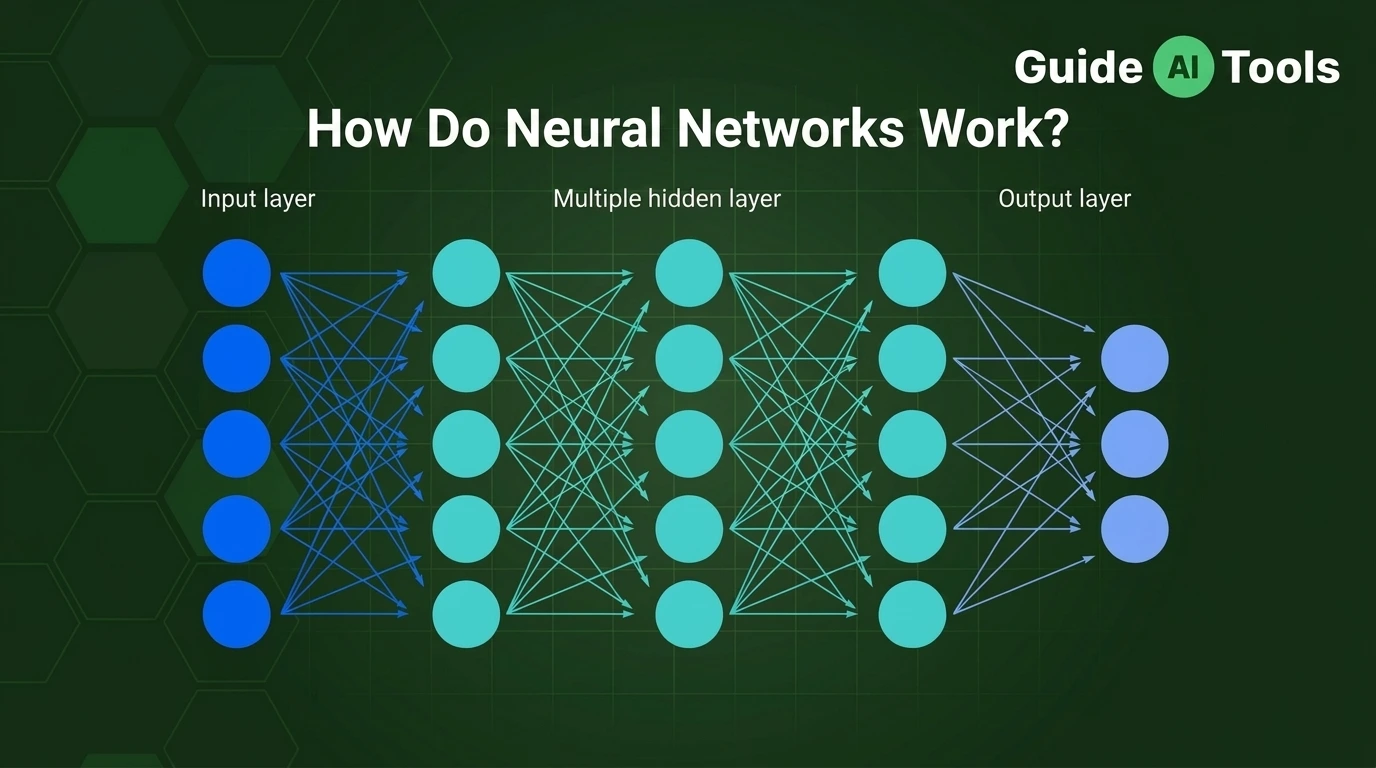
Neural networks can model far more complicated relationships, especially with images, text, audio, and other high-dimensional data.
But keep one thing straight.
A model architecture is not the same thing as a learning paradigm.
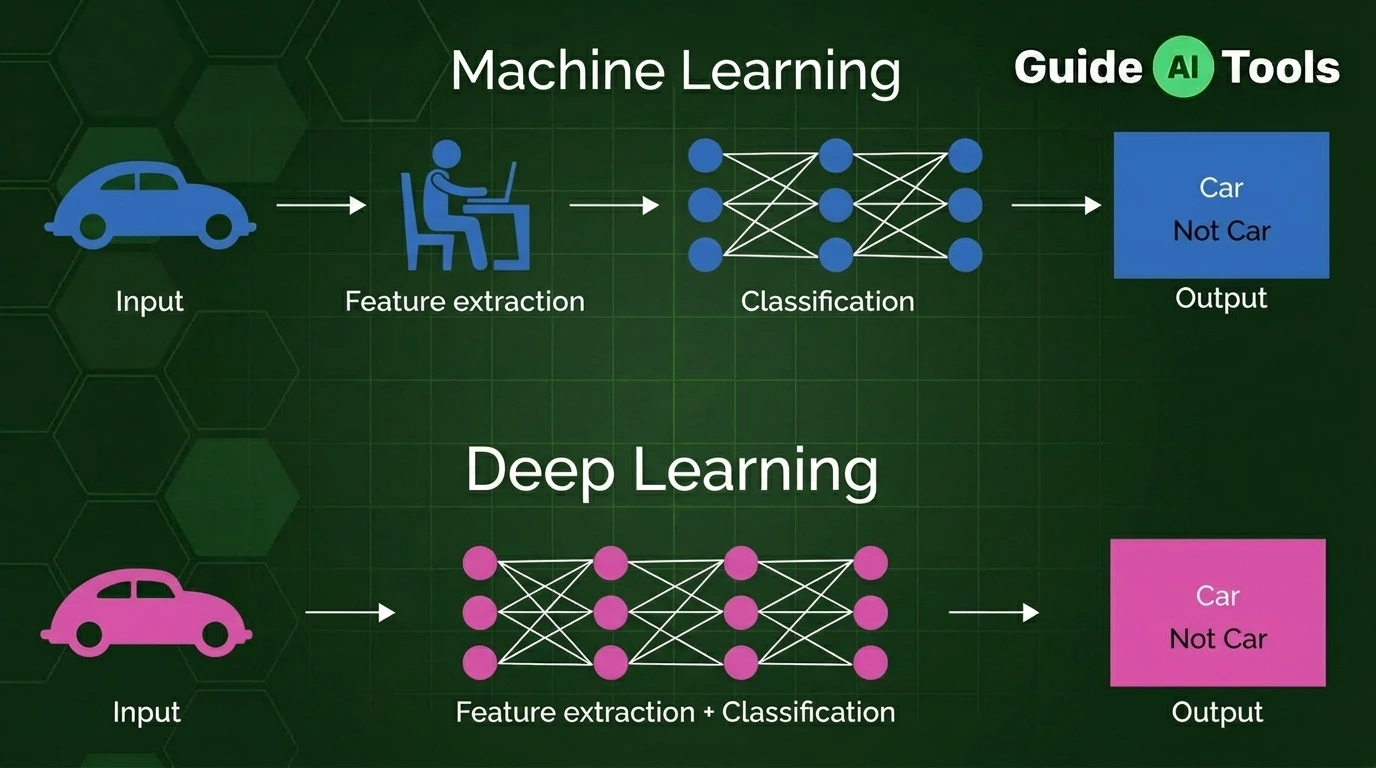
A neural network can be trained using supervised learning, self-supervised learning, reinforcement learning, or another objective.
The same is true for deep learning. Deep learning does not automatically mean supervised learning.
Supervised Learning Example From Start to Finish
Spam detection is a good example because the whole supervised workflow is easy to see.
Imagine a company has 100,000 historical emails.
Each email has already been marked as either spam or legitimate.
The model receives information extracted from each message. That might include word patterns, sender information, links, formatting signals, or other features.
It also receives the correct label.
During training, the model starts making predictions.
Some are wrong.
The learning process uses those errors to improve the model.
A validation set helps tune the model without touching the final test set.
Then the test set measures how well the trained model handles emails it has not seen.
Once deployed, a new message arrives.
No label is attached.
The model predicts a class, perhaps with an estimated probability.
Here is the subtle part.
The model never needs a hand-written rule saying “the word prize means spam.”
It learns statistical relationships from the labeled examples.
And that creates a risk too. If legitimate emails in the training data happen to contain certain words disproportionately, the model can learn the wrong pattern.
How Do You Evaluate a Supervised Learning Model?
You evaluate a supervised model by measuring how well its predictions match known outcomes on data it did not train on.
But the right metric depends on the task.
For classification, common metrics include accuracy, precision, recall, F1 score, and ROC-AUC.
For regression, teams often use MAE, MSE, RMSE, or R2.
Accuracy sounds obvious.
It is also easy to misuse.
Imagine 10,000 transactions where only 100 are fraudulent.
A useless model predicts “legitimate” for every transaction.
It gets 9,900 predictions correct.
That is 99 percent accuracy.
Yet it catches zero fraud.
Bad model.
This is why precision and recall can matter more than raw accuracy for imbalanced problems.
Precision asks how many predicted positives were actually positive.
Recall asks how many real positives the model found.
F1 balances the two.
For regression, MAE tells you the average absolute error, while RMSE penalizes larger mistakes more heavily.
The metric should reflect the business cost of being wrong.
What Is Overfitting in Supervised Learning?
Overfitting happens when a model fits its training examples too closely and fails to generalize to new data.
The model looks smart during training.
Then reality arrives.
A classic sign is very strong training performance combined with noticeably weaker validation or test performance.
Think of a student who memorizes practice questions word for word.
If the exam asks the same questions, the score is excellent.
Change the wording, and the student struggles.
That is the practical feel of overfitting.
A model that memorizes the training set has learned the dataset, not necessarily the problem.
Underfitting is the opposite problem.
The model is too simple, poorly specified, or insufficiently trained to capture useful patterns even in the training data.
Good supervised learning sits between the two.
It fits enough structure to be useful without becoming dependent on quirks in the sample.
Why Does Data Quality Matter?
Supervised learning can only learn from the targets and features it receives.
Bad labels do not become good just because a sophisticated algorithm sees them.
Suppose a hiring model trains on historical hiring decisions.
If those decisions reflect inconsistent evaluation standards, the model can learn those inconsistencies as if they were useful signals.
The same problem appears with noisy labels.
An image may be tagged incorrectly.
A customer may be labeled as “churned” because of a data-entry mistake.
A medical outcome may be missing or coded inconsistently.
A supervised model learns toward the answers it is given, even when those answers are flawed.
Data leakage is another nasty failure mode.
Imagine building a loan-default model and accidentally including a field that only becomes available after the borrower has already defaulted.
The model may score brilliantly.
It is not predicting.
It is seeing part of the answer.
Class imbalance can also distort evaluation, while distribution shift can break a model months after deployment when real-world behavior changes.
More data does not automatically fix any of this.
Better data often matters more.
Supervised Learning Examples
Supervised learning appears anywhere historical examples contain known outcomes that can teach a model what to predict.
| Application | Task Type |
|---|---|
| Spam detection | Classification |
| Fraud detection | Classification |
| Customer churn prediction | Classification |
| Medical image classification | Classification |
| Credit risk classification | Classification |
| House price estimation | Regression |
| Demand forecasting | Regression |
| Sales prediction | Regression |
Fraud detection is a classification problem when the target is “fraud” or “not fraud.”
House pricing is regression because the target is a numerical value.
Customer churn is usually classification because the model predicts whether a customer will leave.
Demand forecasting is often regression because the output is a quantity.
These are all supervised problems for the same reason.
The training examples contain known outcomes.
Advantages of Supervised Learning
Supervised learning works especially well when the prediction target is clearly defined and reliable labeled examples are available.
The biggest advantage is measurability.
Because the correct outputs are known, you can compare predictions with actual answers and quantify performance.
That gives teams a clear way to test different models.
Classification and regression also cover a huge range of business and scientific problems.
And with good labels, representative data, and careful evaluation, supervised models can make highly useful predictions.
There is another practical benefit.
Known targets make debugging easier.
If performance drops, you have a reference answer to compare against.
That is much harder in problems where no ground truth exists.
Limitations of Supervised Learning
Supervised learning fails when the labels are weak, the target is badly defined, or the training data does not represent the environment where the model will operate.
Labeling can also be expensive.
A spam dataset may be easy to label.
A medical imaging dataset may require trained specialists.
That changes the economics fast.
Another issue is historical bias.
If labels reflect past decisions rather than objective truth, the model may reproduce those decisions.
Class imbalance can hide poor performance.
Leakage can make evaluation look unrealistically strong.
Overfitting can produce impressive training numbers and disappointing production results.
And even a good model can degrade after deployment if user behavior, markets, sensors, language, or operating conditions change.
This is called distribution shift.
Supervised learning is powerful, but it is not self-correcting by default.
Supervised Learning vs Unsupervised Learning
The main difference is whether the training examples include a predefined target.
| Supervised Learning | Unsupervised Learning |
|---|---|
| Uses known targets | Has no predefined target |
| Trains on labeled examples | Works with unlabeled examples |
| Predicts an outcome | Finds structure or patterns |
| Classification and regression | Clustering and dimensionality reduction |
Supervised learning asks questions such as:
“Will this customer churn?”
“What price should we predict?”
Unsupervised learning asks something different:
“What structure exists in this data?”
That difference is why these methods should not be ranked as if one is simply better.
They solve different problems.
For the wider context, see the types of machine learning.
When Should You Use Supervised Learning?
Use supervised learning when you have historical examples with reasonably trustworthy known outcomes and you want to predict that same kind of outcome for new cases.
It is usually a strong fit when the target is clear, enough relevant examples exist, labels are consistent, future data resembles the training data, and model performance can be measured objectively.
It is a weaker fit when labels do not exist, the goal is exploratory pattern finding, the target changes constantly, or historical outcomes are too noisy to trust.
One practical test helps.
Ask:
“If I showed this training example to the model, could I also show it the answer I want it to learn?”
If yes, supervised learning may fit.
If no, another machine learning approach may make more sense.
FAQs
What is supervised learning in one sentence?
Supervised learning trains a model using examples where the correct output is already known, so it can learn to predict outputs for new examples.
What are the two main types of supervised learning?
The two main types are classification and regression.
Classification predicts categories, while regression predicts numerical values.
What is a label in supervised learning?
A label is the known target associated with a training example.
For spam filtering, the label might be “spam.” For house pricing, the target may be the actual sale price.
What is the difference between a feature and a label?
A feature is input information used to make a prediction.
A label is the output the model is trained to predict.
For house pricing, square footage is a feature. Sale price is the target.
Does supervised learning always require human-labeled data?
No. Labels can come from human annotation, historical outcomes, sensor measurements, transaction records, databases, or other trustworthy sources.
Is deep learning supervised learning?
Not necessarily. Deep learning refers to neural network-based model architectures and training methods. Those networks can be trained with supervised, self-supervised, reinforcement, and other learning approaches.
Is a neural network supervised learning?
No. A neural network is a model architecture. It becomes part of a supervised learning system when it is trained using input examples paired with known targets.
Why is supervised learning useful?
Supervised learning is useful because known targets give the training process a measurable objective.
Teams can compare predictions with actual outcomes and test whether the model generalizes to unseen data.
What is the biggest disadvantage of supervised learning?
The biggest practical weakness is the need for enough reliable labeled data.
Creating good labels can be expensive, slow, subjective, or impossible in some domains.
Can supervised learning make mistakes?
Yes. A model can fail because of bad labels, weak features, overfitting, class imbalance, biased historical data, leakage, or changes in the real-world data after deployment.
Does a supervised model keep learning after deployment?
Not automatically.
Most deployed models use fixed learned parameters during inference. They only change when the system is retrained or designed for some form of continued updating.
Is supervised learning the same as prediction?
No. Prediction is what the trained system outputs.
Supervised learning is one way to train a model that can make those predictions.
A rule-based system can also produce predictions without using machine learning.
The Real Test Comes After Training
Supervised learning works because the model has something concrete to learn toward: known outcomes.
But labels alone do not make a useful model.
The training data has to represent the problem. The evaluation must use genuinely unseen examples. The labels need to be trustworthy. And the learned relationship still has to hold when the answer is no longer supplied.
That is the real dividing line between fitting historical data and building a model that can handle reality.

Related Blog Posts