How Does Generative AI Work? Step-by-Step Guide
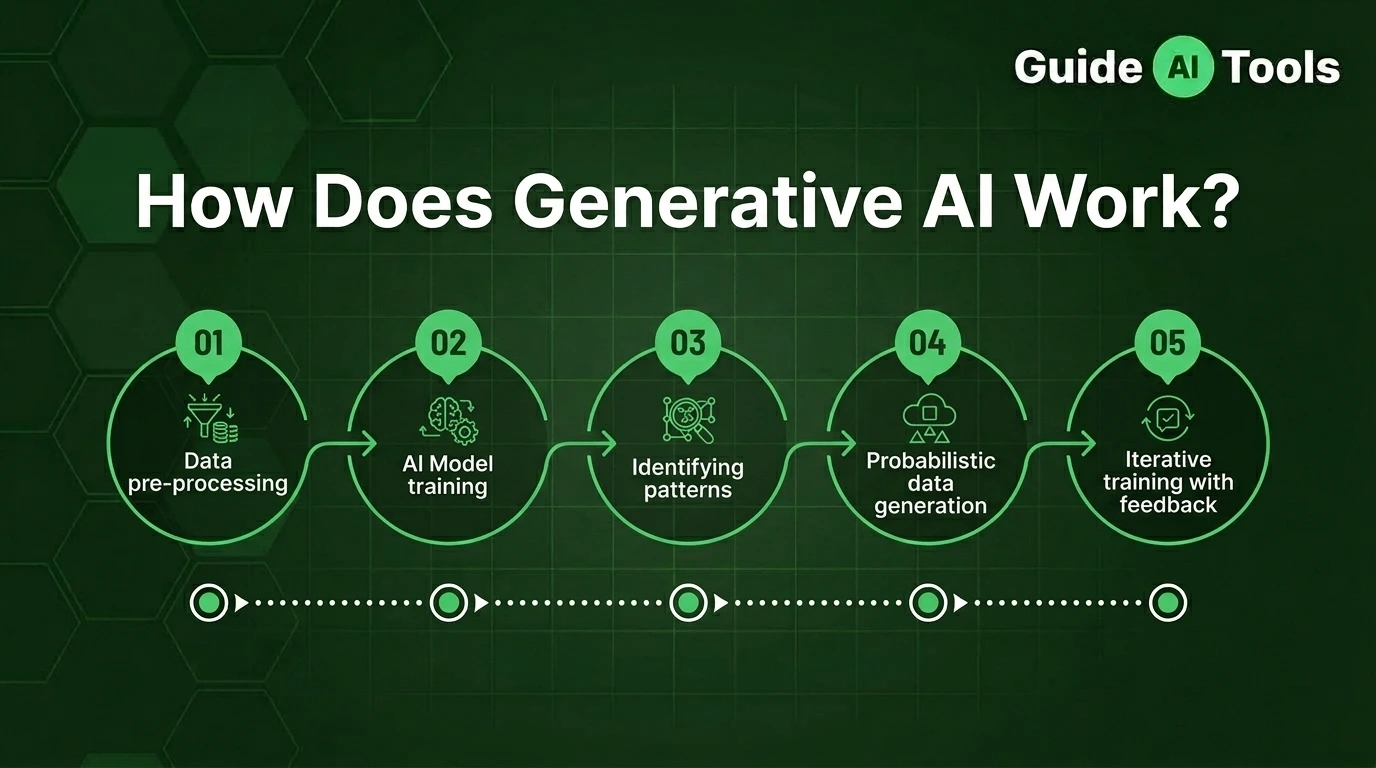
Generative AI does not think, dream, or pull pre-made answers from a hidden database. It operates like an infinitely sophisticated autocomplete engine, calculating the exact mathematical probability of which word, pixel patch, or audio wave should come next.
Understanding that probability engine is the secret to getting predictable results from AI.
In my testing with large foundation models, I’ve noticed that engineers and business teams waste hours trying to prompt models because they treat them like conscious search engines. The reality is much simpler. It all comes down to math, vectors, and statistical sampling.
How Does Generative AI Work? The Short Answer
Generative AI works by mapping input prompts into multi-dimensional mathematical vector space, analyzing statistical patterns learned during pretraining, and sampling probability distributions to generate new, original sequences of text tokens, image pixels, audio waves, or code.
That process does not rely on copy-pasting existing files. Instead, the model constructs brand new outputs by picking the most likely next elements based on its training.
To understand how these generative engines fit into the wider world of artificial intelligence, read our guide on what is generative ai for clear context.
Every single output generation begins with an input sequence. The network converts that input into numbers, passes those numbers through stacked neural layers, and estimates output probabilities.
If you want to review basic model training mechanics first, check out our breakdown on how does ai work to see how inputs turn into predictions.
Generative models synthesize original outputs by continually sampling learned probability distributions across high-dimensional vector spaces.
Discriminative vs Generative AI: The Fundamental Shift
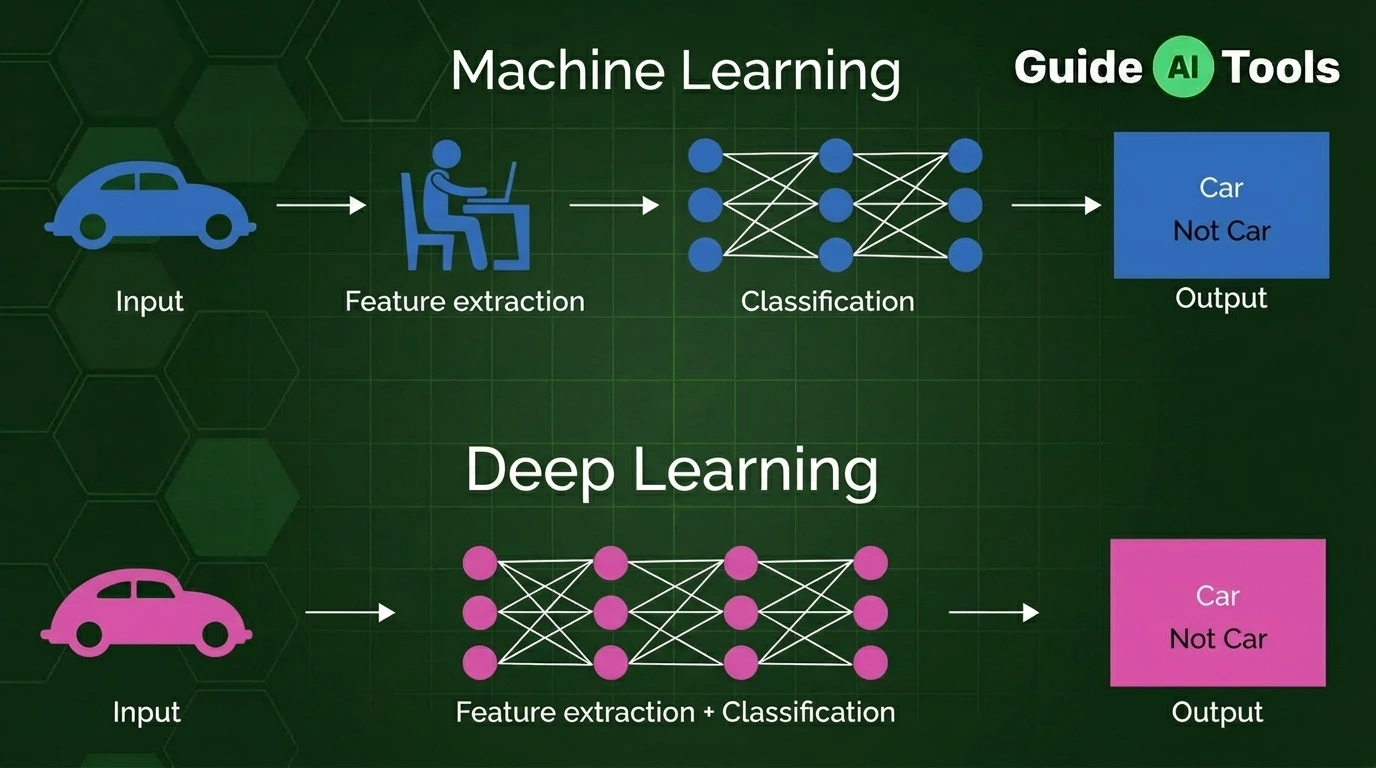
Traditional machine learning focused on classification. You gave a model an image of a dog, and it told you whether the image contained a dog or a cat.
That is discriminative AI in action. It draws mathematical boundaries between existing categories to label incoming data correctly.
Generative AI flips that equation completely upside down.
Instead of predicting a simple label for a complex input, a generative model takes a simple prompt and builds a complex output from scratch. It studies the underlying distribution of training data so it can sample new items that look like they belong in that original dataset.
From what I have seen in production environments, conflating these two paradigms leads to bad architectural decisions. Discriminative systems excel at fast filtering, while generative systems handle creative synthesis.
| Feature | Discriminative AI (Traditional) | Generative AI (Modern) |
| Primary Goal | Classify data or predict labels | Generate new, original content samples |
| Mathematical Objective | Calculate conditional probability $P(Y \vert X)$ | Calculate joint probability $P(X, Y)$ or $P(X)$ |
| Input to Output | Complex input to simple label | Simple prompt to complex output sample |
| Primary Risk | Classification error | Hallucinations, mode collapse, bias |
| Common Architectures | Decision trees, CNNs, SVMs | Transformers, Diffusion, GANs, VAEs |
Discriminative models draw boundary lines while generative models sample probability distributions to construct new data.
The Three-Stage Training Pipeline
Building a modern generative model takes massive compute power, months of processing time, and a careful three-stage pipeline.
Look at how raw web data transforms into a polite conversational assistant. You cannot just feed raw internet text into a neural network and expect a helpful agent right away.
Stage 1: Unsupervised Pretraining.
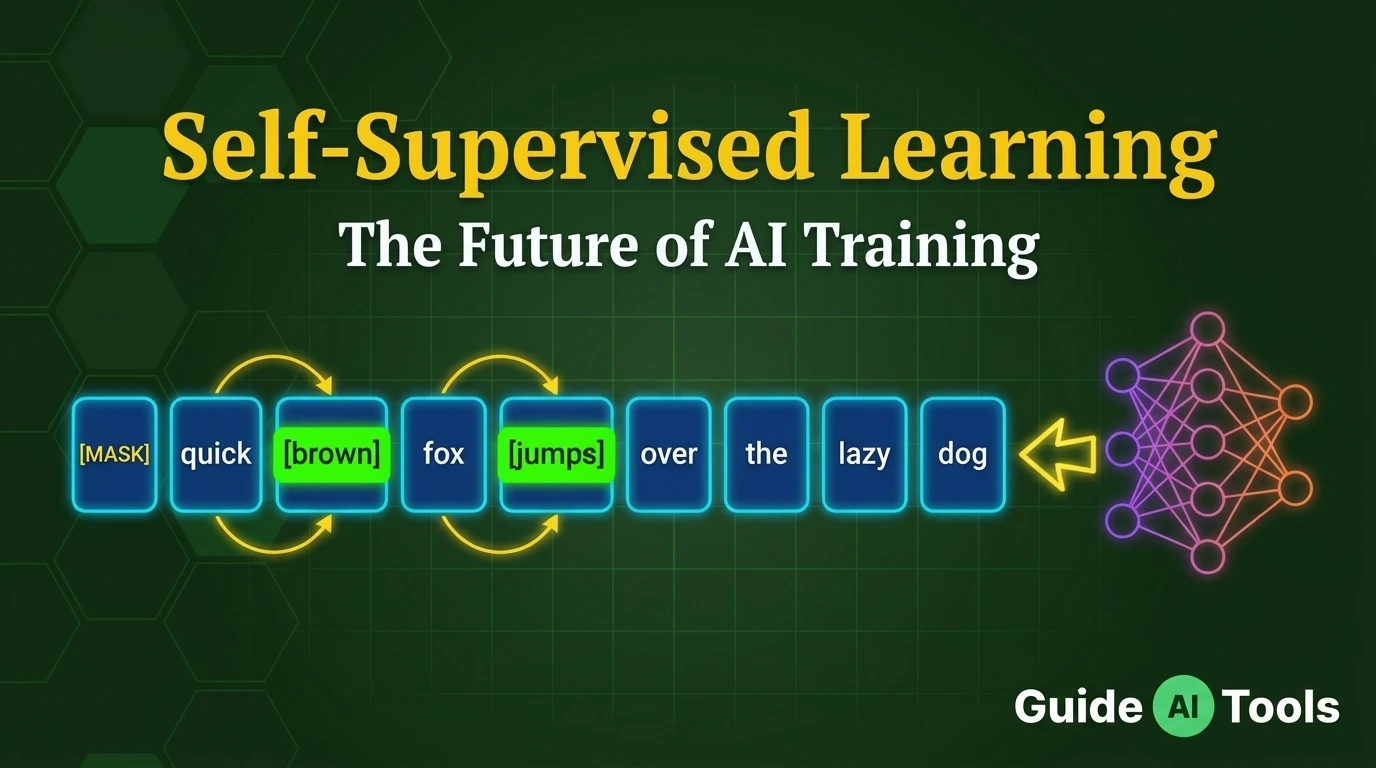
The base model processes hundreds of terabytes of unstructured text, code, or images. It learns grammar, factual facts, visual relationships, and world logic by trying to predict masked words or missing image pixels.
To explore how models learn from unlabeled raw data without human taggers, read our guide on what is self-supervised learning on GuideAITools.
Stage 2: Supervised Fine-Tuning (SFT).
Raw pretrained models are chaotic text completion engines. If you ask a raw model “How do I fix a leaky faucet?”, it might respond by generating ten more faucet questions because it thinks it is completing an online forum thread.
Supervised fine-tuning fixes this behavior. Human annotators write thousands of clean prompt-and-response pairs, teaching the model how to act like a helpful assistant that answers questions directly.
According to Stanford Institute for Human-Centered Artificial Intelligence research on foundation models, this instruction tuning phase aligns base neural networks with specific human tasks.
Stage 3: Human Alignment with RLHF and DPO.
Even after fine-tuning, models can produce rude, unsafe, or rambling answers.
Reinforcement Learning from Human Feedback (RLHF) uses a second preference model to rate multiple model outputs. The main model gets mathematical rewards when it produces helpful, accurate responses and penalties when it strays.
Direct Preference Optimization (DPO) achieves similar alignment without needing a separate reward model, updating neural weights directly from human preference pairs.
Human alignment converts raw text completion engines into safe conversational assistants through structured feedback loops.
How Text Generation Works: Transformers and Next-Token Prediction
Text generation algorithms do not write full sentences at once. They generate content one token at a time.
A token is a piece of a word. In English text, one token averages roughly four characters or three-quarters of a word.
The process starts with tokenization. The system breaks your input text prompt into a list of numerical token identification numbers.
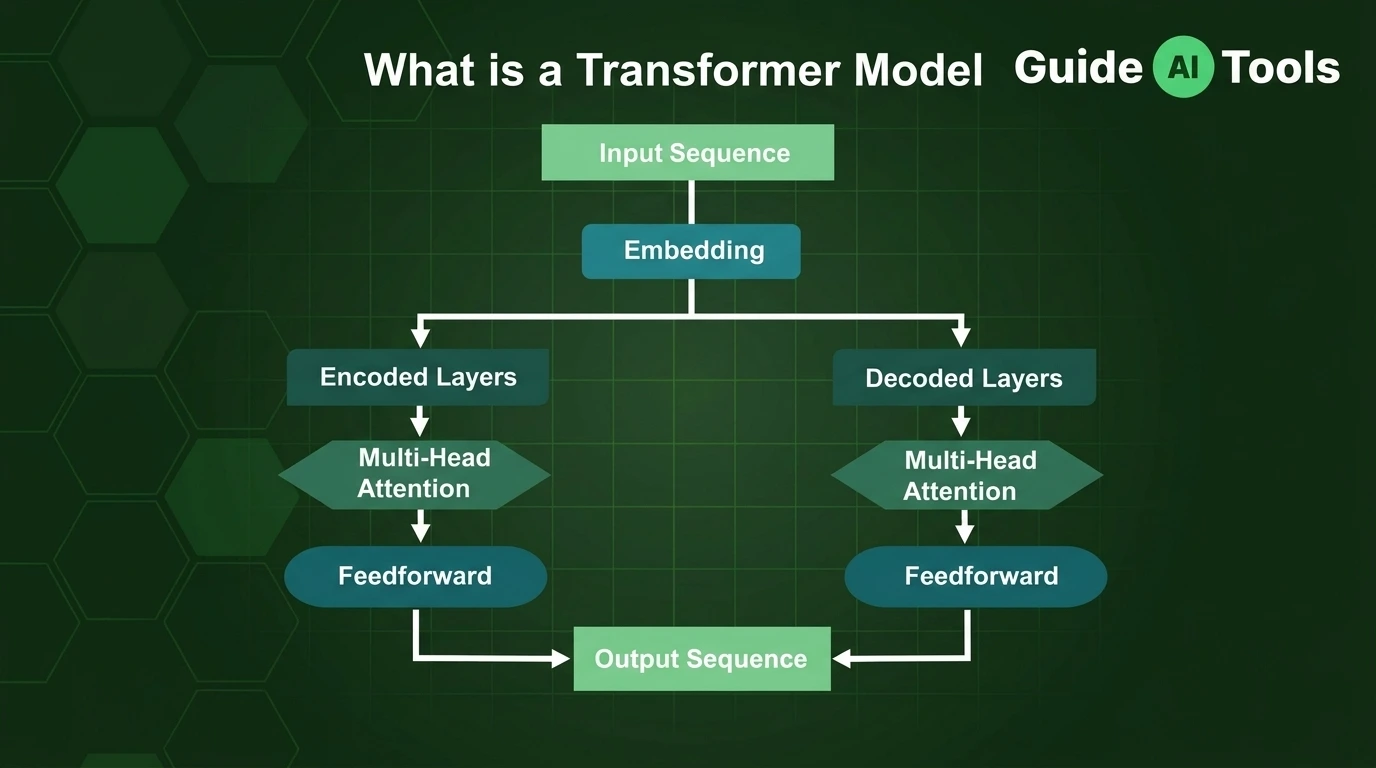
Next, those token IDs enter a transformer neural network architecture.
Transformers rely on a self-attention mechanism. As tokens pass through the network, self-attention calculates strength scores between every word and every other word in the context window.
When processing the word “bank” in a sentence, self-attention checks surrounding words like “river” or “deposit” to figure out the exact meaning.
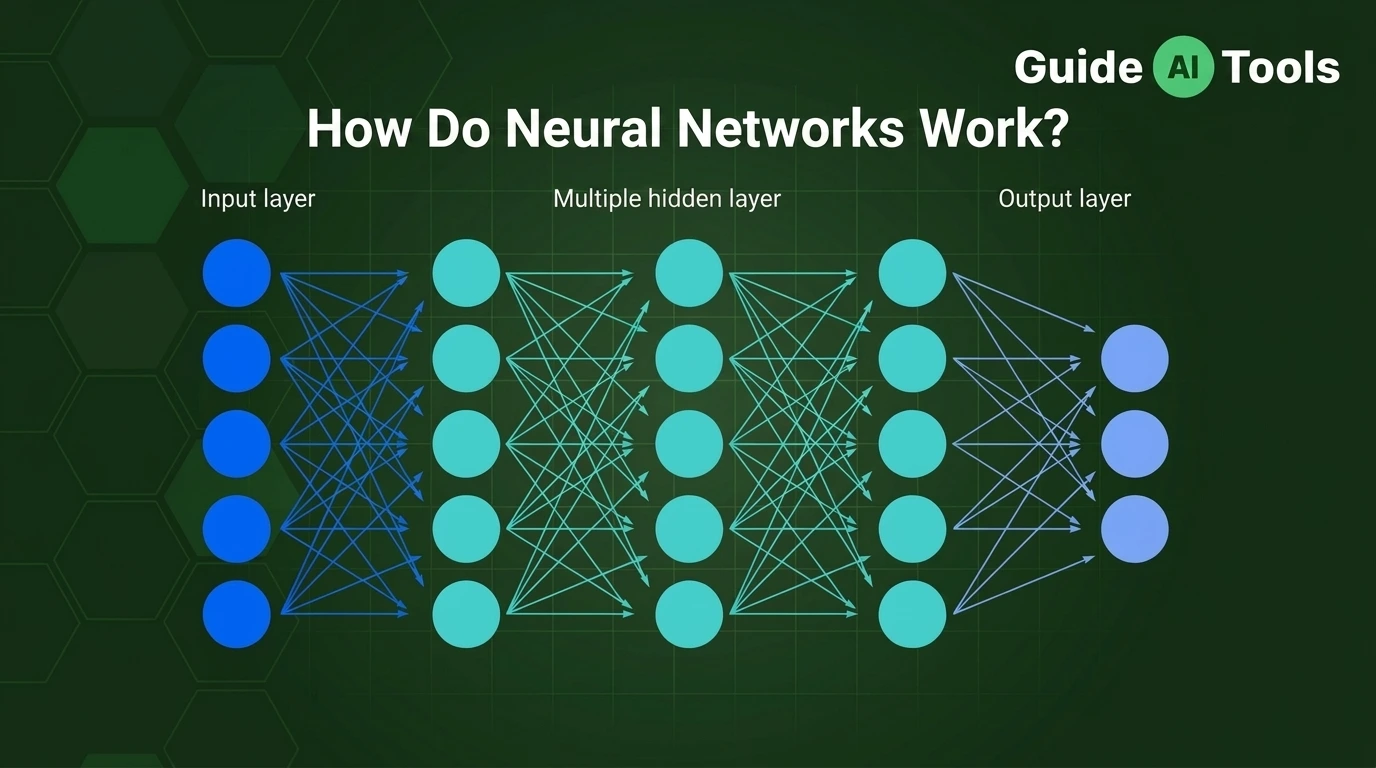
To see how stacked node layers process those mathematical signals step by step, check out our guide on how do neural networks work for deep technical details.
Once the network evaluates token relationships across all hidden layers, it generates a list of raw probability scores called logits for every possible token in its vocabulary.
Then comes probability sampling. The model uses three key control knobs to select the winning token.
- Temperature controls randomness. Lower values make outputs deterministic and conservative, while higher values force creative, unpredictable token choices.
- Top-k sampling limits candidate choices to the top k most probable tokens in the vocabulary list.
- Top-p (nucleus) sampling selects tokens from a dynamic pool whose combined probability hits a specific threshold like 0.90.
- Output appending adds the winning token to the prompt, and the entire cycle repeats to generate the subsequent word piece.
If you want to read more about how large transformer models handle massive context windows, review our guide on what are large language models to examine model scaling.
Self-attention mechanisms allow transformers to track contextual relationships across thousands of tokens during generation.
How Image Generation Works: Diffusion Models and Latent Space
Image generation engines like Midjourney, Stable Diffusion, and DALL-E do not build images line by line like an inkjet printer.
They use a process called diffusion.
Imagine starting with a crisp photograph of a mountain. During training, forward diffusion adds microscopic layers of random Gaussian noise over hundreds of steps until the photograph becomes pure television static.
The AI model learns how to reverse that process.
Reverse diffusion trains a neural network to examine a noisy image, predict how much noise was added at that specific step, and subtract it.
Running reverse diffusion on a full 1024×1024 pixel image takes immense compute power. Modern systems solve this by using latent diffusion.
Instead of working on raw pixels, a variational autoencoder compresses the image into a smaller mathematical representation inside latent space. The diffusion network cleans up noise inside that compressed space before a decoder converts the final result back into sharp pixels.
| Generation Stage | Text Models (Transformers) | Image Models (Latent Diffusion) |
| Input Processing | Text prompt to token numerical IDs | Text prompt to CLIP vector embeddings |
| Core Mechanism | Self-attention word-relationship scoring | Reverse denoising across latent vector space |
| Sampling Control | Temperature and Top-P probability rules | Guidance scale (CFG) and denoising steps |
| Final Synthesis | Decoded token string output | Decoded latent vector to high-res pixel array |
Latent diffusion generates high-resolution artwork by iteratively removing predicted noise inside compressed vector space.
What Is Latent Space and Why Does It Matter?
Latent space is a multi-dimensional coordinate system where artificial intelligence models map semantic concepts as vector numbers.
Think of it as a spatial map where similar ideas sit close together.
In a language model’s latent space, the vector for “dog” sits near “puppy” and “canine.” The vector for “cat” sits near “kitten” and “feline.”
This mathematical structure makes conceptual arithmetic possible.
If you take the vector coordinate for “king,” subtract the vector for “man,” and add the vector for “woman,” the resulting coordinate lands directly next to “queen.”
Generative AI uses latent space coordinates to merge concepts smoothly. When you ask an image generator for a “cat wearing an astronaut suit on Mars,” the model finds the coordinates for cats, space suits, and Martian terrain.
It navigates to the overlapping vector intersection and decodes those coordinates into brand new pixels.
Navigating latent space allows generative algorithms to combine distinct concepts smoothly without copying source materials.
Why Generative AI Fails: Hallucinations and Trade-Offs
Generative AI is not flawless. Its greatest strength-predicting probable patterns-is also its primary point of failure.
Hallucinations happen because models optimize for plausible language rather than factual truth. If a model lacks exact information about a niche topic, its probability engine fills gaps with words that sound right grammatically but are completely false.
Honestly, most teams mess this up by relying on generative LLMs for accurate database retrieval. They are generators, not search indices.
Compute limits create another major headache. Running real-time inference on 70-billion-parameter models requires specialized GPU clusters with massive memory bandwidth.
Context windows also suffer from attention degradation. As context windows grow to millions of tokens, models begin to miss facts buried in the middle of long prompts, a phenomenon engineers call “lost in the middle.”
- High vulnerability to confident hallucinations when training data lacks clear answers.
- Heavy hardware dependence on expensive GPU hardware for inference latency.
- Attention degradation across ultra-long prompt inputs.
- Vulnerability to adversarial prompt injection attacks that bypass safety guardrails.
Hallucinations are an inherent side effect of statistical probability engines that prioritize plausible language over strict truth.
FAQs
How does generative AI work step by step?
Generative AI works by converting prompts into numerical vectors, analyzing learned patterns through neural network layers, and sampling probability distributions to produce new text, image, or audio outputs.
What is the difference between generative AI and traditional AI?
Traditional AI classifies existing data or predicts simple labels, while generative AI synthesizes entirely new, original content samples based on learned probability distributions.
How do diffusion models generate images from text?
Diffusion models convert text prompts into vector guideposts, start with pure random static noise, and iteratively remove predicted noise until a clear image emerges.
What is latent space in generative AI?
Latent space is a multi-dimensional vector space where neural networks map semantic concepts as mathematical coordinates, allowing algorithms to combine features logically.
How does ChatGPT predict the next word?
ChatGPT converts text into tokens, uses self-attention mechanisms to calculate word relationships across the prompt, and selects the next token using probability sampling rules like temperature and top-p.
What is RLHF in generative AI training?
Reinforcement Learning from Human Feedback is an alignment technique where human preference scores train a reward model to adjust the main model’s weights toward safer and more helpful outputs.
Why do generative AI models hallucinate?
Generative AI models hallucinate because they are trained to predict plausible word sequences based on statistical likelihood rather than verifying factual accuracy against an external database.
What role do transformers play in generative AI?
Transformers serve as the core neural network architecture for language models, using self-attention mechanisms to process long text sequences and track complex context across tokens.
Mastering Generative AI for Better Workflows
Generative AI relies on probability math, self-attention, and high-dimensional vector spaces. Moving beyond basic search to creative synthesis requires understanding how these models handle inputs under the hood.
If you want to build better workflows or prompt models effectively, mastering the underlying mechanics gives you a massive advantage.
To write better prompts that guide vector generation, check out our guide on what is prompt engineering for clear strategies.
Explore our full directory at GuideAITools to compare top generative AI frameworks, text tools, and image generators. Compare features, test model capabilities, and build your ideal software stack today.

Related Blog Posts