What Is Generative AI?
Generative AI is a type of artificial intelligence that creates new content from patterns learned during training. It can produce text, images, audio, video, code and other digital content from prompts or other inputs. ChatGPT, image generators and AI music tools are all familiar examples of generative AI in practice.
The word “generative” is the key.
Traditional AI might tell you whether an email looks like spam. Generative AI can write the email.
That sounds like a small difference. It isn’t.
The two systems can use related machine learning techniques, but their jobs can be very different.
What does generative AI actually mean?
Generative AI, often shortened to GenAI, refers to AI systems designed to generate new content from learned patterns.
Give the system a prompt, request, image or another input. It processes that information through a trained model and produces an output.
That output could be a paragraph, a picture, a song, a video clip or a piece of software code.
For example, you could ask a generative AI tool:
“Write a short product description for a waterproof travel backpack.”
The system doesn’t look for one finished description and simply paste it back. A generative model uses patterns learned during training to produce a new response that fits your request.
That’s what makes the technology different from many older AI applications.
Stanford HAI describes generative AI as systems capable of creating content such as text, images, music, code and video.
How is generative AI different from traditional AI?
The easiest way to understand the difference is to look at the job each system is being asked to perform.
| Traditional or predictive AI | Generative AI |
|---|---|
| Classifies information | Creates new content |
| Predicts an outcome | Produces an output |
| Detects spam | Writes an email |
| Identifies objects in an image | Creates an image |
| Predicts customer churn | Writes a customer retention message |
| Detects fraud patterns | Generates an investigation summary |
| Recommends an item | Creates product descriptions |
A fraud detection model, for example, might estimate whether a transaction looks suspicious.
A generative AI system could take that information and produce a written explanation for a compliance team.
But don’t take the table too literally.
Generative models still rely heavily on prediction internally. A language model generates text by repeatedly selecting likely next tokens based on the context it has received. IBM makes this distinction between generative and predictive AI while explaining that generative systems use learned patterns to produce new content.
So the useful distinction is the kind of output the system is designed to produce, not the idea that one type predicts and the other never does.
What can generative AI create?
This is where the subject gets much bigger than chatbots.
Generative AI can work across several types of content, depending on the model and application.
| Content type | What generative AI can produce |
|---|---|
| Text | Articles, emails, summaries, stories and answers |
| Images | Illustrations, product visuals and concept art |
| Audio | Speech, sound effects and music |
| Video | Scenes, clips, animation and edited footage |
| Code | Functions, scripts and application code |
| 3D content | Objects, assets and environments |
| Synthetic data | Artificial datasets for testing and research |
| Scientific outputs | Molecules, simulations and research concepts |
This is why calling generative AI a “writing technology” misses a large part of the picture.
A text model and an image model may work differently, but both belong to the broader generative AI category because they can produce new outputs.
AWS also describes generative AI across conversations, stories, images, videos and music, while Stanford includes text, images, music, code and video in its current definition.
How does generative AI create new content?
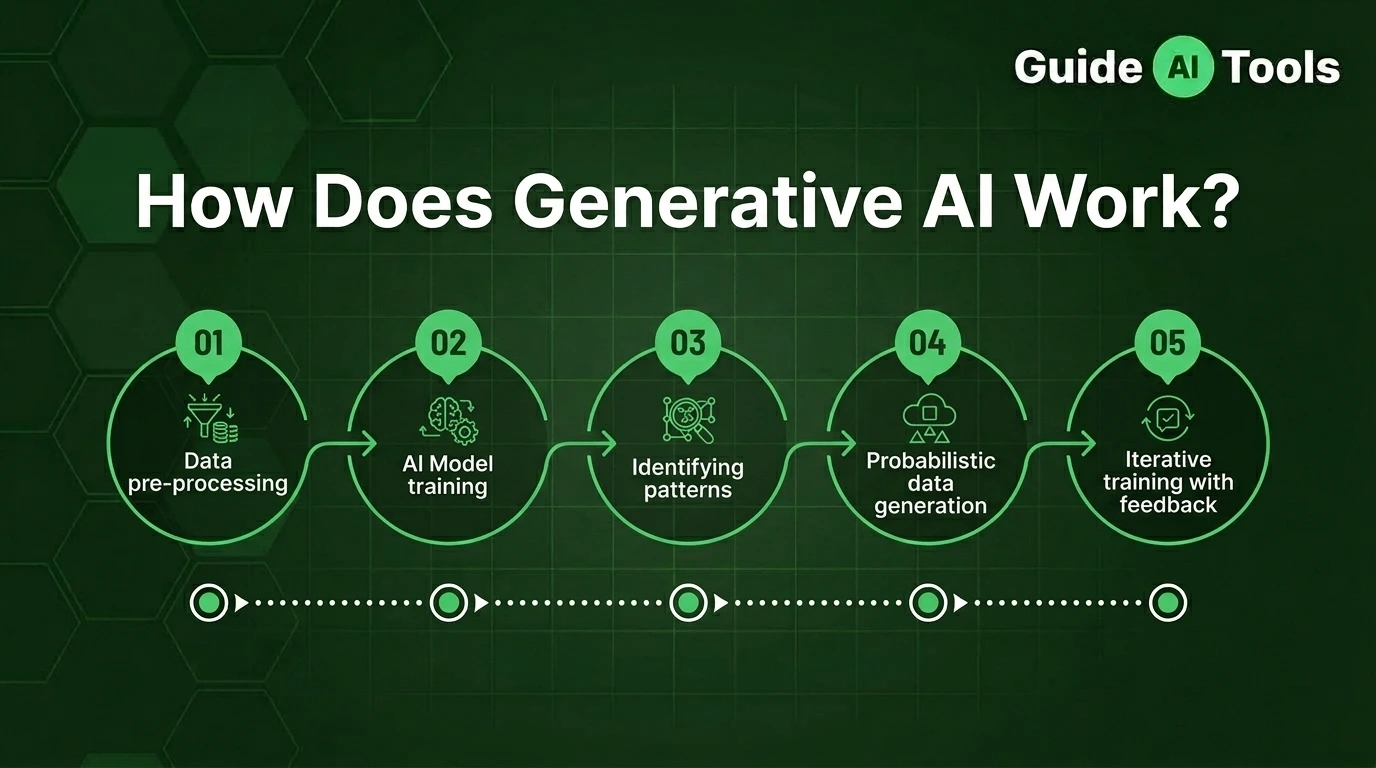
At a high level, the process looks like this:
Training data
↓
Pattern learning
↓
Trained model
↓
Prompt or input
↓
Generated output
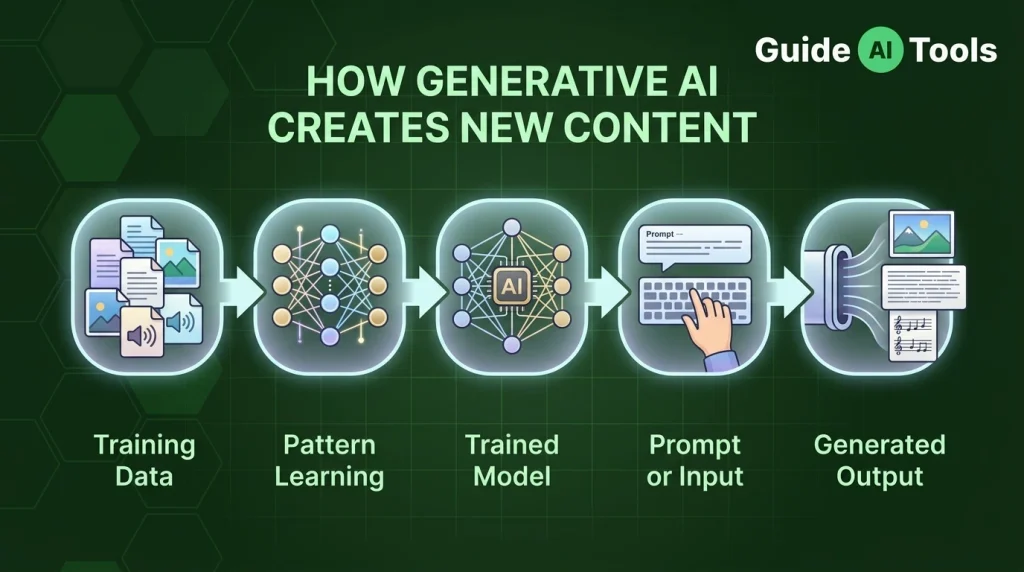
During training, a model processes large amounts of data and learns relationships and patterns within that material.
A language model might learn relationships between words, phrases and larger pieces of context.
An image model can learn visual relationships.
An audio model can learn characteristics of speech, music or sound.
When you provide a prompt later, the trained model uses what it learned to generate an output that fits the request.
This is the simple version.
The actual process can involve large neural networks, parameters, training objectives, fine-tuning, inference and other technical steps. Those details deserve their own explanation rather than being squeezed into a basic definition.
If you want the technical version, see our guide to how AI works.
What models power generative AI?
Generative AI isn’t one model or one architecture.
Several model families have played major roles in the technology.
Large language models
Large language models, or LLMs, are designed primarily around language.
They can generate text, answer questions, summarize documents, translate content and assist with programming.
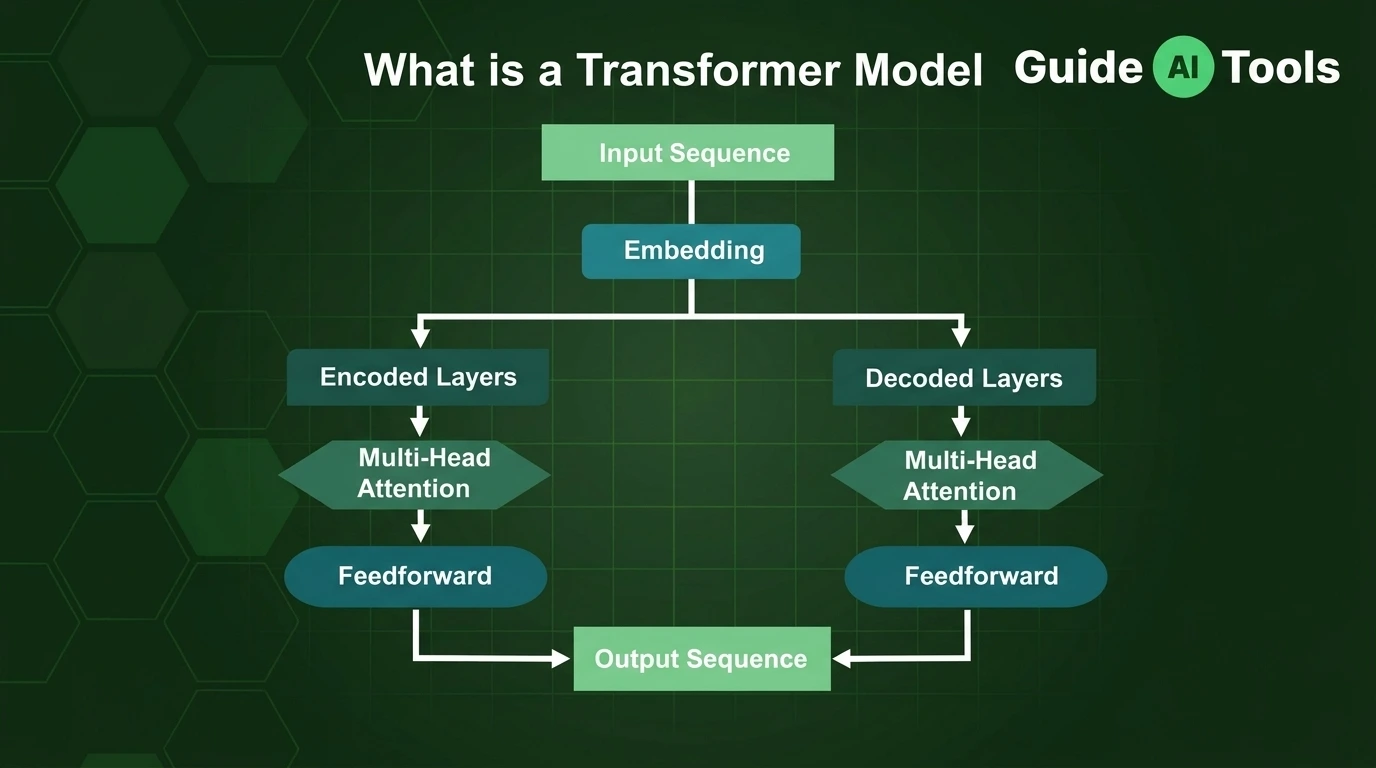
GPT models are a well-known example of transformer-based language models. Stanford describes GPT as a family of large language models based on the transformer architecture.
Diffusion models
Diffusion models are widely used for image generation and also appear in other generative applications.
A simplified explanation is that the model learns how to remove noise step by step until it can produce a meaningful result.
That process helps explain why image generation can start with what looks like random visual noise and gradually form a recognizable image.
GANs
Generative adversarial networks, or GANs, use two neural networks called a generator and discriminator.
The generator creates synthetic data.
The discriminator evaluates it.
The two systems work against each other during training, helping the generator improve its ability to create realistic outputs. Stanford includes GANs among the major architectures associated with generative AI.
Foundation models
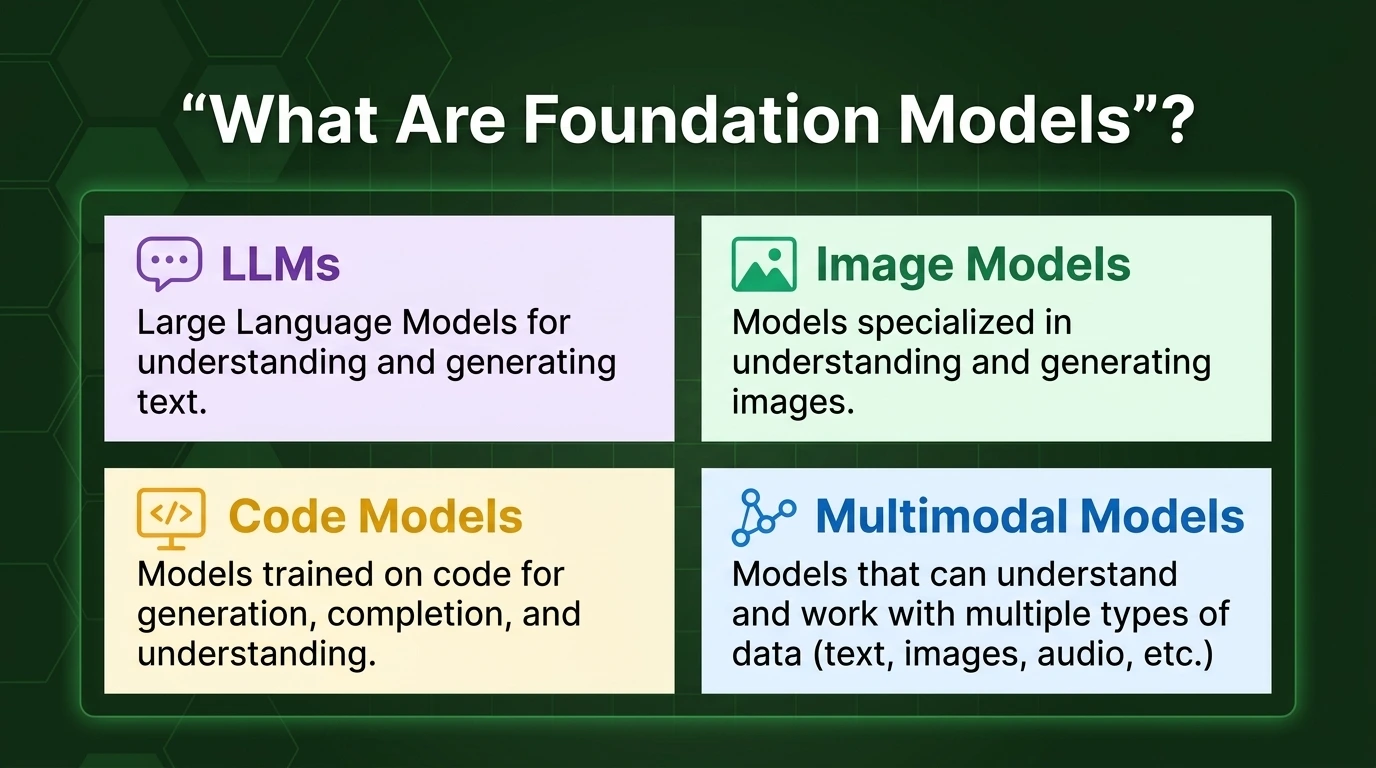
Foundation models are large models trained on broad datasets that can later be adapted for different tasks.
They can serve as a base for many applications rather than being built from scratch for one narrow job. IBM describes foundation models as broad models that can be adapted for many downstream tasks.
This is one reason modern AI products can be built much faster than older task-specific systems.
What is a foundation model?
A foundation model is a broadly trained AI model that can serve as the starting point for multiple applications.
Think of it as a general-purpose base rather than a finished product.
A company might take a foundation model and adapt it for customer support, document analysis, coding, image generation or another specific task.
Foundation models can work across different modalities too. Some focus on text, while others work with images, audio, video or combinations of these.
The important distinction is that a foundation model isn’t automatically the same thing as a consumer AI application.
A model is the underlying technology.
An application is what the user interacts with.
That difference becomes much clearer when you look at tools such as ChatGPT.
Is ChatGPT generative AI?
Yes. ChatGPT is an example of a generative AI application.
You provide a prompt, and the system generates a response based on the capabilities of the underlying models.
But ChatGPT isn’t the definition of generative AI.
That’s an easy mistake to make because ChatGPT became one of the most visible examples of the technology after its public launch in 2022.
Generative AI existed before ChatGPT. Earlier research produced generative models for images, text, music and other types of data.
ChatGPT helped make the technology accessible to a much larger audience.
IBM notes that the arrival of ChatGPT in 2022 played a major role in pushing generative AI into mainstream attention, while the underlying machine learning research goes back much further.
What are some real examples of generative AI?
You probably use generative AI more often than you realize.
ChatGPT and Gemini can generate text and other types of responses.
Image generators can create artwork, product concepts, illustrations and visual variations from prompts.
Music generators can produce songs or instrumental tracks.
AI video tools can create short scenes, animations and other video content.
Coding assistants can generate functions, explain code and suggest changes.
The common thread is simple.
The system produces something new based on an input.
For GuideAITools, this distinction also helps explain why AI writing, image, audio, video and coding tools can sit in different categories while still belonging to the wider generative AI space.
You can explore related tools through our AI tools directory.
Where is generative AI used?
Generative AI is now used across creative work, software development, research and everyday business tasks.
A marketing team might use it to create campaign concepts and first drafts.
A developer might use it to explain unfamiliar code or generate a starting point for a function.
A designer might generate several visual concepts before choosing one direction.
A teacher might create practice questions or adapt material for different learning levels.
A researcher might use AI to summarize large amounts of material or explore possible research directions.
A customer support team might generate draft responses based on a company’s existing knowledge.
The important part is the workflow.
Generative AI often works best as a starting point or assistant rather than an unquestioned final authority.
What are the benefits of generative AI?
The biggest practical benefit is that it reduces the time between an idea and a usable first draft.
You can start with a rough prompt instead of a blank page.
That can help with:
- brainstorming ideas
- creating first drafts
- summarizing information
- generating code
- creating design concepts
- producing content variations
- personalizing material
- building prototypes
The quality of the result still depends on the model, the input, the task and the amount of human review.
A poor prompt can produce a poor result.
A confident-looking answer can still be wrong.
That second point matters more than it sounds.
What are the limitations and risks of generative AI?
Generative AI can produce impressive results, but it doesn’t automatically produce correct results.
One major issue is hallucination, where a system generates information that sounds convincing but is inaccurate or unsupported.
Bias is another concern.
Models learn from data, and that data can contain biases or gaps that influence generated outputs.
Privacy also matters. Sensitive information entered into an AI system can create risks depending on how the service handles, stores or processes that information.
Then there are copyright and ownership questions.
The legal treatment of AI-generated material can vary by jurisdiction and situation, so a simple “AI content is copyrighted” or “AI content is not copyrighted” statement can be misleading.
Synthetic media creates another concern.
Generative tools can produce realistic images, voices and videos that may be used to mislead people.
Microsoft’s current beginner guidance specifically tells users to verify AI-generated content before using or sharing it.
So the sensible approach is not to reject generated content automatically.
Check it.
Edit it.
Verify important claims.
And keep a human involved when the consequences matter.
Is generative AI the same as AI?
No. Generative AI is a part of the broader AI field.
Artificial intelligence covers a much wider range of systems and techniques.
Some AI systems classify information.
Some detect patterns.
Some predict outcomes.
Some recommend actions.
Generative AI focuses on producing new content.
A simple way to picture the relationship is:
Artificial Intelligence
↓
Machine Learning
↓
Deep Learning
↓
Generative AI
But this diagram is a simplified teaching model, not a strict technical ladder.
The categories overlap, and not every deep learning system is generative.
For a broader foundation, read What Is Artificial Intelligence?.
Is generative AI the same as machine learning?
No.
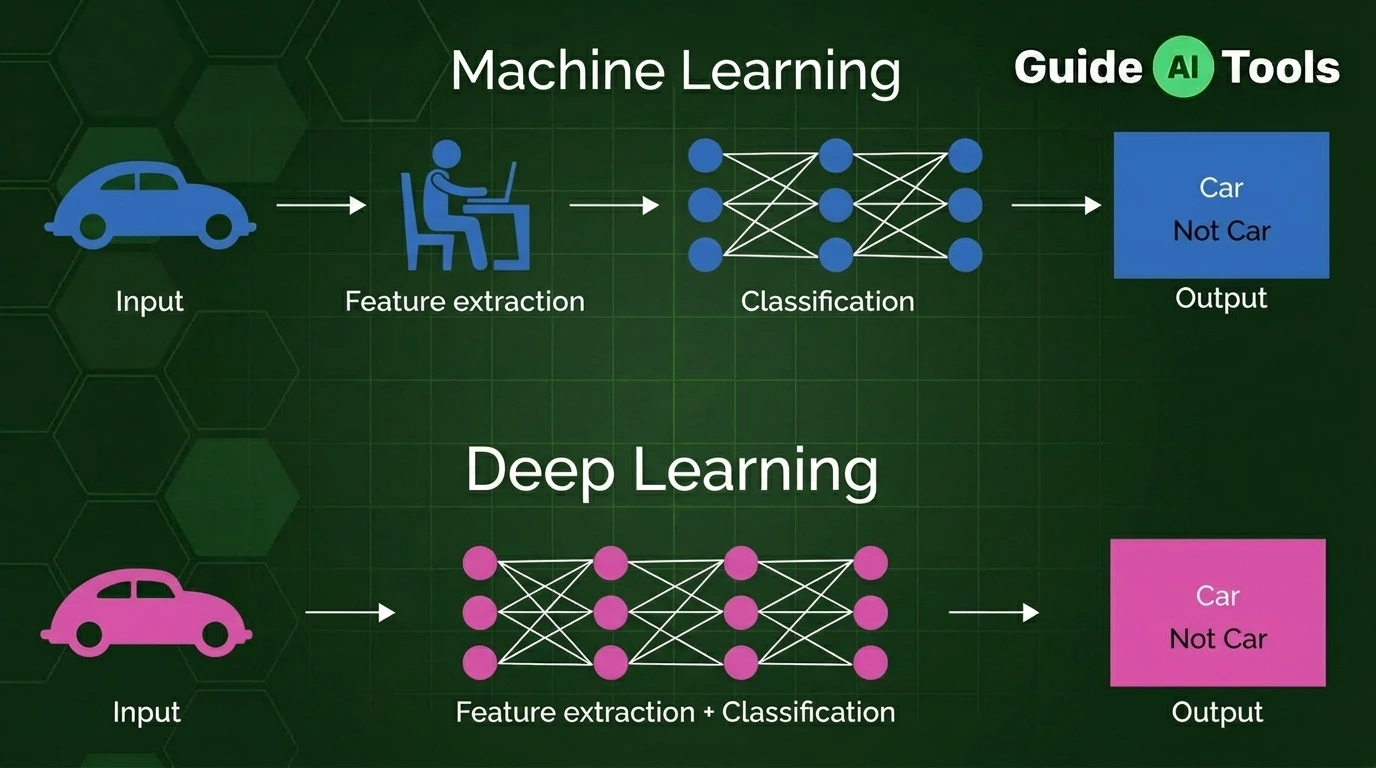
Machine learning is a broader approach in which models learn patterns from data.
Generative AI describes systems designed to create new content.
Modern generative AI commonly relies on machine learning and deep learning, but machine learning has many uses that aren’t generative.
For example, a machine learning model could predict whether a transaction is fraudulent without generating an article, image or piece of audio.
If you want the foundation first, our guide to What Is Machine Learning? explains the broader concept.
Why did generative AI become so popular?
Generative AI didn’t suddenly appear when ChatGPT launched.
Researchers had already been working on generative models for years.
GANs, VAEs, transformer architectures and other approaches helped establish important pieces of the technology.
The major shift came when several things started working together:
More data. More computing power. Larger models. Better training methods. Easier interfaces.
Foundation models also changed how developers could build AI applications.
Instead of training every model from zero, developers can start with an existing broadly trained model and adapt it for a particular task.
That lowered the barrier for creating new AI products.
IBM describes modern generative AI as building on deep learning, foundation models and architectures such as transformers, while Stanford traces the current wave to foundation models trained at scale.
Is generative AI going to replace traditional AI?
Not really.
The two approaches solve different kinds of problems.
A bank may still need predictive models for fraud detection.
A retailer may still need recommendation systems.
A healthcare system may still use models for classification and risk assessment.
Generative AI can sit alongside those systems.
For example, a fraud model might identify a suspicious transaction, while a generative system creates a plain-language explanation for an analyst.
That combination can be more useful than treating generative AI as a replacement for every other AI technique.
What does the future of generative AI look like?
The direction is moving beyond simple text prompts.
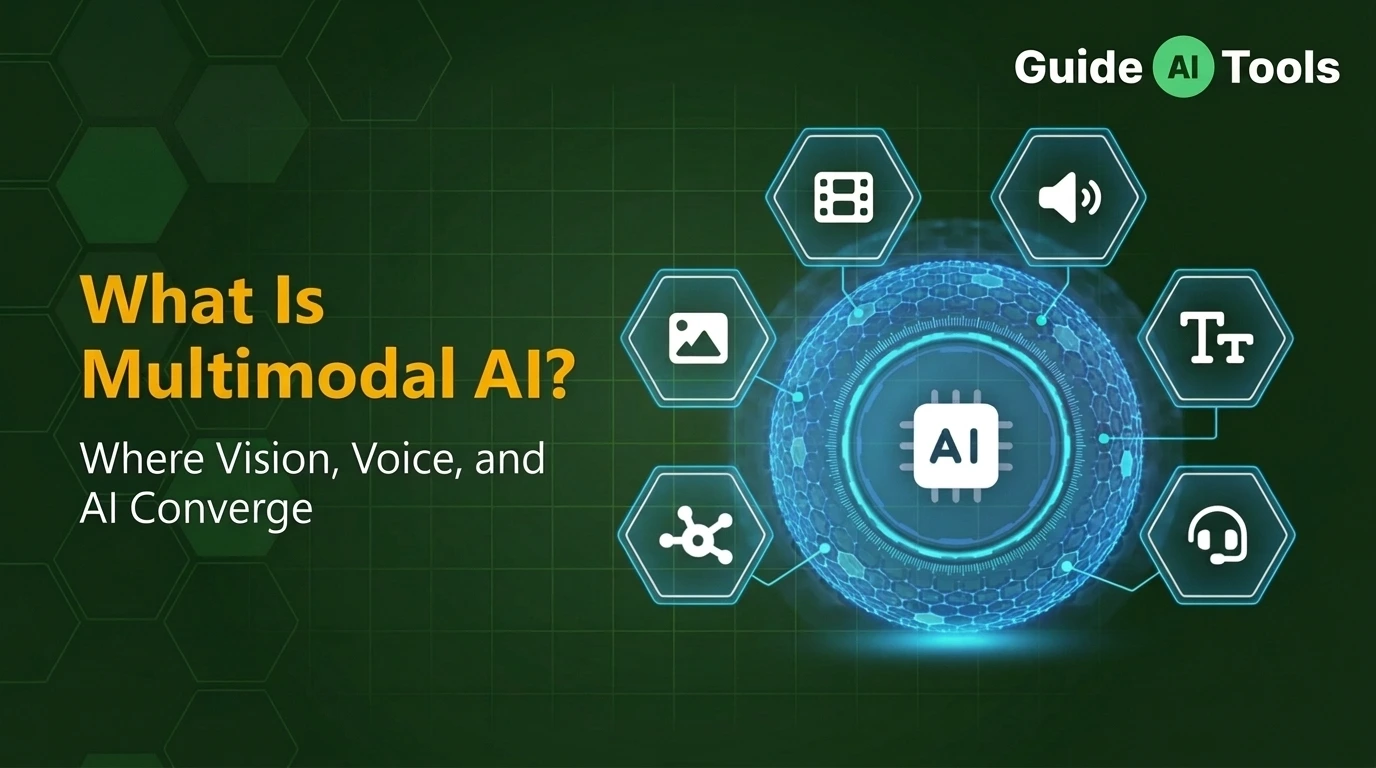
Multimodal systems can work with combinations of text, images, audio and video.
AI systems are also becoming more connected to tools, software and external information sources.
That creates a bridge toward AI agents, which can use models to reason about a task, interact with tools and take actions.
Generative AI will also continue to raise questions about privacy, copyright, safety, misinformation and how much human oversight is appropriate.
The technology will keep changing.
The basic idea won’t.
Give a capable model an input, and it can generate an output based on patterns learned from data.
For the deeper technical side, the next useful topics are What Are Large Language Models? and What Is a Neural Network?.
FAQs
What is generative AI in simple terms?
Generative AI is technology that can create new content such as text, images, audio, video or code from prompts and other inputs.
What does generative AI do?
It generates new outputs based on patterns learned during training. Depending on the model, those outputs can include written content, images, music, speech, video, code and other forms of digital content.
Is generative AI the same as AI?
No. Generative AI is a part of the broader artificial intelligence field. AI also includes systems designed for classification, prediction, recommendation, perception and other tasks.
Is generative AI machine learning?
Generative AI commonly uses machine learning and deep learning, but the two terms aren’t interchangeable. Machine learning is a broader field that includes many systems that don’t generate content.
What are examples of generative AI?
ChatGPT, Gemini, image generators, AI music tools, AI video generators and coding assistants are common examples of generative AI applications.
What can generative AI create?
Depending on the model, generative AI can create text, images, audio, music, video, code, 3D assets and synthetic data.
How does generative AI learn?
Generative AI models learn patterns and relationships from large training datasets. During later use, the trained model applies those learned patterns to inputs such as prompts and generates an output.
What is a generative AI model?
A generative AI model is a machine learning model designed to generate new data or content based on learned patterns and an input.
Is ChatGPT generative AI?
Yes. ChatGPT is a generative AI application that generates responses from user prompts. It is one example of the broader generative AI category.
What are the risks of generative AI?
Common risks include inaccurate outputs, bias, privacy concerns, misinformation, deepfakes, security misuse and copyright questions.
Is generative AI safe?
It can be used safely in many situations, but safety depends on the model, application, data, safeguards and human oversight. Important information should be checked rather than accepted blindly.
What is the difference between generative AI and traditional AI?
Generative AI is designed to create new content, while many traditional AI systems focus on tasks such as classification, prediction, recommendation or detection. The distinction isn’t absolute because generative systems also use prediction internally.
Final thoughts
Generative AI is easier to understand once you stop treating it as a synonym for artificial intelligence.
It’s one part of a much bigger field.
The simplest definition is also the most useful: generative AI creates new content from patterns learned during training and information supplied through an input or prompt.
That single idea covers the text generated by an LLM, an image created from a description, a song generated from a short prompt and code produced by an AI coding assistant.
The technology behind those systems can get extremely technical.
You don’t need all of that to understand the basic concept.
Start with the distinction between AI, machine learning, deep learning and generative AI. Then move deeper into foundation models, LLMs, transformers and multimodal AI as you need them.
That gives you a much cleaner mental model of how the pieces fit together.

Related Blog Posts