What Is Self-Supervised Learning? How AI Learns Without Human Labels
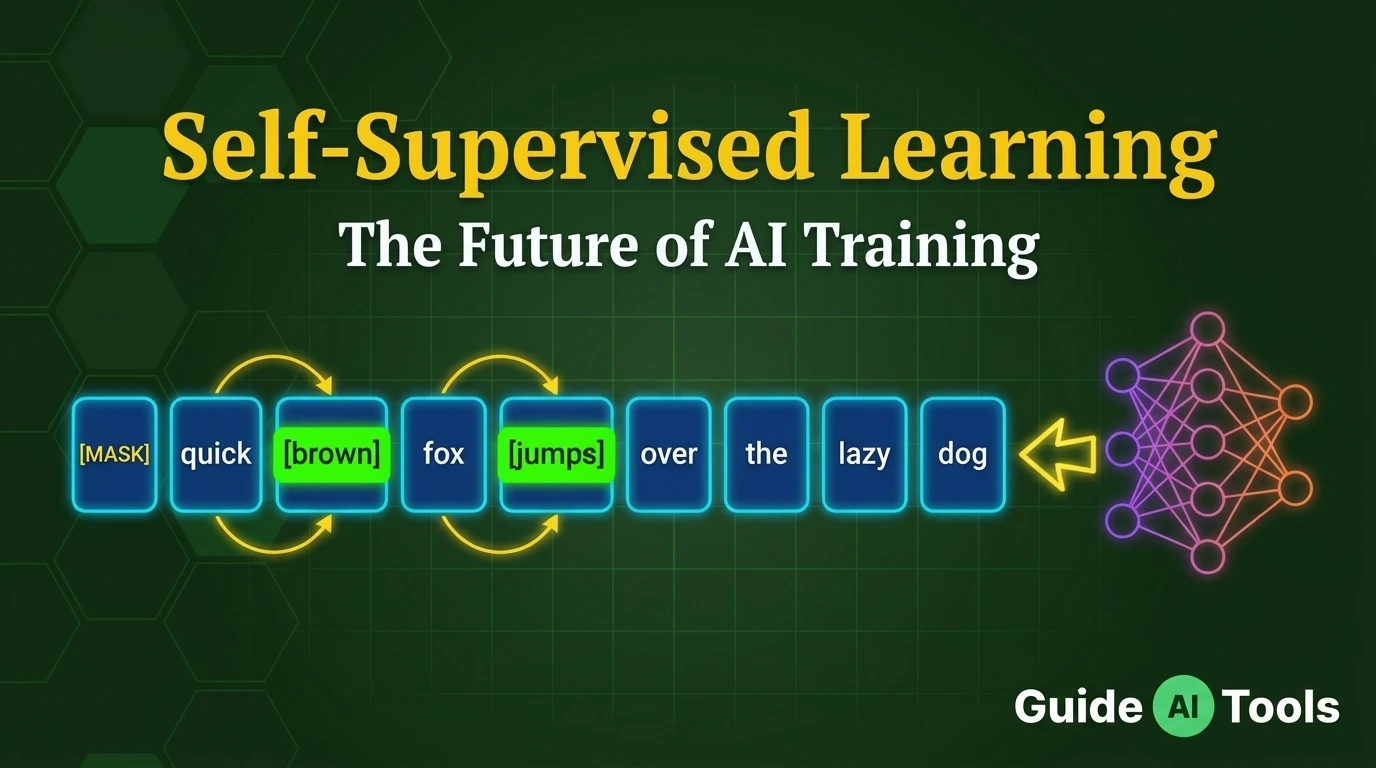
Self-supervised learning is a machine learning technique where an algorithm generates its own training labels directly from raw, unlabeled data. By withholding parts of the input and attempting to predict the missing pieces, the model learns rich structural patterns without human data annotation.
Look at how modern foundation models scale. If engineers had to manually tag every single training image or paragraph of text, progress would grind to a halt. The manual annotation bottleneck is real.
In my testing with machine learning architecture, I’ve noticed that self-supervised systems bypass this roadblock entirely. They turn raw data into a self-contained learning game.
The network hides a portion of the input from itself. It then tries to reconstruct those missing fragments based on surrounding context. Through this simple feedback loop, the model extracts deep semantic representations on its own.
According to Meta AI’s research on self-supervised learning, this paradigm represents the vast majority of machine intelligence growth. It forms the core foundation of modern generative AI systems.
Why Self-Supervised Learning Is Reshaping AI
Human data annotation does not scale. Paying thousands of human workers to draw bounding boxes around cars or label sentences with part-of-speech tags costs millions of dollars. It takes forever.
And text datasets on the public web contain trillions of words. You simply cannot label that volume by hand.
Self-supervised methods flip the entire workflow upside down. Instead of asking humans for ground-truth targets, the software turns the raw dataset into its own instructor.
From what I have seen in enterprise deployments, this approach slashes data preparation timelines from months down to hours. It unlocks web-scale training data that was previously unusable.
The system ingests raw text, uncurated images, or raw audio files directly. Self-supervised learning makes unlimited data scale economically viable for AI teams.
| Learning Method | Label Source | Human Annotation Cost | Data Scale Potential |
| Supervised Learning | Human annotators | High | Limited by human labor |
| Unsupervised Learning | None (finds clusters) | Zero | High volume, unstructured output |
| Self-Supervised Learning | Auto-generated from input structure | Zero | Unlimited web-scale data |
Honestly, most teams mess this up by thinking self-supervised learning is just a fancy name for unsupervised algorithms. It is not. Unsupervised methods look for statistical clusters without clear targets. Self-supervised methods construct explicit internal targets automatically.
How Does Self-Supervised Learning Work?
The mechanics rely on a clever two-stage pipeline. The entire process hinges on splitting the training workflow into two distinct phases.
First comes the pretext task. This is a synthetic objective created automatically from the raw data.
For example, the algorithm might take a sentence and blank out every fifth word. Or it might convert a color photograph into black-and-white. The model must predict the hidden words or reconstruct the original colors.
The system compares its prediction against the original uncorrupted file. It calculates its own error margin and updates its internal weights.
- Raw input ingestion without external human tags
- Automatic data corruption or token masking
- Pretext task prediction against the original uncorrupted source
- Internal representation learning inside latent space
- Downstream task fine-tuning for specific end-user applications
Second comes the downstream task. Once the model masters the pretext task, it possesses a deep understanding of structure and context.
Engineers strip away the temporary prediction head. They attach a new lightweight classification layer and fine-tune the model on a tiny set of labeled data for a specific business task.
This two-step process means you only need a fraction of labeled data to achieve high accuracy.
Key Self-Supervised Learning Approaches
Different data types require different auto-labeling strategies. AI researchers split these methodologies into three primary technical categories.
Generative Autoencoding and Autoregressive SSL
Generative methods focus on reconstructing missing parts of the input data stream.
In natural language processing, autoregressive models predict the very next token in a sequence based on prior context. This exact mechanism powers modern systems that handle complex text workflows.
Autoencoding models take a different route. They mask random tokens across a passage and force the network to fill in the blanks simultaneously.
Vision models use masked autoencoders too. They erase up to 80 percent of image patches and force the neural network to reconstruct the missing pixels.
Contrastive Learning
Contrastive methods do not try to reconstruct raw pixels or words. Instead, they learn by comparing different data samples against each other inside a vector space.
The model takes a single image and creates two slightly modified versions using crop, rotate, or color jitter filters. These two modified images form a positive pair.
The system also grabs a completely different photo from the dataset to serve as a negative pair.
The network adjusts its parameters to pull positive pairs closer together in latent space while pushing negative pairs far apart. Contrastive frameworks teach models abstract concepts by comparing similar and dissimilar inputs.
Algorithms like SimCLR and MoCo use this exact mechanism to build visual features without human labels.
Predictive and Joint Embedding
Predictive embedding frameworks attempt to forecast representation vectors directly instead of raw pixels.
Instead of generating every missing pixel, joint embedding architectures predict the high-level semantic representation of hidden image regions.
This prevents the model from wasting compute capacity on trivial pixel noise or background textures.
Architectures like DINO and VICReg use non-contrastive joint embedding to build spatial feature maps that rival human perception.
Self-Supervised Learning vs Other Learning Paradigms
Understanding where self-supervised methods sit within the broader machine learning landscape helps clarify your architecture choices. You need to know how it compares to traditional options.
To understand the broader context, review our guide on what is machine learning to see how algorithmic models evolve.
Supervised algorithms depend entirely on human labels. If you want to identify spam emails, a human must mark thousands of messages as spam or clean beforehand.
Unsupervised algorithms work without labels too, but they lack explicit target goals. They group data points into clusters or reduce vector dimensions based on raw mathematical distance.
Self-Supervised algorithms sit in a unique position. They take unlabeled raw inputs like unsupervised methods, but they construct concrete supervisory targets like supervised methods.
| Feature | Supervised Learning | Unsupervised Learning | Self-Supervised Learning |
| Training Data | Requires human-labeled targets | Raw, unlabeled data | Raw, unlabeled data |
| Supervisory Signal | Explicit human target | None | Self-generated pseudo-labels |
| Primary Goal | Direct output mapping | Pattern discovery and clustering | Representation learning |
| Primary Limitation | Data annotation bottleneck | Lower task-specific accuracy | High pretraining compute demand |
| Typical Output | Classifications or predictions | Clusters and dimensionality reduction | Foundation embeddings for fine-tuning |
You can learn more about these foundational categories in our deep breakdown of types of machine learning. For direct comparisons with legacy approaches, explore our guides on supervised learning and unsupervised learning.
Real-World Examples of Self-Supervised Learning
Self-supervised architectures power almost every major AI breakthrough in recent years. They sit behind the tools businesses use every day.
Large Language Models
Generative text engines rely heavily on self-supervised pretraining.
Models digest massive dumps of web pages, digital books, and open-source code repositories. By constantly guessing the next word across billions of documents, they absorb grammar rules, world facts, and reasoning patterns naturally.
If you want to understand how these systems process text, read our guide on what are large language models for a deeper technical breakdown.
Once this self-supervised pretraining phase finishes, developers fine-tune the model with targeted human feedback for conversational safety.
Computer Vision Systems
Modern vision models no longer require hand-annotated ImageNet bounding boxes to understand visual scenes.
Algorithms like Masked Autoencoders slice digital images into grid patches and black out most of the frame. The network learns object contours, lighting behavior, and spatial depth by filling in missing visual blocks.
Medical imaging teams use this technique to train diagnostic tools on millions of unlabelled X-ray scans.
These models extract subtle radiological patterns long before a radiologist adds a single diagnostic note.
Speech Recognition and Audio
Processing raw audio waveforms was historically messy and required manual phonetic alignment.
Self-supervised models like wav2vec process unlabelled speech recordings directly. They mask short temporal chunks of raw audio signals and predict latent speech representations across time steps.
This enables speech models to learn clear language acoustics from unscripted podcast recordings or phone audio.
To see how this connects to software tools, explore our overview of what is generative AI on GuideAITools.
Limitations and Trade-Offs of Self-Supervised Learning
Self-supervised techniques are powerful, but they are far from perfect. Every engineering choice comes with real drawbacks.
Pretraining a self-supervised model requires massive compute budgets. Running next-token prediction across trillions of text fragments demands thousands of specialized GPU chips running for months.
Small development teams cannot afford this raw hardware scale. The initial pretraining phase creates a high cost barrier that restricts foundational training to major research labs.
Quality control presents another major risk. Because these models ingest raw web data without human filtering, they absorb toxic commentary, factual mistakes, and societal bias naturally.
- Massive compute expenses during initial pretraining runs
- Automatic absorption of noisy or biased web data
- Complex diagnostic evaluation during the pretext training phase
- Downstream fine-tuning still requires carefully curated validation data
Evaluating model progress during the pretext phase is also tricky. High accuracy on a synthetic pretext task does not always guarantee good performance on downstream business problems.
FAQs
What is self-supervised learning in simple terms?
Self-supervised learning is a way for AI to learn from raw data without humans labeling every file. The system hides part of the input and tries to guess the missing piece, learning patterns automatically.
How does self-supervised learning work?
It creates an automatic pretext task from raw input data, such as masking words in a sentence or patches in an image. The model predicts those missing pieces, compares its answer to the original data, and updates its weights.
What is the difference between unsupervised and self-supervised learning?
Unsupervised learning looks for statistical patterns or clusters without setting specific target goals. Self-supervised learning creates explicit internal target goals by hiding parts of the raw input data.
What is a pretext task in self-supervised learning?
A pretext task is a temporary, self-generated objective used to train a model on raw data without human labels. Examples include predicting the next word in a text sequence or colorizing a black-and-white image.
Is GPT pretraining self-supervised learning?
Yes, pretraining GPT models relies entirely on self-supervised next-token prediction across unlabelled text datasets. Human alignment tuning only happens later in the process.
What is contrastive learning?
Contrastive learning is a self-supervised technique that trains models by comparing similar and dissimilar data samples. It pulls modified versions of the same image closer together in vector space while pushing different images apart.
Why is self-supervised learning important for foundation models?
Foundation models require web-scale datasets that are too large for human teams to label manually. Self-supervised learning enables algorithms to process unlabelled internet data at scale.
What are examples of self-supervised learning?
Common examples include next-token prediction in large language models, masked image reconstruction in computer vision, and raw audio representation learning in speech tools.
Finding the Right AI Stack for Your Workflow
Building modern AI applications starts with choosing the right underlying model architecture for your data pipeline. Understanding how self-supervised learning powers foundation models gives you a clear edge when evaluating commercial software integrations.
Whether you are building internal developer tools or selecting ready-to-use software for your business, data requirements dictate your total cost.
Explore our full software directory at GuideAITools to compare the best commercial AI tools, developer frameworks, and specialized models available today. Test different platform setups, evaluate API pricing, and select the right tool stack for your organization.

Related Blog Posts