How Is AI Used in Scientific Research?
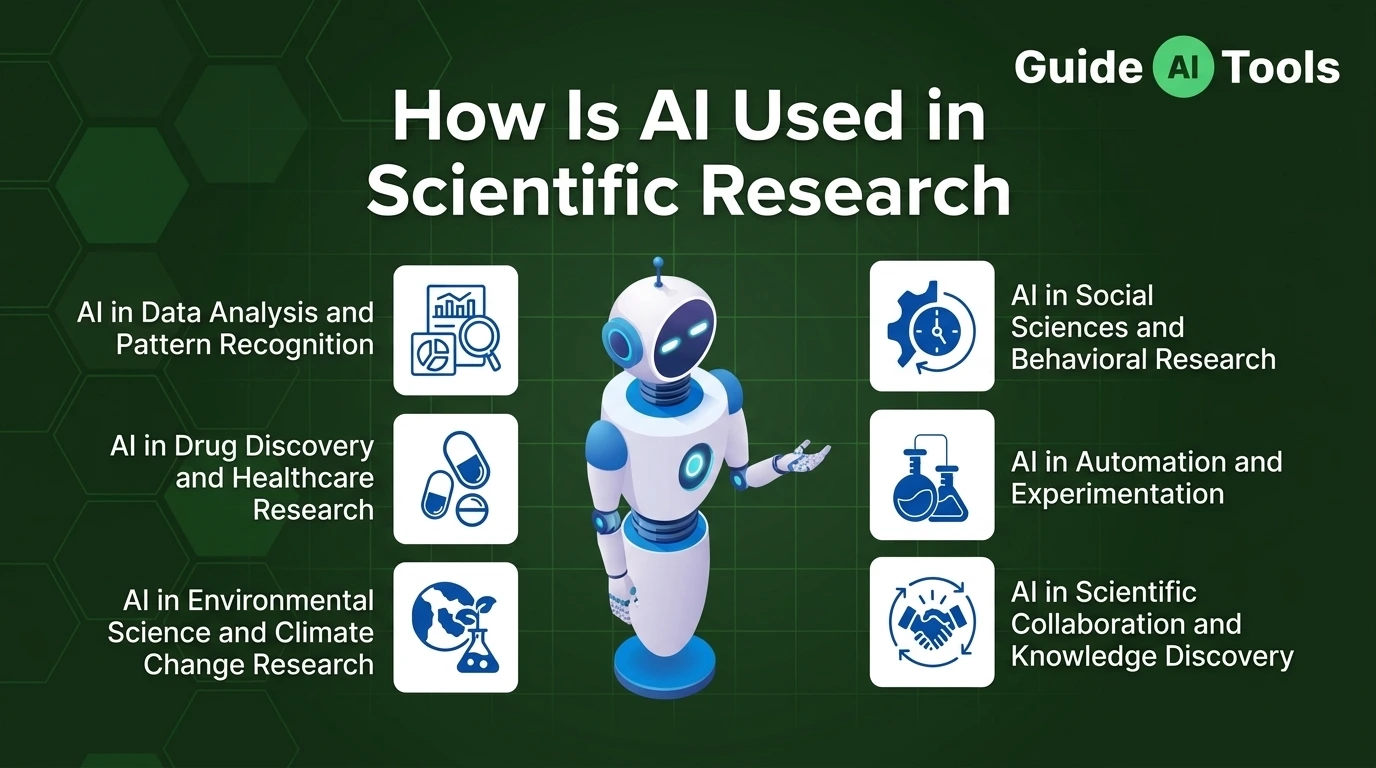
AI in scientific research means models that read the literature, spot patterns in data no human team could hold in view, predict the structures of proteins and the properties of new materials, and, in a few labs, even run experiments. Humans still set the questions and check the answers.
In 2024, the Nobel Prize in Chemistry went to an AI system and the people who built it. That had never happened before, and it tells you how far this has moved in a few short years.
But headlines skip the slow half of the story. For every confirmed result there are thousands of predictions nobody has checked, and the checking takes years.
This guide maps the cycle stage by stage, grades the famous results by the evidence behind them, and ends with the rules that govern the work. At GuideAITools, that is the order we trust: map first, evidence second, rules always.
What AI in Scientific Research Actually Means
AI in scientific research is an umbrella term, and the umbrella hides three quite different machines. Prediction models learn patterns from past data and forecast something new: the shape of a protein, the stability of a crystal, tomorrow’s weather. Language models read and write, so they search literature, summarise papers, and draft text, while lab automation steers robots and instruments through experiments with little human touch.
Discovery systems like AlphaFold sit in the first group and do work no tool could do before. Everyday assistance sits in the second: summaries, code help, a cleaner paragraph. Readers mix the two up constantly, and the mix-up inflates expectations, because a chatbot that polishes your methods section is not a discovery tool.
Underneath all three sit machine learning and deep learning, the methods that let models learn from examples instead of following fixed rules. Knowing which machine you are looking at is the first skill this field demands, and it is the split we use across the GuideAITools fundamentals library.
The Research Cycle, Stage by Stage
Research runs in a cycle: ask, read, guess, test, analyse, write, get checked. AI has entered every stage, but at very different depths, and it changes jobs more than it removes them.
| Research stage | What AI does | What stays human | Main risk |
|---|---|---|---|
| Asking the question | Scans the literature for gaps and under-tested ideas | Chooses what is worth asking, and why | Fashionable topics pull more attention while quiet questions get skipped |
| Reading the literature | Searches, summarises, and translates thousands of papers | Reads the key papers closely and judges their quality | Summaries hide weak methods and invented references |
| Forming a hypothesis | Proposes candidate explanations, molecules, and materials | Decides which ideas are plausible and testable | Plausible-sounding ideas with no real mechanism behind them |
| Designing and running experiments | Plans protocols, tunes conditions, and in self-driving labs runs the robots | Designs the controls and approves anything costly or risky | A flawed setup produces clean-looking wrong data at speed |
| Analysing results | Finds patterns in datasets far beyond human scale | Checks the statistics, the outliers, and rival explanations | Spurious patterns and overfitted models presented as findings |
| Writing the paper | Drafts text, formats references, draws first-pass figures | Owns every claim, number, and citation in the text | Fabricated citations and claims the data does not support |
| Reviewing and replicating | Screens submissions, checks images, and flags errors | Peer reviewers judge novelty and soundness, and other labs replicate | AI-written papers screened by AI tools, with nobody reading closely |
The deepest foothold is analysis and prediction. Models hold millions of data points in view at once, and the stage rewards exactly that, much as AI in manufacturing rewards automated lines that test and adjust around the clock.
At the other end sits the first stage. Choosing a question worth years of work takes taste, field knowledge, and a feel for what a result would change. Models rank by what the data rewards, so human judgement still carries the whole field at the point where the field is chosen.
Famous Results, and What the Evidence Actually Shows
Where you read a result changes what it means. A peer-reviewed paper has survived outside scrutiny, and a preprint has been posted but not vetted.
A company announcement has been vetted by the company’s own marketing team. Grade every claim by that ladder before you repeat it, which is how we grade them on GuideAITools.
| Result | Field | How it was published | What is confirmed so far |
|---|---|---|---|
| AlphaFold 2 protein structures | Structural biology | Peer-reviewed paper in Nature, 2021 | A public database of over 200 million predicted structures, used daily by biologists. The entries are predictions, not measurements |
| 2024 Nobel Prize in Chemistry | Structural biology | Official award, announced by the Royal Swedish Academy of Sciences | Half went to David Baker for protein design, half to Demis Hassabis and John Jumper for protein structure prediction |
| GNoME materials predictions | Materials science | Peer-reviewed paper in Nature, 2023 | 2.2 million predicted crystal structures, about 380,000 classed as stable. Of those, 736 matched materials outside labs had already made independently |
| GraphCast weather forecasts | Climate and weather modelling | Peer-reviewed paper in Science, 2023 | Beat the ECMWF reference forecast on about 90 percent of 1,380 test targets, days faster than the standard method |
| FunSearch mathematical results | Mathematics | Peer-reviewed paper in Nature, 2023 | New solutions to the cap set problem and better bin-packing rules, both checkable by other mathematicians |
| Insilico AI-designed lung drug | Drug discovery | Phase IIa trial results in Nature Medicine, 2025 | The drug rentosertib met its safety endpoint and improved a lung function measure in a 71-patient trial. It is an experimental candidate, not an approved treatment |
The Nobel row is the outlier: an award, not a paper. The 2024 Nobel Prize in Chemistry recognised protein design and prediction as settled contributions, the closest thing science has to a final stamp.
The drug row needs the opposite care. One Phase IIa result is a promising early mile on a long clinical road, the road our guide to AI in healthcare walks in full, and most candidates that reach this point still fail later.
Now the scrutiny the headlines skipped. After the GNoME paper, chemists including Robert Palgrave at UCL and Leslie Schoop at Princeton argued that many listed crystals were near-duplicates of known structures or physically unrealistic, and later analyses found duplicate entries inside the database itself. DeepMind stands by the paper, and honest guides print the claim and the criticism side by side.
Underneath sits the validation bottleneck. GNoME predicted 2.2 million structures and labs have confirmed a few hundred of them, because making a crystal, running a trial, or checking a forecast takes benches, budgets, and years. Predictions are cheap now, and confirmation is the real speed limit of AI science.
Self-Driving Labs and the AI Scientist
A self-driving laboratory is a lab where software and robots run the experiment cycle with minimal human handling: propose a candidate, run the test, measure the result, adjust, and propose the next round. It is a loop, not a robot scientist in a coat. Systems like these lean on AI agents, programs that plan a sequence of steps and act on them.
The Berkeley A-Lab is the worked example. Its Nature paper reported 41 new compounds made from 58 targets across 17 days of autonomous running, with recipes drawn from the published literature.
Then the pushback landed. Palgrave and Schoop argued in print that none of the 41 were truly new, that most were misclassified and the rest already known, and the dispute is still argued in the journals. That argument is not a scandal. It is the checking working as it should.
One level up sit AI scientist systems, such as Sakana AI’s AI Scientist, which draft a full machine learning paper end to end: idea, code, experiments, write-up. One manuscript scored 6.33 out of 10 from reviewers at an ICLR workshop, above its acceptance line, and was withdrawn under a prior agreement with the organisers. A workshop paper at a modest score is a real milestone, and it is not Nobel-grade work, whatever the press release implies.
Where AI in Research Goes Wrong
Start with the failure ordinary researchers actually meet: invented references. Ask a model for sources and it may hand back papers that look perfect and do not exist, complete with authors, journals, and plausible titles, and real papers have been corrected or withdrawn over citations nobody checked. Our guide to AI hallucinations shows why models do this and how to catch it.
Next comes confident wrongness in analysis. A model can run a flawed method beautifully and hand you a clean chart, and the error hides until another team tries to replicate the work. Speed makes it worse, because ten wrong analyses arrive before one careful check.
Bias rides along quietly. Models learn the literature as it is, gaps included, so well-studied diseases and wealthy regions pull still more attention while under-studied ones fall further behind.
Then there is deskilling. If junior researchers hand every slow task to a model, the field may lose the people who can smell a wrong result, and judgement is trained by doing the boring parts.
Money draws the outer ring. The flagship systems come from a handful of rich labs with the compute and the data to train them, so access decides who gets to do this kind of science.
The Rules: Authorship, Disclosure, and Checking the Work
How do scientists check results that AI produced? Slowly, by hand, with the same tools science always used: read the source, rerun the test, compare the numbers. The formal rules around the work are now written down too.
COPE, the publishing ethics body, and major journals including the Nature portfolio hold that an AI system cannot be a named author, for one plain reason: an author must answer for the work, and a model cannot answer for anything. Human authors stay responsible for every word, including the words a model drafted.
Disclosure is the second rule. Using AI to draft, edit, write code, or analyse data must be declared in the paper, and many publishers treat hidden use as misconduct.
The checking routine is short enough to copy, and it is the one we teach every GuideAITools reader. Open every citation and confirm it exists, then rerun the analysis, or a sample of it, by a second method.
That second method includes code, where the habits in our guide to AI in software development apply directly. Check every number in an AI-written summary against the source table, and ask what data the model never saw.
Everyday AI research tools, the literature searchers and writing assistants, are allowed inside these rules. The rules govern honesty, not abstinence.
FAQs
How does AI help scientists discover new drugs?
It shortens the search. Models screen libraries of millions of molecules, predict which candidates might bind a target, flag likely toxicity early, and find old drugs that may treat new diseases. The Insilico lung drug in our table came through this pipeline. A shortlist is not a medicine, though: lab tests and years of trials still decide.
What did AlphaFold actually prove?
It proved a model can predict the 3D shape of a protein from its amino acid sequence with accuracy close to lab methods, across a huge range of proteins. The open database holds over 200 million predicted structures, a starting map for drug and disease research. Two limits matter: predictions are not measurements, and disordered regions stay unreliable.
Can AI come up with its own hypotheses?
Yes, inside narrow fences. Systems recombine patterns from data and literature to propose hypotheses nobody had listed, and FunSearch produced genuinely new mathematical results this way. What they cannot do is judge which hypothesis matters. They rank by what the data rewards, so scientists still supply the taste, the context, and the final call.
Can AI write a research paper by itself?
Yes, at a modest level. Sakana AI’s AI Scientist has drafted complete machine learning papers, and one scored above the acceptance line at an ICLR workshop before being withdrawn by agreement. Read the fine print, though: the work was workshop grade, errors slip through, and any AI drafting in a real submission must be disclosed to the journal.
Can AI be listed as an author on a scientific paper?
No. COPE and major journals, including the Nature portfolio, bar AI systems from the author list because an author must take responsibility for the work, and a model cannot. Humans who use AI for drafting, editing, code, or analysis must disclose that use, and they remain answerable for every claim, figure, and citation that carries their name.
Will AI replace scientists?
No sign of it. AI is absorbing pattern work: screening, predicting, summarising, drafting. The parts that define a scientist are untouched so far, choosing the question, judging the evidence, and standing behind the result. The real shift is in the workload: less time generating candidates, far more time checking them. Science still ends with a human signature.
Conclusion
So here is the decision rule this guide leaves you. When a headline announces an AI breakthrough, ask two questions: how was it published, and what has a lab confirmed? A peer-reviewed paper with independent replication sits at one end of the scale, and a company post sits at the other. This article completes the applications batch here on GuideAITools, and for the base ideas underneath all of it, start with what artificial intelligence is and work outward.

Related Blog Posts