12 Best AI Trading and Investing Tools for 2026 (Compared)
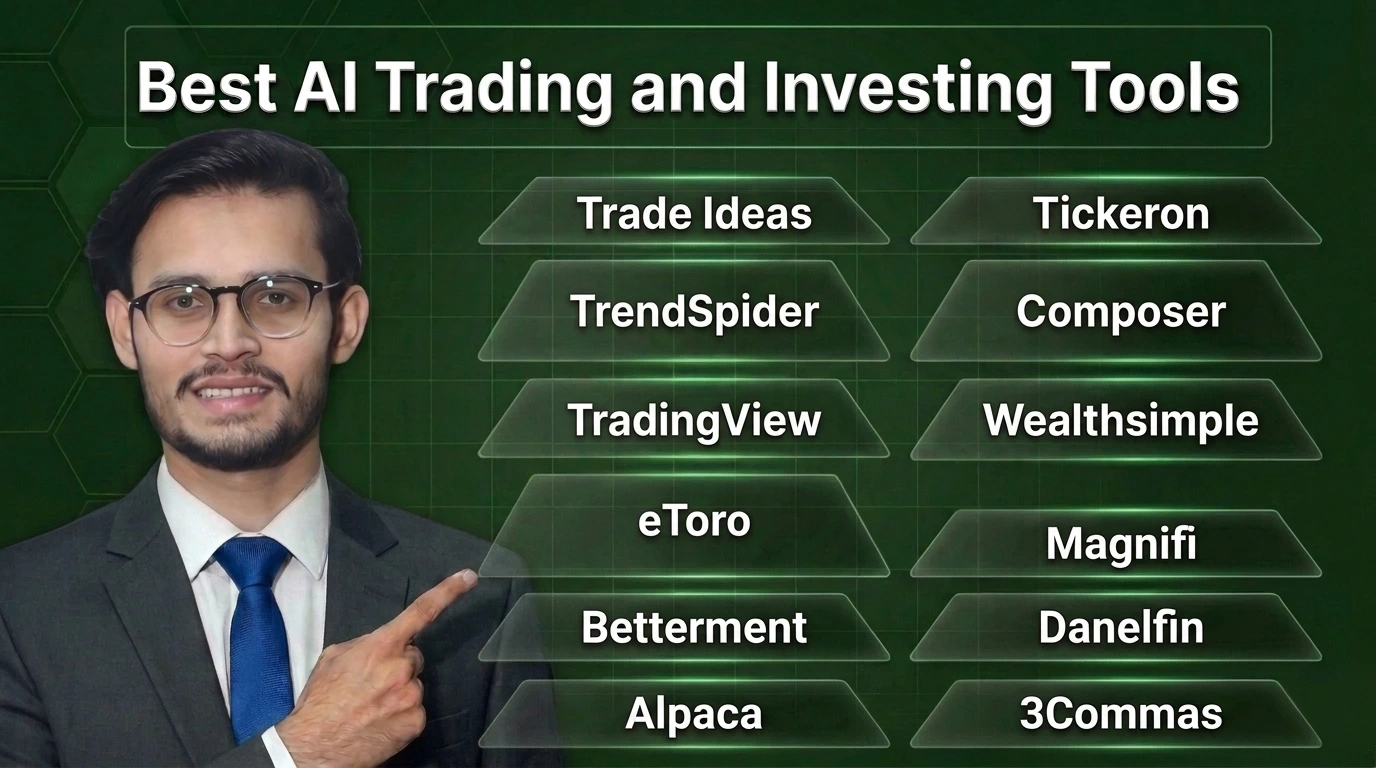
The best AI trading tools depend on how you trade: Trade Ideas for AI stock scanning, TrendSpider for automated chart analysis, Betterment for hands-off robo-advice, and Composer for no-code automation. Start free or on a demo, learn the tool, and never fund an account before paper trading it first.
Why open with a warning? In September 2026, the SEC charged four entities behind fake AI trading bots that took more than $15 million from retail investors who believed the bots existed. They did not. At GuideAITools we track thousands of AI tools, and trading is the category with the most inflated claims per product.
Whether you are shopping for AI stock trading software or a set-and-forget investing app, the honest split is this: real tools help you research, automate, and stay disciplined. Fake ones promise the market itself.
What Are AI Trading and Investing Tools?
AI trading tools are software that use machine learning to analyze market data and help you decide what to buy, sell, or hold. Some go further and place the trades for you. If you want the plain-English version of how AI works under the hood, start there, then come back.
The market splits into four camps. Research assistants like Magnifi and Danelfin answer questions and score stocks. Chart and signal platforms like TradingView and Trade Ideas scan markets and flag setups. Automated strategy builders like Composer and Alpaca run rules you set. Robo-advisors like Betterment build and manage a whole portfolio for a percentage fee.
Here is the split that matters most. Some tools hand you ideas, and some tools pull the trigger. Confusing the two is how beginners end up running automation they do not understand. The same models also power the AI analytics tools that scan earnings, sentiment, and price data at a scale no human can match by hand.
What AI genuinely adds is speed and discipline. It reads more data than you can, and it does not panic at red candles. What it cannot do is predict the future, and a tool that claims otherwise has told you something important about itself.
The 12 Best AI Trading and Investing Tools for 2026
We grouped scanners, signal engines, bots, and the best AI investing apps in one list because most readers compare across those lines. Read the category first, the price second, and the marketing last. Every price below was verified from official pricing pages.
Trade Ideas
Best for active stock traders who want setups handed to them each morning. Holly, the AI engine, tests strategy combinations overnight and publishes trade ideas with entries and exits, while OddsMaker backtests your own ideas against past data.
Pricing is steep: $127 a month for Standard, $254 for Premium (about $178 a month billed yearly), and Holly sits in Premium only. Superb scanner, real learning curve, and a fee that demands a properly funded account.
TrendSpider
Best for chart-driven traders who hate drawing lines by hand. TrendSpider automates technical analysis, drawing trendlines, Fibonacci levels, and chart patterns for you, and its Sidekick AI chatbot reads your chart and answers questions. Every plan includes the same features, and higher tiers buy capacity instead: more bots, more alerts, deeper backtests.
Pricing runs from about $59 to $89 a month for Standard depending on billing term, with a paid 14-day trial. No free plan is the downside.
TradingView
Best for almost everyone as a charting home base, and the platform readers mention most at GuideAITools. You get clean charts on any device, a huge library of community indicators, screeners for stocks, crypto, and forex, and paper trading built in. The free Basic plan is genuinely usable. Paid plans run from $14.95 a month for Essential up to $239.95 a month for the top tier, real-time exchange data costs extra, and the AI Copilot is a paid add-on rather than a built-in feature.
eToro
Best for beginners who would rather copy than analyze. CopyTrader mirrors the trades of experienced investors automatically, and the free virtual portfolio lets you practice with play money first. There is no subscription: real stocks carry $0 commission, crypto trades cost a flat 1%, and withdrawals cost $5. Accounts open with as little as $10 in the US. The catch is real: copying a stranger is still a strategy you do not control, and CFD spreads add up quietly.
Betterment
Best for hands-off investors who want the benchmark robo-advisor. Betterment builds a goal-based ETF portfolio, rebalances it automatically, and harvests tax losses in taxable accounts. Pricing is a percentage, not a subscription: 0.25% a year once you hold $24,000 or set up $200 in monthly deposits, otherwise $5 a month. Premium at 0.65% a year adds unlimited access to human advisors from $100,000. You cannot pick individual stocks inside the managed portfolios. That is by design.
Alpaca
Best for coders who want to build their own AI trading bots. Alpaca is a brokerage built API-first, so your Python strategy trades US stocks, ETFs, and options with $0 commissions, and paper trading is free while you build. Our rule applies here in full: paper trade for 30 days before a single real dollar moves. Full real-time data from every US exchange needs the Algo Trader Plus plan at $99 a month. There is no friendly app to fall back on, and if you cannot code, Composer below does this job visually.
Tickeron
Best for traders who want ready-made AI signals and robots. Its pattern search and trend prediction engines scan thousands of stocks and ETFs, and its AI Robots publish trade records you can inspect before following. Pricing is modular and messy: a free Beginner plan, engines from $30 a month after a 14-day trial, and robot subscriptions from $90 a month at regular prices. The honest warning: that plan maze confuses almost everyone, and published robot records are marketing until your own paper trading confirms them.
Composer
Best for no-code automation. Composer lets you build trading strategies, called symphonies, in a visual editor, backtest them against history, and run them automatically with zero coding. Building and backtesting are free. Live automated trading needs the Trading Pass at $40 a month or $384 a year, with a 14-day free trial, and trades carry $0 commissions. The limits are US stocks and ETFs only, and a visual editor still lets you build a bad strategy faster than ever.
Wealthsimple
Best for Canadians who want low-fee managed investing. Wealthsimple builds and rebalances ETF portfolios, supports TFSA and RRSP accounts, and pairs them with commission-free self-directed trading in the same app. Managed portfolios cost 0.5% a year, dropping to 0.4% once you pass $100,000 and as low as 0.2% at the top tiers, plus small fund fees inside the ETFs themselves. Canada only is the hard limit, and US dollar accounts cost extra for smaller clients.
Magnifi
Best for investors whose accounts are scattered across several brokers. Magnifi links your existing accounts and answers plain-language questions about your own portfolio, like where your risk hides or what a rate rise does to your holdings. A free plan covers tracking and basic analysis. Premium costs $14 a month, or about $99 a year billed yearly, and adds forecasts and scenario testing. The AI advises and explains. It does not manage money for you, and its answers are only as good as the data you link.
Danelfin
Best for stock pickers who want an explainable second opinion. Danelfin scores US and European stocks and ETFs from 1 to 10 by their probability of beating the market over roughly three months, and it shows the technical, fundamental, and sentiment signals behind every score. A free plan covers the basics. Plus runs $22 a month billed annually, Pro $59, and Elite $134 for API access. Scores update daily rather than in real time, so day traders should look elsewhere.
3Commas
Best for crypto traders who want bots running across exchanges from one dashboard. Grid, DCA, and signal bots cover the major exchanges, and the SmartTrade terminal handles manual trades with proper exits. A free plan covers portfolio tracking without live trading. Paid plans run $20 a month for Starter, $50 for Pro, and $140 for Expert, with annual billing cutting each by about a quarter. Now the serious part: in December 2022, leaked 3Commas API keys cost users millions, which is why the API safety rules later in this guide are not optional reading.
Comparison Table: All 12 Tools Side by Side
Read this table by job, not by price. A $20 crypto bot and a 0.25% robo-advisor are not rivals, they are different animals built for different people. The right question is which row matches how you actually invest, and only then whether the fee fits your account size.
| Tool | Best For | Category | Starting Price | Free Tier | Key Strength |
|---|---|---|---|---|---|
| Trade Ideas | Day traders wanting AI setups | Signals | $127/month | Yes | Holly AI overnight scanning |
| TrendSpider | Technical traders | Research | $59/month on annual billing | No | Automated pattern recognition |
| TradingView | Charting for every level | Research | Free | Yes | Charts plus community indicators |
| eToro | Beginners copying traders | Automation | $0 commission on stocks | Yes | CopyTrader |
| Betterment | Hands-off US investors | Robo-advisor | 0.25%/year | No | Tax-loss harvesting |
| Alpaca | Developers building bots | Automation | $0 commission via API | Yes | Brokerage API with free paper trading |
| Tickeron | Signal followers | Signals | Free plan, engines from $30/month | Yes | AI robots with inspectable records |
| Composer | No-code automators | Automation | Free to build, $40/month to automate | Yes | Visual strategy builder |
| Wealthsimple | Canadian investors | Robo-advisor | 0.5%/year | No | TFSA and RRSP portfolios |
| Magnifi | Multi-broker investors | Research | Free | Yes | Plain-language portfolio answers |
| Danelfin | Stock pickers | Research | Free, Plus $22/month | Yes | Explainable AI scores |
| 3Commas | Crypto bot traders | Automation | Free plan, paid from $20/month | Yes | Grid and DCA bots |
AI Trading Tools vs AI Investing Tools: What Is the Difference?
A trading bot and a robo-advisor both wear the AI label, and they do opposite jobs. An AI robo advisor builds a diversified portfolio of ETFs, rebalances it on schedule, and mostly leaves it alone. Its goal is steady compounding with low effort and low tax friction. An AI trading bot hunts short-term moves instead. It trades often, sometimes daily, chasing chart patterns or momentum signals in stocks, forex, or crypto.
Trading tools cost more and demand more. Subscriptions run into hundreds a month, screens demand your attention, and frequent trades create frequent tax events. Investing tools charge a small percentage of your balance and ask almost nothing of your week.
Neither camp is better. They solve different problems, and that is the whole active trading vs passive investing split: it decides your costs, your taxes, and your stress levels. The mismatch is what hurts people. A patient investor paying for a day trading scanner, or a would-be trader expecting a robo-advisor to catch breakouts, both end up frustrated.
Use the simple test. If you check prices daily, you are trading. If you check quarterly, you are investing. Buy the tool that matches the habit you actually have, not the one you imagine having.
How Much Money Do You Need to Start?
You can start with $0. Paper trading on TradingView, Alpaca, and most brokers costs nothing and risks nothing, and it is where every beginner reading this page should spend the first month.
Real accounts are flexible once you go live. eToro opens at $10 in the US, Betterment has no account minimum, and most brokerage accounts fund comfortably between $500 and $5,000. The tool bill is the real gatekeeper, and it deserves honest math.
Run the numbers before any subscription. A $100 monthly tool on a $5,000 account costs you $1,200 a year, a 24% hurdle your trading must clear before you make a cent. On a $50,000 account the same tool is a 2.4% hurdle. Still painful, but survivable. Percentage fees scale kinder: Betterment at 0.25% takes $25 a year on a $10,000 balance.
Set your guardrails before your first live trade. A stop-loss is a preset price where a losing trade closes itself. Position sizing caps how much one idea can hurt you, often 1% of the account per trade. A max daily loss is the number where you close the laptop and stop for the day, no exceptions.
How to Choose the Right Tool for Your Style
Answer four questions honestly and the category picks itself.
One: do you want ideas or automation? Ideas mean signals and research, with you placing every trade. Automation means the software trades your rules while you sleep. Two: which assets? Stocks and ETFs live everywhere on this list, forex and futures narrow it fast, and crypto points you at 3Commas or Alpaca. Three: what is your monthly budget, honestly? Under $25 points to TradingView, Danelfin, or a robo-advisor, while anything over $100 needs the account size to justify it. Four: can you code? Yes opens Alpaca. No points to Composer for automation or TrendSpider for analysis.
We see the two classic mistakes constantly at GuideAITools: buying automation when you wanted research, and paying for real-time data tiers your strategy never touches. Readers comparing broader platforms for a business should also work through our roundup of the best AI business tools, but trading software stays specialized for good reason.
Now the AI-washing detector, because half this market is a plain rules engine wearing an AI costume. Ask any vendor three things. Can I see a backtest with trading costs included? Is there a paper trading mode? What happens when the model is wrong? Real machine learning vendors answer all three. Marketers change the subject.
One more piece of literacy. A backtest replays a strategy on old data, and overfitting means the strategy memorized that data instead of learning from it. Ask for walk-forward results, tested on data the model never saw during training. Survivorship bias hides the rest, because dead stocks quietly vanish from old data and make old results look kinder than they were.
What AI Trading Tools Really Cost
Two pricing models run through this list. Subscriptions charge you the same in a good month and a terrible one. Percentage fees grow only when your balance does, which is why robo-advisors feel painless at small balances and pricey at large ones.
The subscription is never the whole bill. Real-time data is the classic add-on, since TradingView and TrendSpider charge extra for certain exchange feeds and Alpaca charges $99 a month for full US exchange coverage. Brokers take their cut inside spreads and currency conversion instead of sending invoices. And frequent trading creates a tax bill nobody advertises: short-term capital gains and wash-sale problems are real, so work through our guide to the best AI tools for accounting and talk to a tax professional before a bot starts trading daily in a taxable account.
Every price in the table below was checked against official pricing pages, with no date attached because vendors change these numbers quietly and often.
| Tool | Free Tier | Starting Price | What the Top Tier Includes |
|---|---|---|---|
| Trade Ideas | Yes | $127/month | Premium at $254/month adds Holly AI, OddsMaker backtesting, and auto trading |
| TrendSpider | No | $59/month on annual billing | Advanced adds capacity: 100 bots, 400 alerts, and the deepest backtests |
| TradingView | Yes | $14.95/month | Top plan at $239.95/month adds 16 charts per tab and 1,000 alerts |
| eToro | Yes | $0 commission on stocks | No tiers. Costs sit in spreads, a 1% crypto fee, and a $5 withdrawal fee |
| Betterment | No | 0.25%/year | Premium at 0.65%/year adds unlimited human advisor access, $100,000 minimum |
| Alpaca | Yes | $0 commission via API | Algo Trader Plus data plan at $99/month for full exchange coverage |
| Tickeron | Yes | $30/month per engine | Robot subscriptions up to $250/month for the fastest 5-minute agents |
| Composer | Yes | $40/month Trading Pass | Annual pass at $384/year. One pass covers unlimited automated trading |
| Wealthsimple | No | 0.5%/year managed | Fee falls to 0.4% over $100,000 and toward 0.2% at the top tiers |
| Magnifi | Yes | $14/month | Premium is the top tier: forecasts, scenario testing, premium research |
| Danelfin | Yes | $22/month billed annually | Elite at $134/month adds API access and unlimited portfolios |
| 3Commas | Yes | $20/month | Expert at $140/month raises bot limits to 1,000 and adds read-write API |
Risks, Regulation, and How to Spot AI Trading Scams
Start with the freshest evidence. On September 29, 2026, the SEC charged four entities, Cryptoaiml Ltd., Cryptoaiml Capital Foundation, TSAI Pro Ltd., and TSAI Capital Foundation, over two schemes that took more than $15 million from over 2,000 retail investors. The pitch ran through WhatsApp group chats: fake AI signals in one scheme, rented AI trading bots in the other. The SEC says those bots never existed. Both schemes waved falsified Form D filings and fake SEC certificates as proof of legitimacy, and investors who tried to withdraw were told to pay advance fees first.
Read that again and then read this disclaimer, because it applies to every tool in this guide, the honest ones included. AI trading tools do not guarantee returns. Trading involves risk of loss, including the possible loss of your entire investment. This article is for education only and is not financial advice.
Know your regulators before you trust a logo. The SEC oversees US securities markets, FINRA oversees US brokers, the CFTC covers futures and much of forex, and the FCA regulates firms in the UK. SIPC insurance protects you if a US broker fails, up to $500,000. It does not protect you from losing trades, and no regulator anywhere insures a drawdown. Diversification and position sizing blunt volatility, but every account takes a peak-to-trough fall in a bad stretch. For the wider picture, our guide to the risks of AI covers what these systems get wrong beyond the markets.
The SEC maintains an SEC investor alert on AI and investment fraud that every reader should open before funding anything. Then run any new platform against this red-flag list:
- Guaranteed or fixed daily returns, promised in writing or inside a group chat
- A guru or mentor recruiting you through WhatsApp, Telegram, or social media messages
- Deposits sent to the platform itself instead of an account at a regulated broker in your own name
- Fees, taxes, or extra payments demanded before you are allowed to withdraw
- No demo or paper trading mode, only pressure to fund an account right now
- Certificates and government filings waved as proof of regulation, since a Form D filing is a notice, not an approval
Last, the API safety protocol, because bots trade through API keys and a key is a password that can place trades. Create trade-only keys for every connection. Never enable withdrawal permission on a key you hand to any tool, and turn on IP whitelisting where your exchange offers it so the key only works from approved addresses. The December 2022 3Commas leak shows why: more than 100,000 user API keys escaped, attackers placed unauthorized trades with stolen keys, and one verified group of 44 victims lost about $14.8 million before 3Commas confirmed the leak and asked exchanges to revoke the connected keys. Platforms have tightened up since. Your rule should not change: least permission, every time.
FAQs
Can AI really predict the stock market?
No. AI cannot predict the stock market reliably, and no tool in this guide can either. These systems find patterns in past data and score probabilities, but markets shift, news breaks, and old patterns fail without warning. Treat every prediction as an opinion with math behind it, not a forecast you can bank on.
Do AI trading bots actually work?
They work as automation, not as money machines. A bot executes your rules with discipline, no fear, and no sleep, which genuinely helps some traders. But a bot running a bad strategy just loses money faster and more consistently. The edge, when one exists, comes from the strategy and your risk controls, not from the bot itself.
Is AI trading legal?
Yes. Using AI tools and bots on your own brokerage or exchange accounts is legal in the US, the UK, and most other markets. What matters is the venue: trade through regulated brokers, and remember that the scams are the illegal part, not the software. Selling unregistered investment schemes and promising guaranteed returns is exactly what the SEC charged in September 2026.
What is the best AI trading app for beginners?
Start with a free one. TradingView’s free plan teaches chart reading with zero risk, and a robo-advisor like Betterment is the better first step if you want investing handled for you. Among automated investing tools, simple beats clever at the start. Graduate to scanners and bots only after a month of paper trading shows you what you actually enjoy doing.
Are AI trading apps safe?
The established names in this guide are real, regulated businesses, and your cash at a US broker carries SIPC protection if the firm fails. Safe software cannot make trading itself safe, though. Market losses, bad strategies, and leaked API keys are risks no regulation removes, which is why the safety protocol in this guide matters as much as the tool you pick.
Can I lose money with AI trading?
Yes. Most active traders lose money, and AI does not change that base rate by itself. Bots can amplify a bad idea at machine speed, and subscription fees drag on small accounts even when trades go nowhere. Paper trading first, small position sizes, and a hard max daily loss are how you keep a learning phase from becoming an expensive one.
Do I need to know coding to use AI trading tools?
No. Composer builds automated strategies in a visual editor, TrendSpider automates chart analysis for you, and robo-advisors need nothing but a deposit and a goal. Coding only becomes mandatory when you want fully custom strategies, which is where Alpaca’s API earns its place. Pick the tool that matches the skills you have today, not the ones you plan to learn someday.
Final Verdict
Pick by temperament, not by advertising. Beginners should start free: TradingView for charts, or an automated investing tool like Betterment that removes decisions entirely. Active traders get the most from TrendSpider or Trade Ideas, funded only after 30 days of paper trading proves the habit sticks. Hands-off investors in Canada belong at Wealthsimple, and crypto traders can use 3Commas with trade-only API keys, or not at all.
At GuideAITools we keep tracking these categories as they shift, and our AI trends 2026 coverage follows where the money and the scams are moving next. Start on a demo. Stay skeptical of anyone promising returns. Let a tool earn your trust in simulation before it ever touches your money.

Related Blog Posts