What Are the Risks of AI? 10 Artificial Intelligence Risks Explained
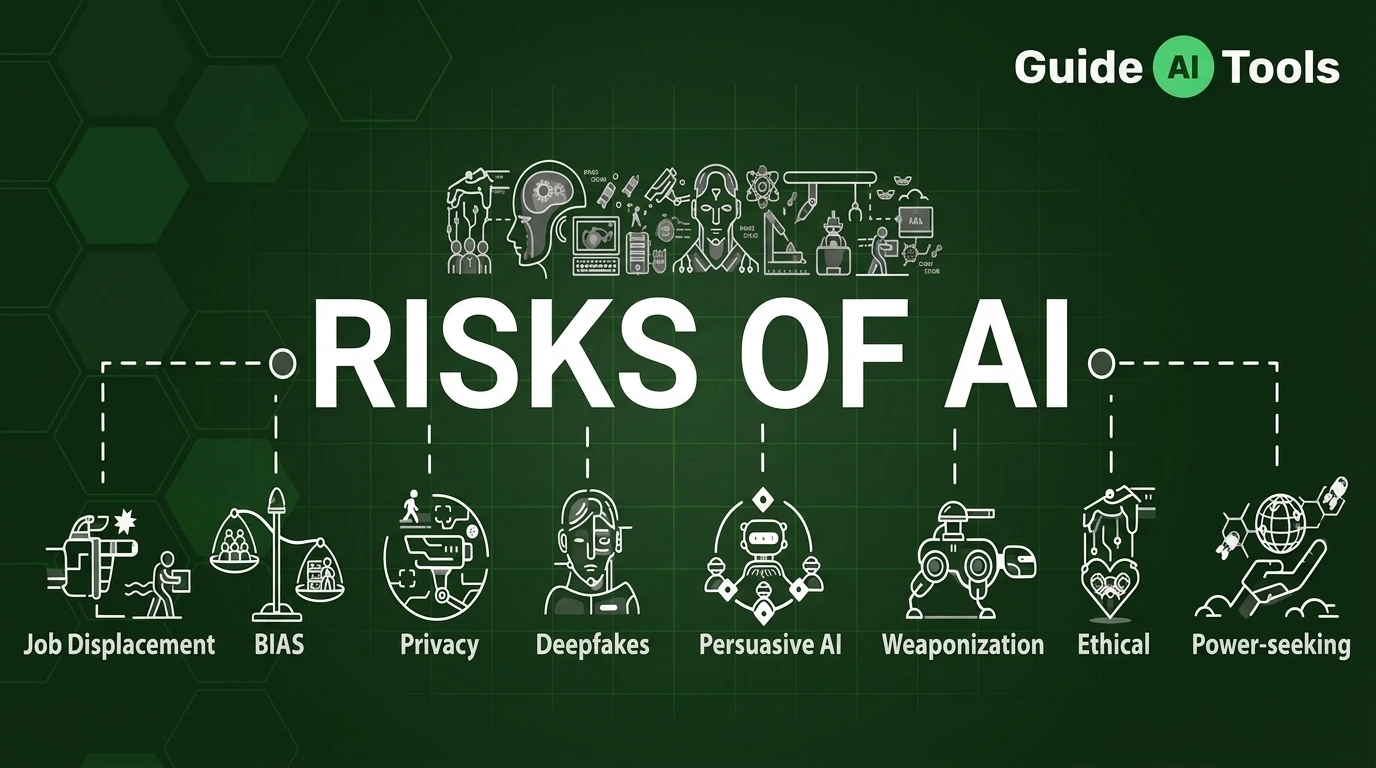
The main risks of artificial intelligence include inaccurate outputs, bias, privacy breaches, cyberattacks, misinformation, fraud, overreliance, job disruption, environmental costs and failures in high-stakes systems. How serious each risk becomes depends on the system, how people use it, who is affected and what happens when something goes wrong.
That distinction matters.
People often talk about AI risk as though it were one problem. It isn’t. Some failures come from the model, some begin with poor data, and others happen because people deliberately misuse the technology.
Even the same mistake can have wildly different consequences.
A bad restaurant recommendation is irritating. A bad medical recommendation can put someone at risk.
Understanding that context gives you a much clearer picture of the risks of artificial intelligence than another list of scary predictions.
What Are the Main Risks of AI?
AI can cause problems when a system produces unreliable results, treats people unfairly, exposes data, gets manipulated or is trusted beyond what it can actually do.
Some risks are already easy to observe. Others concern more capable systems that are still developing.
| AI Risk | What Can Go Wrong | Simple Example |
|---|---|---|
| Incorrect output | False information appears credible | Fabricated research citation |
| Bias | People receive unequal treatment | Unfair hiring recommendation |
| Privacy | Sensitive information is exposed | Confidential customer data leaks |
| Security | An AI system is manipulated | Prompt injection |
| Misinformation | False content spreads quickly | Synthetic news or media |
| Fraud | AI helps impersonate someone | Voice-cloning scam |
| Overreliance | People trust an answer without checking | Incorrect financial advice |
| Economic disruption | Tasks and jobs change unevenly | Routine work becomes automated |
| Environmental cost | Computing requires energy and infrastructure | Heavy data-center demand |
| Safety failure | Wrong output has serious consequences | Faulty automated medical advice |
The MIT AI Risk Repository shows how much broader the subject really is. Its current database contains more than 1,700 documented risks drawn from 74 frameworks, organized into seven domains and 24 subdomains.
So bias and hallucinations are part of the picture.
They aren’t the whole picture.
Why Can AI Create Risk?
A useful way to understand AI risk is to ask three questions.
Who caused the problem? Was it deliberate? And did the issue begin before or after the system was deployed?
MIT’s causal taxonomy uses this kind of structure. It distinguishes risks linked to AI actions, human actions or other causes, then looks at intent and timing.
Imagine a hiring model trained on poor historical data.
The risk may begin before deployment because the data itself contains patterns that produce unfair results. You can learn more about the underlying training process in our guide to how AI works.
Now consider someone using a voice generator to impersonate another person in a scam.
The technology may work exactly as designed. The risk comes from deliberate human misuse.
Not every AI failure is caused by AI acting on its own.
That sounds obvious, yet a lot of discussion misses it.
1. AI Can Produce Incorrect or Misleading Information
AI can sound certain while being wrong.
Generative systems may invent facts, produce false citations, misunderstand a question or create answers that conflict with reliable information.
These failures are often called hallucinations or confabulations.
NIST describes confabulation as generated content that is confidently presented but erroneous or false. It can happen because generative models produce likely outputs based on patterns rather than checking every statement against reality.
The problem becomes much more serious when accuracy matters.
A fictional citation in a casual brainstorming session may waste a few minutes. An incorrect claim used in legal, medical, financial or academic work could create much larger consequences.
Fluency is not proof of accuracy.
When facts matter, check the original source rather than trusting the tone of the answer.
2. AI Can Reinforce Bias and Discrimination
Models learn from data, and real-world data isn’t automatically fair.
Historical patterns may reflect discrimination, uneven representation or decisions that shouldn’t be reproduced.
Machine learning can identify patterns extremely well. The uncomfortable part is that a model can learn an unwanted pattern just as efficiently as a useful one.
Bias can also enter through design choices.
Which data gets collected? Who appears in the training set? What outcome is the model optimized for? How is performance measured across different groups?
These questions matter in hiring, lending, facial recognition, insurance and other areas where automated recommendations affect people.
MIT’s risk taxonomy includes unfair discrimination, misrepresentation and unequal performance across groups as distinct AI risks.
A biased system doesn’t need malicious intent to cause harm.
That is exactly why testing across different users matters.
3. AI Can Create Privacy Risks
Privacy problems can start long before someone notices them.
AI systems may process names, conversations, financial information, work documents, location data or other sensitive material.
Sometimes the risk comes from the model or dataset.
Sometimes it comes from the user.
Picture an employee copying a confidential customer file into a public chatbot because they want a quick summary. The tool may work perfectly, yet sensitive data has now been shared with a service that may not be approved for that information.
AI systems can also infer private information from apparently unrelated data.
MIT places unauthorized collection, leakage and inference of sensitive information inside its privacy and security risk domain.
Think before you paste.
A convenient prompt box can still be a data-sharing decision.
4. AI Systems Can Be Attacked or Manipulated
AI introduces security problems that ordinary software doesn’t always face in the same way.
Attackers may try to manipulate model inputs, poison data, steal models, exploit connected tools or trick a system into ignoring its intended instructions.
Prompt injection is one example.
Imagine an AI assistant that reads documents and follows instructions. A malicious instruction hidden inside a document could attempt to influence what the assistant does next.
The risk grows when the AI can access email, databases, browsers, files or external tools.
This matters even more with AI agents, because an error can move beyond a bad text response and lead to an action.
Good security still needs the familiar basics.
Limit permissions. Protect data. Test systems before giving them access to sensitive tools. Monitor what they actually do.
5. AI Can Scale Misinformation, Deepfakes and Fraud
Generating convincing text, images, audio and video has become much easier.
That has useful applications, but it also lowers the effort needed to create deceptive material.
Misinformation can be false without being intentionally deceptive. Disinformation is different because someone deliberately creates or spreads misleading content.
Deepfakes add another layer.
A synthetic voice can imitate a real person. An altered image can show something that never happened. A generated video can make fabricated evidence feel much more believable than plain text.
Then there is fraud.
AI can help scale impersonation attempts, fake documents, phishing content and other deceptive material.
The 2026 International AI Safety Report notes that general-purpose AI has already been used in deception and fraud, while future capability increases may introduce risks that have not yet fully materialized.
Generative AI makes content cheap to produce.
Verification has to catch up.
6. People Can Rely on AI Too Much
A system doesn’t need to be wrong every day to become risky.
Sometimes being right most of the time creates the problem.
You get a useful answer. Then another. Then twenty more.
Eventually, checking starts to feel unnecessary.
That is where automation bias and overreliance creep in. People may accept a recommendation because it came from a system, or treat a conversational assistant as though it understands more than it really does.
A confident tone makes this worse.
MIT’s taxonomy includes overreliance, unsafe use and loss of human agency among human-computer interaction risks.
Consider a financial calculation that looks polished but contains one wrong assumption.
If nobody checks the assumption, the quality of the explanation doesn’t help.
A useful assistant can become dangerous when people stop verifying it.
Keep judgment where judgment belongs.
7. AI Decisions Can Be Hard to Explain
Some AI systems can produce a prediction without giving a clear explanation for how they reached it.
That becomes uncomfortable when the decision affects a person.
If an AI system helps reject a loan application, filter a job candidate, assess an insurance claim or prioritize a medical case, the person affected may reasonably ask why.
A vague answer such as “the model scored you lower” isn’t always enough.
Lack of transparency can make errors harder to find and accountability harder to assign.
MIT identifies transparency and interpretability as a specific system-safety concern, especially where people need to understand, challenge or correct model behavior.
Not every model needs to explain every internal calculation.
But the higher the consequence, the harder it becomes to justify a decision nobody can meaningfully review.
8. AI Can Disrupt Jobs and Increase Inequality
AI can automate parts of work.
That does not mean every exposed job disappears.
A job is usually made up of many tasks. Some may be easy to automate, while others still require judgment, physical work, relationships or responsibility.
The International Labour Organization’s 2025 global analysis found that one in four workers were in occupations with some exposure to generative AI. It also concluded that job transformation was more likely than wholesale replacement because most occupations still contain tasks requiring human input.
The distribution matters too.
Workers with access to good tools, training and infrastructure may gain more from AI than workers without them. Some roles may become more productive while others face declining demand for particular tasks.
That can affect wages, skills and bargaining power unevenly.
So the economic risk isn’t simply “robots take every job.”
It’s who gains, who loses and how quickly people can adapt.
9. AI Has Environmental Costs
AI doesn’t run in empty space.
Training and operating models requires computing hardware, data centers, electricity and cooling. Building the hardware also requires physical materials and manufacturing.
The exact environmental impact varies a lot.
A small model processing short requests is not equivalent to a large system serving millions of users.
MIT includes energy use, hardware and carbon footprints in its environmental risk category.
The International Energy Agency also reports rapidly rising electricity demand from data centers, with AI-focused facilities contributing to that growth.
That doesn’t mean every AI task has the same footprint.
Model size, hardware efficiency, electricity source, data-center location and usage volume all change the result.
Scale changes the environmental equation.
10. AI Failures Can Become More Serious in High-Stakes Systems
The same technical mistake can create completely different levels of harm.
Suppose a recommendation model suggests a movie you hate.
Nothing serious happened.
Now imagine a similar confidence error inside a medical support system, industrial controller or financial risk model.
The consequences change dramatically.
NIST frames risk around both the likelihood of an event and the magnitude of the harm that could follow.
That is why asking whether an AI model is “accurate” isn’t enough.
You also need to ask what happens when it isn’t.
| AI Use | Possible Error | Consequence |
|---|---|---|
| Movie recommendation | Poor suggestion | Usually minor inconvenience |
| Marketing draft | False claim | Reputation or compliance problem |
| Hiring screening | Unfair rejection | Harm to an applicant |
| Medical support | Incorrect recommendation | Possible health consequences |
| Industrial control | Unsafe action | Potential physical harm |
Risk depends on context, not just model performance.
Are Today’s AI Risks Different From Future AI Risks?
Yes.
Some AI risks are already observable. Others involve more capable systems and remain less certain.
| Current or Observable Risks | Emerging or More Uncertain Risks |
|---|---|
| Hallucinations | Advanced autonomy failures |
| Algorithmic bias | Loss of meaningful human control |
| Privacy leaks | Advanced alignment problems |
| Deepfakes | Novel dangerous capabilities |
| Fraud | Cascading multi-agent failures |
| Cyber misuse | Broad systemic failures |
| Automation errors | Extreme large-scale harm |
The distinction matters because uncertainty cuts both ways.
It would be wrong to describe advanced loss-of-control scenarios as established future events. It would also be careless to assume a risk cannot matter simply because it hasn’t happened at scale yet.
The 2026 International AI Safety Report separates risks from deliberate misuse, system malfunctions and broader systemic effects. It also distinguishes harms already being observed from risks that may emerge as capabilities advance.
Treat current evidence as current evidence.
Treat uncertain futures as uncertain.
Are All AI Systems Equally Risky?
No. The risk depends on the use case, the user, the system and the consequences of failure.
A simple writing assistant and an automated medical system shouldn’t be judged by the same standard.
This is where risk and harm need to be separated.
A risk is the possibility that something harmful could happen. Harm is the negative outcome after it actually happens.
For example, hidden bias in a hiring model creates a risk.
A qualified applicant being rejected unfairly is the harm.
NIST’s framing is useful here because it combines likelihood with the potential magnitude of consequences rather than treating every technical failure equally.
The question is not just:
Can this AI fail?
Ask:
What happens if it does?
Can AI Risks Be Reduced?
Yes. Many AI risks can be reduced, although no serious risk-management process promises that every failure can be eliminated.
NIST’s AI Risk Management Framework organizes risk work around four functions: Govern, Map, Measure and Manage. The current NIST resource also notes that AI RMF 1.0 is being updated.
Govern means deciding who owns the risk and who is accountable.
Map means understanding the system, its users, its context and the ways it could affect people.
Measure means testing what can actually go wrong. That may involve checking accuracy, security, bias, reliability and other risks relevant to the use case.
Manage means prioritizing those risks, reducing them and monitoring what happens after deployment.
This isn’t a one-time form to complete before launch.
NIST treats risk management as an ongoing activity across the AI lifecycle.
And sometimes the right decision is simple.
Don’t use AI for a task when the risk outweighs the benefit.
Practical Ways to Use AI More Safely
You don’t need to build a corporate governance department before using an AI tool sensibly.
A few habits remove a surprising amount of avoidable risk:
- Don’t paste sensitive or confidential information into a tool unless its policies and your organization permit it.
- Verify factual claims before using them in decisions, reports or published work.
- Keep human review when an error could affect health, money, employment, safety or legal rights.
- Test systems with the people, language and conditions they will actually encounter.
- Monitor performance after launch instead of assuming an initial test proves long-term reliability.
- Give autonomous tools only the permissions they genuinely need.
- Teach users that polished wording and confident answers can still be wrong.
- Use primary and trusted sources when accuracy matters.
These steps don’t make risk disappear.
They make failure harder to ignore.
Risks of AI vs Disadvantages of AI
The terms overlap, but they aren’t identical.
A disadvantage is a drawback or limitation. A risk is the possibility of a harmful outcome.
| Example | Disadvantage or Risk? |
|---|---|
| High computing cost | Usually a disadvantage |
| Time needed to review outputs | Disadvantage |
| Confidential data exposure | Risk |
| Biased hiring decision | Risk |
| Large energy requirement | Can be both |
| Dependence on human review | Usually a limitation, but can create risk |
This is why “disadvantages of artificial intelligence” and “risks of artificial intelligence” often appear in the same discussion.
The risk question goes one step further.
It asks what can actually go wrong.
FAQs
What is the biggest risk of AI?
There isn’t one biggest risk for every situation.
The most serious risk depends on what the system does, how likely it is to fail and how severe the consequences would be. A privacy leak may dominate one use case while physical safety matters far more in another.
Is AI dangerous right now?
Yes, AI can already contribute to real harms, including misinformation, scams, discrimination, privacy problems and unreliable automated decisions.
That doesn’t mean every AI tool is dangerous. The 2026 International AI Safety Report documents current harms while separating them from emerging risks that may appear as systems become more capable.
Can AI make mistakes?
Yes.
AI can produce false information, misunderstand context, classify something incorrectly or make a poor prediction. Performance can also fall when a system encounters people, data or situations that differ from what it was tested on.
Can AI be biased?
Yes.
Bias can come from training data, sampling, model design, evaluation choices or the environment where the system is deployed. Different groups may also experience different error rates.
Is AI a privacy risk?
It can be.
Privacy risks include sensitive information being collected, inferred, retained or exposed without appropriate authorization. Users can also create privacy problems themselves by sharing information with tools that aren’t approved to receive it.
Can AI be hacked?
AI systems can face cybersecurity threats.
Those include manipulated inputs, prompt injection, poisoned data, unauthorized access and attacks on connected software or infrastructure. The specific risk depends on what the system can access and what actions it can take.
Will AI replace people’s jobs?
AI can automate tasks and reshape occupations, but that isn’t the same as predicting that entire categories of jobs will disappear.
ILO research suggests job transformation is currently a more likely broad outcome than full replacement for most exposed occupations.
Can AI become uncontrollable?
Researchers study the possibility that future highly capable or autonomous systems could become difficult to control or behave in ways that conflict with human goals.
Those concerns are different from harms such as fraud, bias and misinformation that can already be observed. They should be discussed as emerging risks, not guaranteed future outcomes.
Can AI risks be eliminated completely?
Usually not.
Testing, monitoring, security controls, human review, restricted permissions and good governance can reduce many risks. But every system still operates within limits, which is why higher-impact uses deserve stricter standards.
The Better Question Is What Happens When AI Fails
Calling AI simply safe or dangerous doesn’t tell you much.
A low-stakes writing tool, a hiring system and an autonomous machine can all use artificial intelligence, yet the consequences of getting something wrong are completely different.
That is the useful way to think about risk.
Look at the system. Look at the people affected. Then look at what happens if the output is wrong, the data leaks or someone deliberately misuses the technology.
AI also has real advantages, which we cover separately in our guide to the benefits of AI.
The goal isn’t to pretend failure can never happen.
It’s to understand where failure matters enough that you need stronger checks before trusting the system.

Related Blog Posts