What Is a Neural Network? How It Works and Its Uses
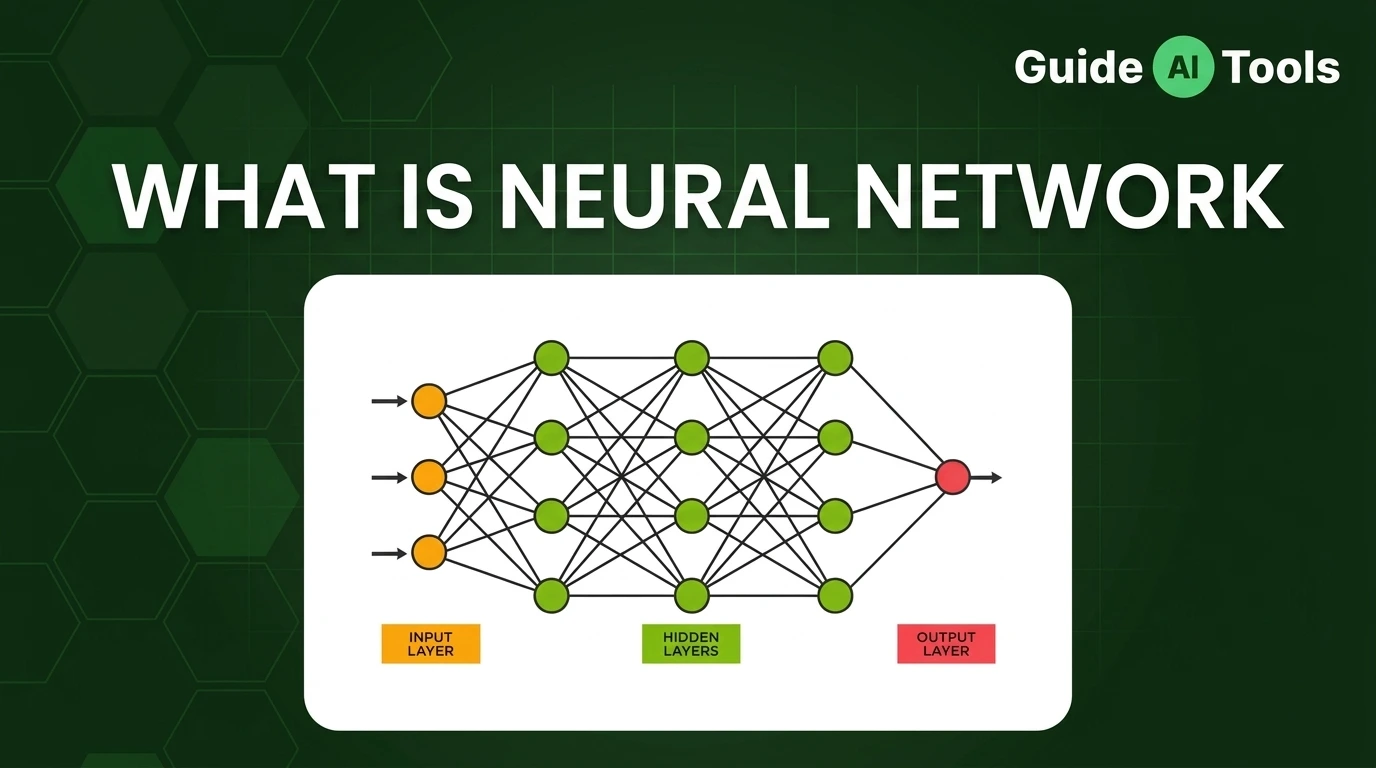
A neural network is a machine learning model made of connected artificial neurons arranged in layers. It learns patterns from data by adjusting numerical values called weights and biases. Once trained, it can process new inputs and produce predictions, classifications, scores or other outputs. Neural networks power many modern AI systems.
What Is a Neural Network?
A neural network is a computational model that learns relationships between inputs and outputs by passing information through connected layers of artificial neurons. Stanford HAI’s definition of neural networks provides a concise explanation of this model and its role in AI.
The name can sound more mysterious than the technology really is. An artificial neuron isn’t a tiny version of a brain cell. It’s a mathematical unit that receives numbers, performs a calculation and passes a result to another part of the network.
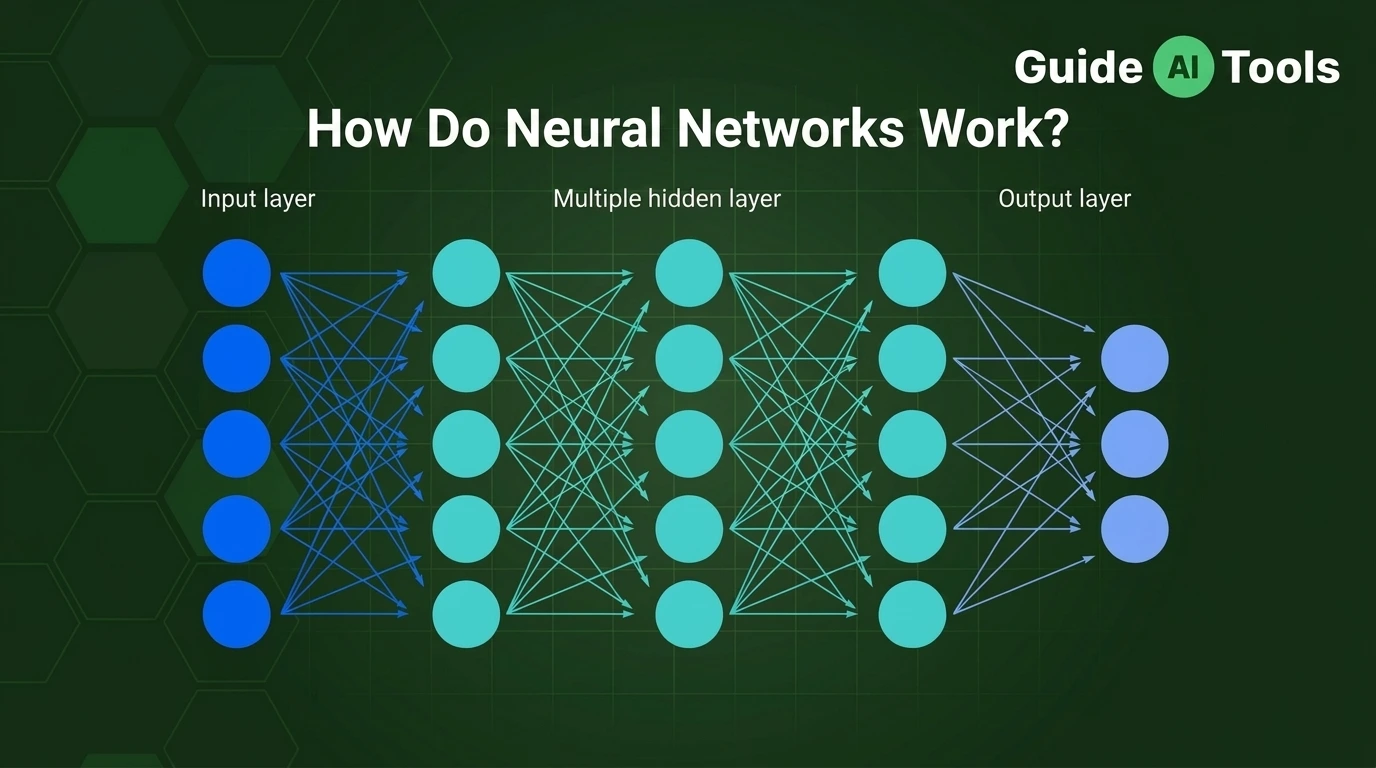
A typical neural network contains three basic parts:
| Part | What it does | Simple example |
|---|---|---|
| Input layer | Receives the data | Image pixels, words or measurements |
| Hidden layers | Process and transform the information | Find useful patterns |
| Output layer | Produces the final result | Class, score or prediction |
Each connection between neurons has a weight. The network also uses biases and activation functions to transform information as it moves through the layers. Stanford HAI describes neural networks as computational models made from interconnected layers of artificial neurons, while IBM describes them as machine learning models that learn pattern-recognizing weights and biases from data.
A simple way to picture it is this:
Input data
   ↓
Input layer
   ↓
Hidden layer
   ↓
Hidden layer
   ↓
Output layer
   ↓
Prediction
The interesting part isn’t just the structure. It’s what happens while the network is learning.
How Does a Neural Network Work?
A neural network works by passing numerical information through layers, applying weights and activation functions, producing an output and adjusting its parameters during training.
Let’s use a spam filter as an example.
Suppose an email contains words such as “prize,” “winner” and “claim.” A trained network can receive numerical representations of those features and use learned relationships to estimate whether the message looks like spam.
The process can be simplified like this:
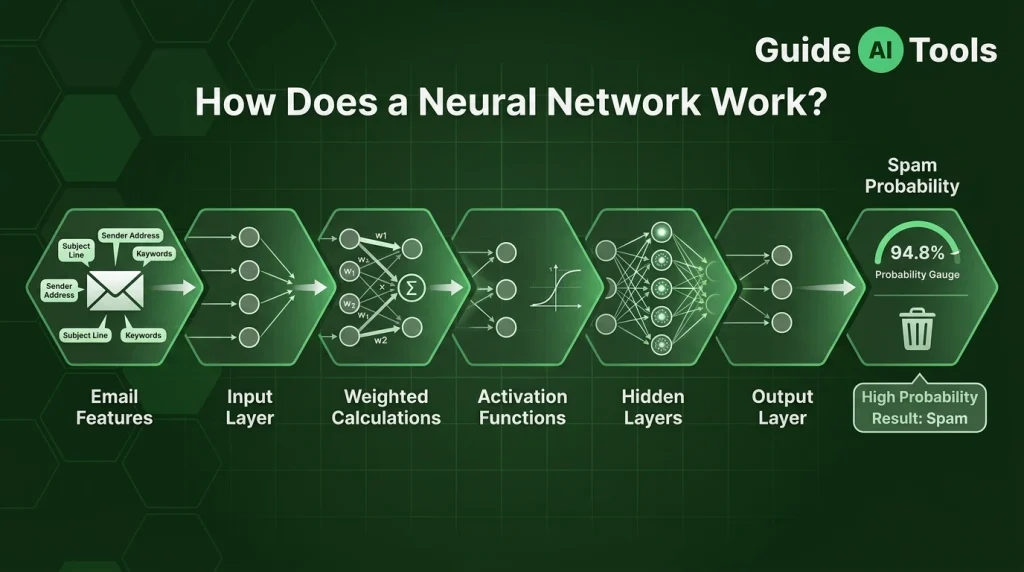
A neuron doesn’t simply ask whether one word exists. It combines information from multiple inputs. Each input can have a different weight, which changes how much that input affects the calculation.
Google Cloud explains that neural networks learn by adjusting the weights connecting neurons during training. The model repeatedly processes data and changes those weights to reduce the difference between its predictions and the expected results.
That’s the basic idea.
The network starts with parameters that don’t yet produce useful predictions. Training gradually changes those parameters. After enough training, the network can apply what it learned to new examples.
What Are the Layers of a Neural Network?
The layers of a neural network divide the work into stages, with each stage receiving information from the previous one and passing its output forward.
Input layer
The input layer receives the features that represent the original data.
For an image model, those values could represent information extracted from an image. For a prediction model, they could represent measurements such as temperature, age or transaction value.
The input layer doesn’t necessarily “understand” the data in a human sense. It receives numerical information.
Hidden layers
Hidden layers sit between the input and output layers.
This is where much of the network’s processing takes place. Each layer transforms the representation it receives and passes the result to the next layer.
A simple network might have only a small number of hidden layers. A deep neural network can contain many.
The word “hidden” doesn’t mean secret. It simply means these layers aren’t the direct input or final output of the model.
Output layer
The output layer produces the network’s final result.
For a binary classification task, the output might represent the probability of one class. For a multi-class task, several output values can represent different classes. Regression models can produce numerical values instead.
AWS describes input, hidden and output layers as the basic structure of a neural network, while also distinguishing deeper networks by their larger number of hidden layers.
One detail matters here: not every neural network has the same architecture. The number of layers, neurons, connections and activation functions depends on the task and model design.
What Are Neurons, Weights and Biases?
Artificial neurons, weights and biases are the basic mathematical pieces that allow a neural network to turn input values into useful outputs.
Think of a neuron as a small calculation point.
It receives inputs from previous neurons. Each input is multiplied by a weight. The results are combined, a bias is added and an activation function transforms the result.
A simplified equation looks like this:
z = w1x1 + w2x2 + b

output = activation(z)
Here:
xrepresents an inputwrepresents a weightbrepresents a biaszrepresents the weighted result before activation- the activation function transforms that result
What does a weight do?
A weight controls how strongly an input affects a calculation.
Imagine a spam classifier has learned that certain features are more closely associated with spam than others. The model can assign different weights to those features based on what it learned during training.
Weights aren’t manually assigned for every prediction. They are learned during model training.
What does a bias do?
A bias gives the neuron another adjustable value that shifts its calculation.
Without getting buried in mathematics, you can think of it as another parameter that helps the neuron produce a useful output.
IBM explains weights and biases as learned model parameters that determine how inputs influence calculations inside a neural network.
What Is an Activation Function?
An activation function transforms the value produced by a neuron and introduces nonlinearity into the network.
Why does that matter?
Without nonlinear activation functions, stacking many purely linear operations wouldn’t give a neural network the same ability to represent complex nonlinear relationships.
Common activation functions include:
| Activation function | Basic behavior | Common role |
|---|---|---|
| ReLU | Converts negative values to zero while keeping positive values | Common in hidden layers |
| Sigmoid | Maps values toward a range between 0 and 1 | Some binary output tasks |
| Tanh | Maps values toward a range between -1 and 1 | Certain neural network architectures |
| Softmax | Converts a set of values into probabilities that sum to 1 | Multi-class classification |
The exact activation function depends on the architecture and task. IBM and NVIDIA both describe activation functions as transformations applied to weighted inputs, with nonlinear functions helping neural networks represent more complex patterns.
So when you see “activation,” don’t think of a neuron switching on like a light bulb.
It’s a mathematical transformation.
How Does a Neural Network Learn?
A neural network learns during training by comparing its predictions with known targets or other learning signals and adjusting its parameters to reduce error.
This is where the process becomes more interesting.
Suppose a model receives an email that is actually spam. It produces a prediction, but the prediction is wrong. The training process needs a way to measure how wrong that prediction was.
That’s the job of a loss function.
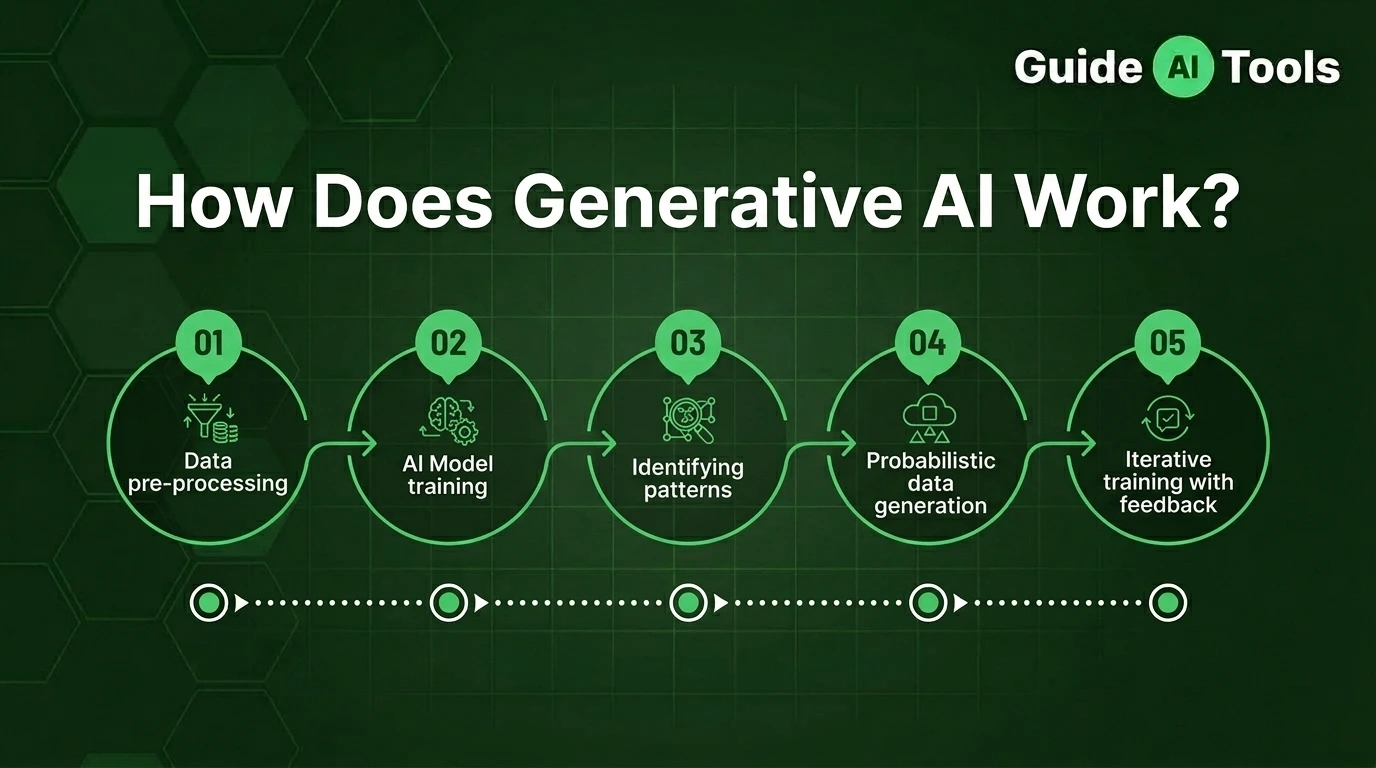
A simplified training cycle looks like this:
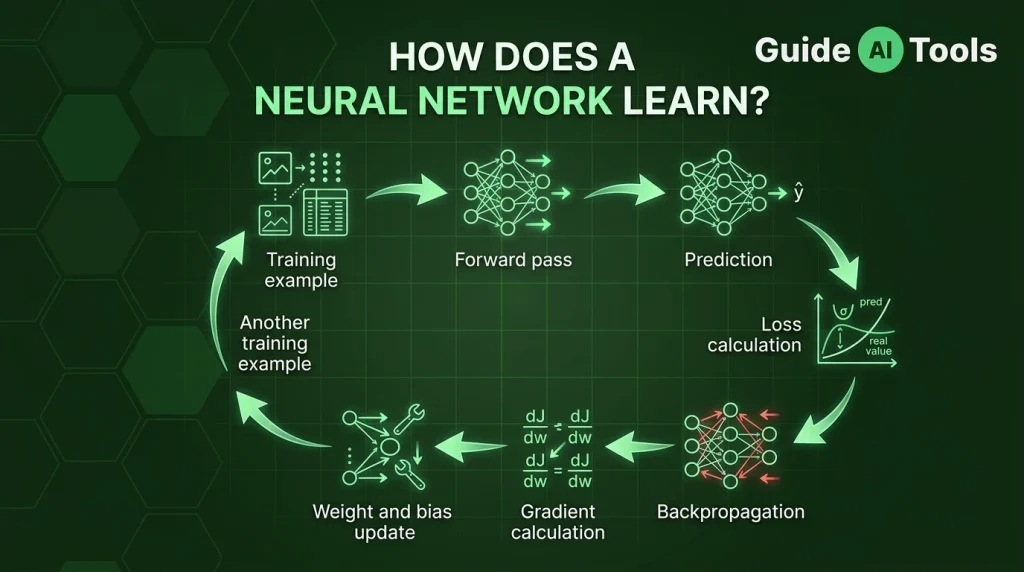
The forward pass sends information through the network and produces a prediction.
The loss function measures the difference between that prediction and the target. The exact loss function depends on the task.
Backpropagation then works backward through the network to calculate how the parameters contributed to the error. An optimization method such as gradient descent can use those gradients to update the weights and biases.
IBM’s current explanation describes this process as a forward pass, error calculation, backward pass through backpropagation and parameter updates using an optimization method such as gradient descent.
The cycle repeats many times.
That repetition is what gradually changes the network from a model with unhelpful parameters into one that can perform the task it was trained for.
What Is the Difference Between Training and Inference?
Training is when a neural network adjusts its learned parameters, while inference is when the trained model uses those parameters to process new input.
| Training | Inference |
|---|---|
| Learns model parameters | Uses learned parameters |
| Processes training data | Processes new input |
| Calculates loss | Produces an output |
| Updates weights and biases | Normally doesn’t update them |
| Happens during model development | Happens when the model is being used |
Consider the spam example again.
During training, the model sees many examples and adjusts its parameters.
During inference, you send it a new email. The trained network processes that email and produces a prediction.
NVIDIA explicitly distinguishes training, where network parameters are adjusted to reduce prediction error, from inference, where a trained network produces predictions from inputs.
This distinction is easy to miss, but it clears up a lot of confusion about how AI models actually operate.
What Are the Main Types of Neural Networks?
Neural networks come in different architectures because different tasks call for different ways of processing information.
Feedforward neural networks
Feedforward networks pass information from the input toward the output without recurrent feedback loops.
Multilayer perceptrons, or MLPs, are a common example.
Convolutional neural networks
Convolutional neural networks, usually called CNNs, are strongly associated with image and spatial data.
They use convolution operations to extract useful features from inputs such as images.
A CNN might learn representations involving edges, shapes and increasingly complex visual patterns across its layers.
Recurrent neural networks
Recurrent neural networks, or RNNs, are designed for sequential information and include connections that allow information from earlier processing steps to influence later ones.
They have been used for tasks involving sequences such as time-series data and language.
Long short-term memory networks
LSTM networks are a type of recurrent neural network designed to handle dependencies across longer sequences.
They became widely used for various sequence-processing tasks before transformer architectures became dominant in many language applications.
Transformers
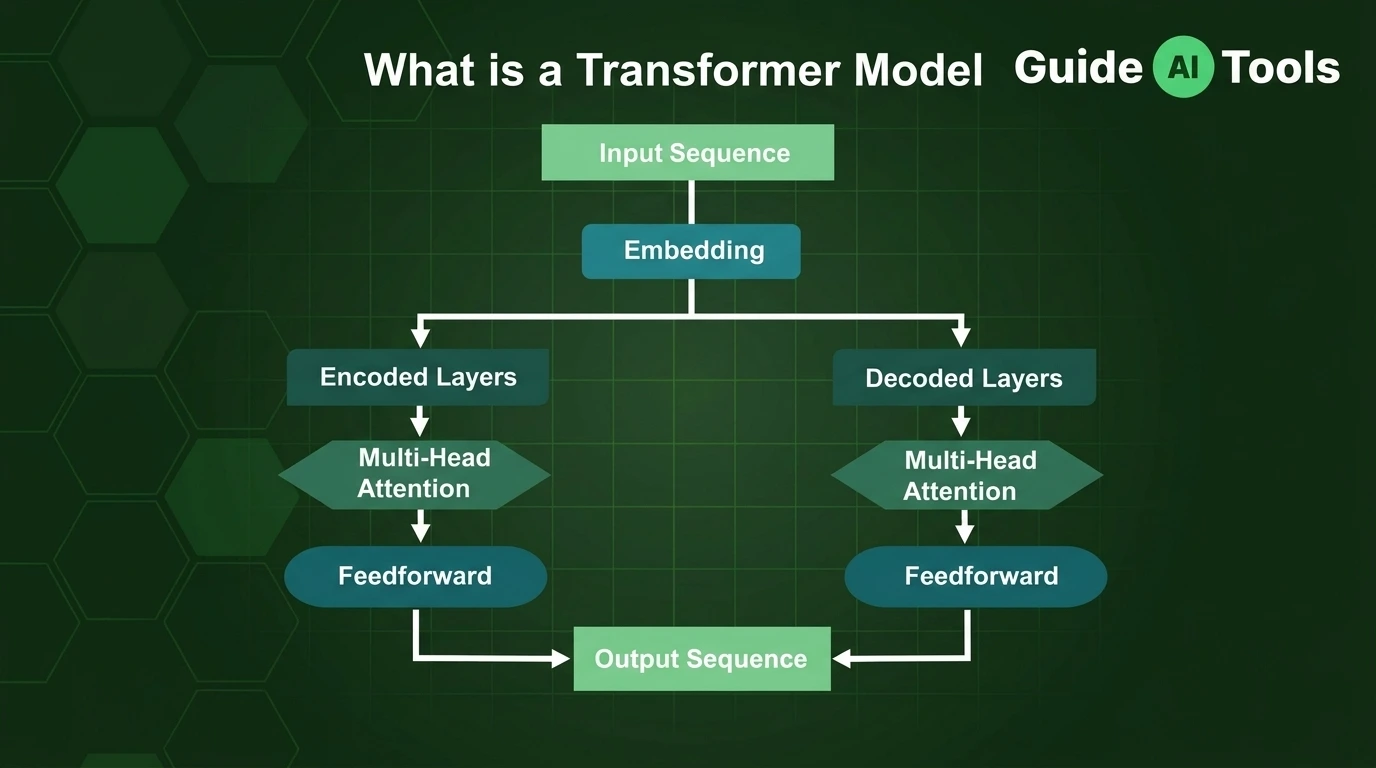
Transformers use attention mechanisms to determine how different parts of an input relate to one another.
They are now widely used in language models and many other modern AI systems.
Google Cloud lists feedforward networks, RNNs, CNNs and GANs among common neural network types, while IBM discusses modern architectures including transformers and convolutional networks.
This doesn’t mean one architecture is automatically better than another. Architecture choice depends on the data, task, training setup and computational requirements.
What Are Neural Networks Used For?
Neural networks are used for tasks involving pattern recognition, classification, prediction and many forms of data processing.
You may already interact with them without realizing it.
| Area | Example use |
|---|---|
| Computer vision | Image classification and object detection |
| Speech recognition | Converting spoken language into text |
| Natural language processing | Classifying and processing text |
| Recommendation systems | Predicting useful content or products |
| Forecasting | Finding patterns in time-series data |
| Fraud detection | Identifying unusual transaction patterns |
| Medical imaging | Analyzing images for relevant patterns |
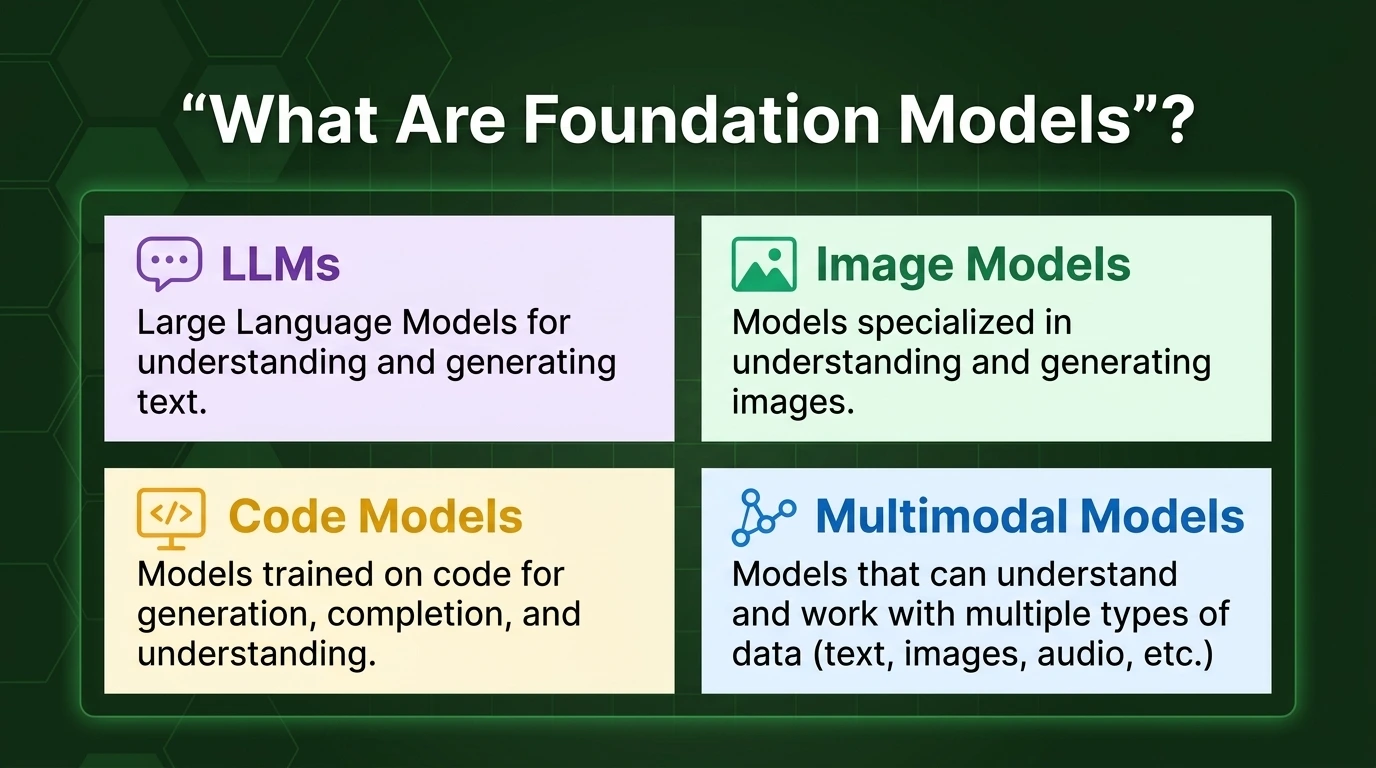
| Generative AI | Supporting models that generate text, images, audio or other content |
Google Cloud lists applications such as handwriting recognition, facial recognition and medical image analysis. MathWorks also describes uses including image segmentation, object detection, speech recognition, medical diagnosis and forecasting.
Neural networks can also sit underneath technologies you encounter in AI tools for writing, image generation, video creation, audio processing and speech recognition.
The tool is what you see.
The model underneath may be doing the heavy mathematical work.
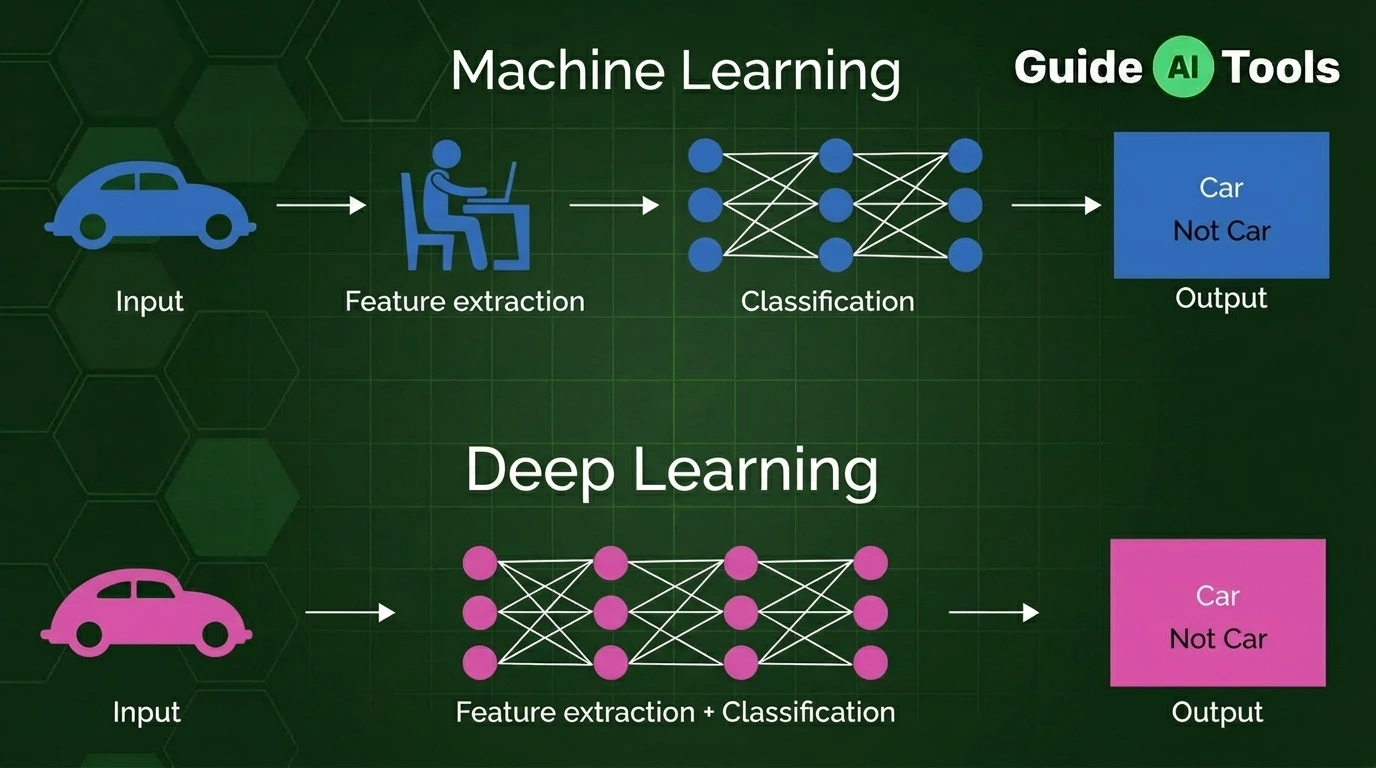
Neural Networks vs Machine Learning vs Deep Learning
AI, machine learning, neural networks and deep learning aren’t interchangeable terms.
| Concept | Meaning |
|---|---|
| Artificial intelligence | Broad field focused on systems capable of tasks associated with intelligent behavior |
| Machine learning | An approach within AI where systems learn patterns from data |
| Neural network | A family of machine learning models built from connected computational units |
| Deep learning | Machine learning based on neural networks with multiple layers |
A neural network can be part of machine learning.
Deep learning generally refers to machine learning methods based on neural networks with multiple layers.
Your existing GuideAITools pages cover these concepts separately, so this page shouldn’t repeat their full explanations. For a deeper explanation, see What Is Machine Learning? and What Is Deep Learning?.
The broader relationship is:
Artificial Intelligence
        ↓
Machine Learning
        ↓
Neural Networks
        ↓
Deep Neural Networks
        ↓
Deep Learning
That diagram is simplified rather than a strict hierarchy in every technical context. Neural networks are a model family within machine learning, while deep learning refers to the use of sufficiently deep neural network architectures.
Are Neural Networks Based on the Human Brain?
Neural networks are inspired by biological neurons, but modern artificial neural networks should not be treated as digital copies of the human brain.
The terminology comes from the idea of interconnected neurons processing information. Artificial neurons, however, perform mathematical operations inside computational systems.
That’s a major distinction.
NVIDIA specifically points out that modern deep learning has limited connection to neurobiology despite the terminology used to describe artificial neurons and neural networks.
So when someone says a neural network “works like the brain,” treat that as a simplified analogy, not a literal description.
The analogy helps explain why the term exists.
It doesn’t explain everything happening inside the model.
What Are the Advantages and Limitations of Neural Networks?
Neural networks are useful because they can learn complex relationships from data, but they also have practical limitations.
Advantages
- They can model nonlinear relationships that are difficult to express with simple rules.
- They can learn useful representations from large datasets.
- They can work with complex inputs such as images, audio and text.
- They support classification, regression, recognition and prediction tasks.
- Different architectures can be adapted to different types of data.
- The same basic learning principles can support both relatively small models and extremely large neural networks.
Limitations
A neural network isn’t automatically the right choice for every problem.
Training can require substantial computing resources, particularly for large models. Data quality also matters. If the training data contains poor labels, unwanted patterns or strong biases, the resulting model can learn those problems.
Overfitting is another concern. A model can perform very well on its training examples while performing poorly on new data.
Interpretability can also be difficult. With a large neural network, understanding exactly why a particular prediction occurred can be much harder than reading a simple rule written by a programmer.
AWS notes that deep neural networks can require considerably more training data than simpler machine learning approaches, while IBM identifies overfitting as a common challenge for neural networks.
So the useful question isn’t “Are neural networks good?”
It’s “Does this architecture fit the problem, data and available resources?”
What Is a Neural Network in Simple Terms?
A neural network is a collection of connected mathematical units that learns from examples.
Imagine giving it thousands of labeled examples. It processes each example, makes a prediction, measures its error and adjusts its internal parameters. After repeating that process, the network can use the learned parameters when it receives new data.
That’s the heart of it:
Examples
   ↓
Prediction
   ↓
Error
   ↓
Adjustment
   ↓
Better parameters
   ↓
New prediction
The network isn’t memorizing a fixed list of answers in the ordinary sense. Its parameters are adjusted so that the model can represent patterns useful for the task.
FAQs
What is a neural network?
A neural network is a machine learning model made of connected artificial neurons arranged in layers. It learns parameters from data and uses them to produce predictions or other outputs.
How does a neural network work?
A neural network passes numerical input through connected layers. Each neuron applies weighted calculations and an activation function, while training adjusts the model’s weights and biases to reduce prediction error.
What is an artificial neuron?
An artificial neuron is a computational unit that receives numerical inputs, combines them using learned parameters, applies a mathematical transformation and produces an output for the next part of the network.
What are weights and biases in a neural network?
Weights control how strongly inputs affect a neuron’s calculation. A bias is another learned parameter that shifts the calculation before the activation function is applied.
How does a neural network learn?
It learns during training by making predictions, measuring their error and adjusting its parameters. Backpropagation calculates how parameters contributed to the error, while optimization methods such as gradient descent update them.
What is backpropagation in neural networks?
Backpropagation is a method used during training to calculate how changes to network parameters affect the loss. Those gradients can then guide parameter updates.
What is the difference between training and inference?
Training adjusts a neural network’s parameters using data. Inference uses the trained parameters to produce an output from new input.
What are neural networks used for?
Neural networks are used for image recognition, speech recognition, natural language processing, recommendation systems, forecasting, anomaly detection and many other prediction or pattern-recognition tasks.
Is a neural network the same as deep learning?
No. A neural network is a model family, while deep learning generally refers to machine learning that uses neural networks with multiple layers.
Are neural networks the same as artificial intelligence?
No. Artificial intelligence is the broader field. Neural networks are one type of machine learning model used within AI systems.
Are neural networks based on the human brain?
They are inspired by some ideas associated with biological neurons, but artificial neural networks are mathematical computational systems and don’t reproduce the human brain.
Final Takeaway
A neural network becomes much easier to understand once you stop thinking of it as a mysterious “AI brain.”
It’s a layered mathematical model.
Inputs move through connected neurons. Weights and biases shape those calculations. Activation functions allow the network to represent nonlinear relationships. During training, the model compares predictions with targets, calculates loss and adjusts its parameters. During inference, it uses what it learned to process new data.
That basic structure sits underneath a huge range of AI applications, from computer vision and speech recognition to recommendation systems and modern generative models.
If you’re building your AI fundamentals knowledge step by step, the natural next concepts are What Is Machine Learning? and What Is Deep Learning?. For the broader foundation, you can also read What Is Artificial Intelligence?.

Related Blog Posts