Best AI Blockchain Tools (2026): Top Web3 & Crypto AI Platforms

Analyzing raw blockchain data manually means reading an endless stream of hexadecimal transaction hashes.
AI blockchain tools bridge this gap by converting complex on-chain records, wallet behaviors, and smart contract code into clear, actionable intelligence.
In my testing across multiple Web3 stacks, I’ve noticed that most teams struggle with indexing latency and gas overhead. Picking the right tools eliminates these bottlenecks quickly.
What Are AI Blockchain Tools? The Short Answer
AI blockchain tools are specialized software platforms and decentralized protocols that integrate machine learning algorithms with Web3 infrastructure. They automate complex on-chain tasks, including wallet tracking, real-time threat detection, automated smart contract auditing, natural language querying, and autonomous agent execution across decentralized networks.
Traditional blockchain analytics tools show static wallet balances without context.
To understand how machine learning models process complex pattern recognition, review our foundational guide on what is artificial intelligence for core structural context.
Modern AI platforms use probabilistic models to detect transaction anomalies and predict wallet movements.
AI blockchain tools turn raw transaction logs into predictive market signals and security automation without manual data parsing.
How We Tested and Ranked the Top AI Blockchain Tools
Our evaluation methodology focuses on strict technical benchmarks rather than marketing hype.
From what I have seen, flashy product claims crumble when API rate limits hit production thresholds. We tested each platform on on-chain retrieval speed, model inference accuracy, pricing transparency, and developer SDK integration.
- Data indexing speed across major networks including Solana, Ethereum, and Polygon.
- API compute unit caps and rate limit thresholds under heavy network load.
- Machine learning model accuracy in identifying labeled wallet entities and code vulnerabilities.
- Developer experience with native SDKs and Web3 wallet connections.
We verified smart contract execution standards against official specifications from the Ethereum Foundation during our testing workflows.
Best AI Blockchain Tools Comparison Matrix
| Tool Name | Core Niche | Primary Target User | Key Standout Feature | Pricing Model |
| Nansen | Crypto & Wallet Analytics | Traders & Funds | Smart Money wallet profiling and token flow alerts | Paid ($49/mo) + Free Tier |
| Chainalysis | Blockchain Compliance | Enterprises & Agencies | Forensics, KYT transaction monitoring, & threat scoring | Enterprise Quote |
| Fetch.ai | Autonomous AI Agents | Protocol Builders | Self-executing Web3 agent infrastructure | Usage / Tokenomics ($FET) |
| Moralis | Web3 Developer Platform | DApp Developers | Cross-chain Web3 APIs and real-time streams | Paid ($149/mo) + Free Trial |
| SingularityNET | Decentralized AI Network | AI Developers | Open marketplace for decentralized AI models | Pay-Per-Call ($AGIX) |
| Dune Analytics | On-Chain Data Queries | Analysts & Teams | Text-to-SQL AI query engine & custom dashboards | Paid ($65/mo) + Free Tier |
| CertiK | Smart Contract Security | Web3 Founders | AI automated code scanning & Skynet monitoring | Quote-Based Audit + SaaS |
| Token Metrics | Market Intelligence | Investors | AI rating engine and price trend forecasts | Tiered Subscription |
| Bittensor | Decentralized ML | ML Engineers | Open network for incentivized AI model training | Staking / Tokenomics ($TAO) |
| Ocean Protocol | AI Data Monetization | Data Scientists | Compute-to-data privacy and data tokenization | Pay-As-You-Go ($OCEAN) |
Detailed Reviews of Top 10 AI Blockchain Tools
Nansen
Nansen is an on-chain analytics platform that labels millions of crypto wallet addresses in real time. It helps traders move past raw transaction hashes to track institutional Smart Money movements.
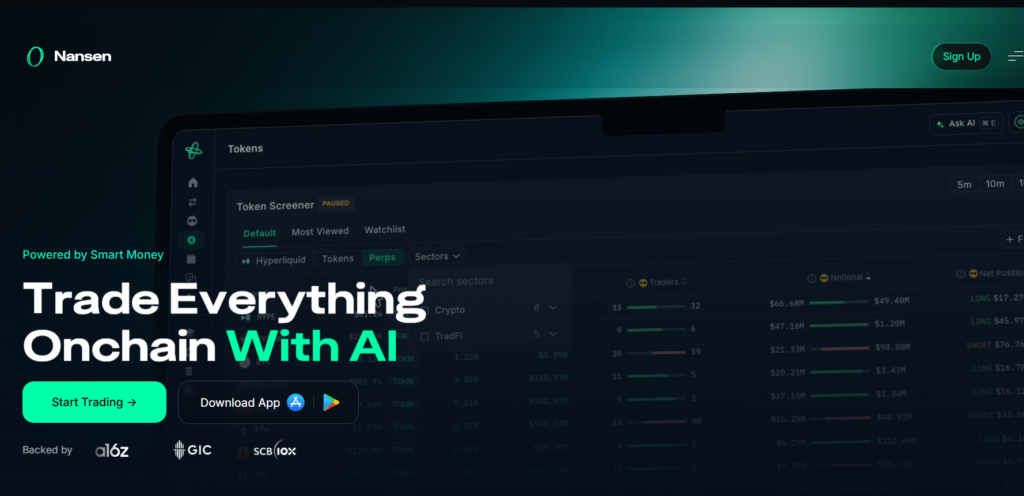
Machine learning algorithms cluster and classify wallet activities across multiple blockchains. The system parses token flows, wallet balances, and exchange deposits, sending automated alerts when tagged wallets move capital.
Pros:
- Real-time tracking of institutional wallets, venture funds, and whales
- Coverage across Solana and EVM chains with custom token dashboards
- Free tier includes basic features and 20 weekly AI agent credits
Cons:
- Pro plans start at $49 per month, which feels high for casual hobbyists
- Interface takes time to learn for beginners unfamiliar with wallet profiling
Chainalysis
Chainalysis provides enterprise-grade blockchain forensics and compliance software. Government agencies, financial institutions, and crypto exchanges rely on this platform to investigate illegal activities and manage risk.
The platform maps wallet addresses to real-world entities using cross-chain data analysis. Its Know Your Transaction engine continuously scans transaction streams, assigning real-time risk scores to incoming and outgoing funds.
Pros:
- Industry standard for legal compliance and threat intelligence
- Detects fraudulent activity, hacks, and mixer transfers across thousands of assets
- Provides deep investigative tools for law enforcement and compliance officers
Cons:
- Requires a custom enterprise quote with no public pricing rate card
- Setup process requires sales onboarding rather than instant self-serve access
Fetch.ai
Fetch.ai is an open platform for building self-executing autonomous AI agents on Web3 infrastructure.

Developers construct software agents inside the Agentverse framework. These agents discover other services on the decentralized network, negotiate contracts, and execute complex cross-chain workflows automatically using machine learning logic.
To learn more about how autonomous software systems operate, read our complete guide on what are ai agents on GuideAITools.
Pros:
- Enables peer-to-peer automation without central server dependencies
- Excellent framework for automated DeFi trading, supply chain tracking, and data routing
- Agentverse playground allows quick prototyping in sandbox environments
Cons:
- Requires knowledge of Python and decentralized network mechanics
- Network gas fees depend on $FET token market volatility
Moralis
Moralis is a Web3 developer platform that delivers cross-chain APIs, RPC nodes, and real-time data streams.
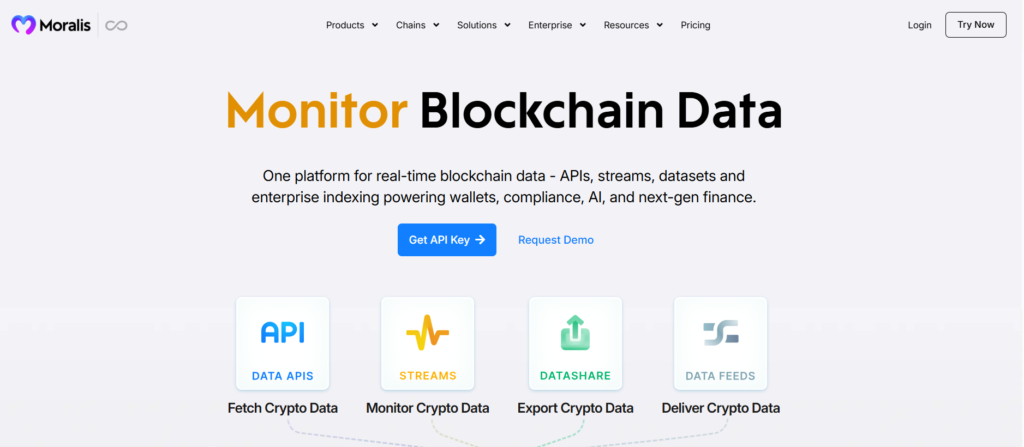
Its indexing engine fetches raw block data from multiple blockchains, parsing it into clean, structured JSON feeds. Developers connect their applications to Moralis SDKs to query wallet balances, NFT metadata, and token transfers instantly.
Pros:
- Saves hundreds of engineering hours spent maintaining custom blockchain indexers
- High-throughput RPC nodes with automatic fallback protections
- Starter tier provides 2 million Compute Units per month for testing
Cons:
- Scaling to high-traffic apps costs $149 to $749 per month quickly
- Monthly compute unit caps require careful rate-limit optimization
SingularityNET
SingularityNET is a decentralized marketplace for hosting, selling, and purchasing AI algorithms.

Machine learning engineers publish their trained AI models as smart contracts on the decentralized network. Users query these models directly via APIs, paying for individual inference calls using AGIX tokens or fiat payment options.
Pros:
- Prevents single-company monopolies over specialized AI models
- Enables cross-model communication where multiple AI tools work together on complex tasks
- Pay-per-call pricing means developers pay only for actual API consumption
Cons:
- Token-based API payments create friction for non-crypto native users
- Marketplace quality varies across niche AI algorithms
Dune Analytics
Dune Analytics is an on-chain data platform that turns raw blockchain logs into custom visual dashboards.
Its built-in Dune AI engine uses natural language processing to translate plain English prompts into accurate SQL queries. The platform executes queries against massive, pre-indexed tables covering major EVM and non-EVM chains.
Pros:
- Dune AI builds complex charts without requiring deep SQL knowledge
- Massive community library of free public dashboards and queries
- Analyst tier provides 4,000 monthly credits for $65 per month
Cons:
- Free tier limits query execution speeds during peak network hours
- Advanced multi-chain queries still require manual SQL tweaking
CertiK
CertiK is a smart contract security platform that combines automated AI vulnerability scanning with formal verification.
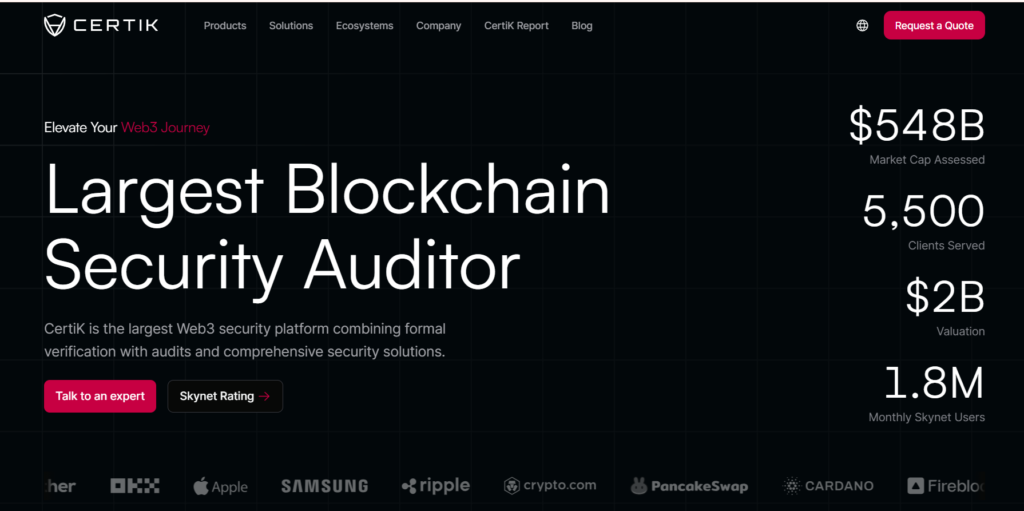
The platform uses static analysis algorithms and machine learning models to review smart contract source code for reentrancy bugs, flash loan exploits, and access control flaws. Its Skynet system provides ongoing on-chain security monitoring post-deployment.
Pros:
- Automated code scanners spot common vulnerabilities before mainnet deployment
- Skynet dashboard provides live security scores and threat alerts for Web3 projects
- Proven track record protecting billions of dollars in DeFi protocol assets
Cons:
- Full manual audits require custom quotes based on code lines
- Automated scans cannot replace comprehensive human security reviews entirely
Token Metrics
Token Metrics is an AI-powered investment platform that delivers quantitative ratings and price signals for crypto assets.
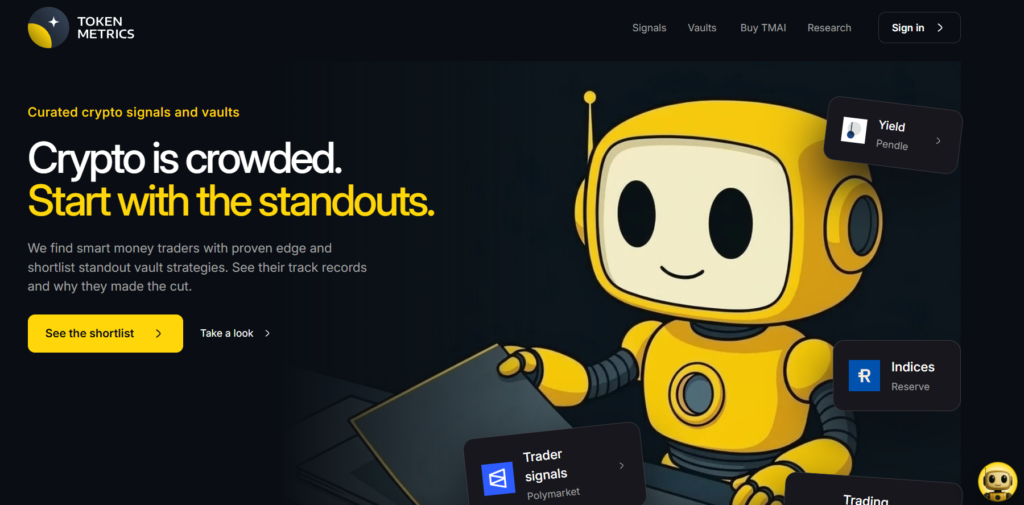
Its machine learning engine processes technical indicators, social sentiment, on-chain data, and fundamental project metrics. The algorithms generate scorecards, trend forecasts, and automated portfolio allocation models for traders.
Pros:
- Quantitative rating system removes emotional bias from crypto trading
- Automatically builds diversified portfolio indices based on risk tolerance
- Offers a basic tier for investors testing automated market signals
Cons:
- Higher-tier plans for advanced trading signals can feel expensive for retail traders
- Predictive models struggle during extreme black-swan market events
Bittensor
Bittensor is an open-source decentralized network that incentivizes the collaborative training of machine learning models.

The network operates on specialized subnets where machine learning engineers run compute nodes. Miners compete to supply AI inference and training, while validators evaluate output quality, rewarding the best models with TAO tokens.
Pros:
- Creates a decentralized alternative to centralized AI compute providers
- Incentivizes open-source AI development through direct token rewards
- Subnet architecture allows specialized models for text, audio, and code
Cons:
- Setting up subnets and mining nodes requires advanced machine learning hardware
- High TAO token staking requirements for validator status
Ocean Protocol
Ocean Protocol is a decentralized data exchange protocol designed for secure AI model training.
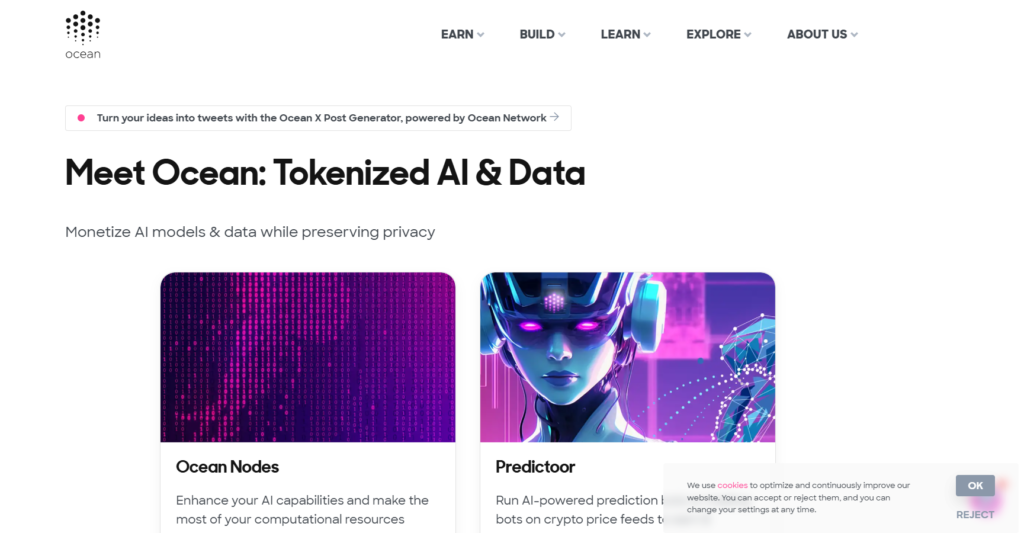
Its Compute-to-Data technology allows AI models to run training runs directly on private datasets without exposing raw records to the model developer. Datasets are tokenized into datatokens, allowing owners to buy, sell, and monetize data on open markets.
Pros:
- Solves data privacy challenges when training enterprise AI models
- Unlocks monetization for sensitive medical, financial, and private datasets
- Pay-as-you-go data access powered by OCEAN tokens
Cons:
- Data marketplace liquidity varies across specialized industries
- Requires custom integration to set up private compute-to-data pipelines
Pricing and Feature Overview Across Top Tools
Pricing models split between flat monthly SaaS subscriptions, compute unit caps, and tokenomic gas fees.
Look at how billing structures differ before selecting software for production apps.
| Tool Name | Free Tier Available? | Starting Paid Price | Top Tier / Enterprise | Primary Billing Metric |
| Nansen | Yes ($0/mo) | $49 / month | Custom / Enterprise | Monthly Subscription & Credits |
| Chainalysis | No (Sales Demo) | Custom Annual Quote | Custom Enterprise | Annual Contract & Volume Tiers |
| Fetch.ai | Yes (Free Sandbox) | Usage-Based ($FET) | Custom Protocol | Network Gas & Agent Credits |
| Moralis | Yes (Free Trial) | $149 / month | $749 / month (Business) | Monthly Compute Units (RPS) |
| SingularityNET | Yes (Test Credits) | Pay-Per-Call ($AGIX) | Enterprise Custom | API Calls & Token Consumption |
| Dune Analytics | Yes ($0/mo) | $65 / month | $349 / mo (Plus) / Custom | Query Credits & Seat Licenses |
| CertiK | Yes (Public Skynet) | Quote-Based Scan | Custom Full Audit | Lines of Code & Monitoring Scope |
| Token Metrics | Yes (Basic Access) | Tiered Subscription | Custom VIP Plan | Monthly/Annual Subscription |
| Bittensor | Yes (Open Source) | Subnet Staking ($TAO) | Protocol Validator | Token Stake & Burn Recycles |
| Ocean Protocol | Yes (Public Market) | Pay-As-You-Go ($OCEAN) | Enterprise Data Pool | Data Token Fees & Gas |
Key Factors to Consider When Choosing an AI Blockchain Tool
Selecting Web3 software requires aligning tools with operational goals.
- Indexing latency matters most for trading workflows. Delayed block data causes trade execution failures.
- Calculate API compute unit caps before scaling up. Moralis offers 2 million to 500 million compute units per month depending on your plan tier.
- Regulated institutional projects require custom enterprise quotes from verified security platforms like Chainalysis.
- Self-hosted developer stacks favor open protocols like Bittensor and Fetch.ai for custom agent flexibility.
Honestly, most teams mess this up by picking consumer dashboards for enterprise infrastructure. Verify API rate limits before signing annual contracts.
FAQs
What are the best AI blockchain tools in 2026?
The best AI blockchain tools include Nansen for wallet tracking, Moralis for Web3 APIs, Chainalysis for compliance, Dune Analytics for data queries, and Fetch.ai for autonomous AI agents.
How is AI used in blockchain technology?
AI machine learning algorithms run transaction monitoring, automated smart contract audits, wallet entity labeling, and predictive crypto market analytics.
What is the best AI tool for crypto trading and wallet tracking?
Nansen leads crypto wallet tracking with Smart Money labeling and real-time token movement alerts.
Which AI tool is best for smart contract security audits?
CertiK offers automated static vulnerability scans and Skynet real-time code monitoring prior to deployment.
What is the difference between SaaS AI tools and decentralized AI protocols?
SaaS tools use flat monthly pricing and hosted cloud APIs, while decentralized protocols use native tokens to pay for compute tasks.
How do autonomous AI agents work on Web3 blockchains?
Autonomous Web3 agents run pre-programmed logic and machine learning models to execute cross-chain transactions and data swaps independently.
How much do AI blockchain analytics tools cost?
Analytics tools start with $0 free plans and range from $49 to $349 per month for pro subscriptions.
Can AI write and audit blockchain smart contracts automatically?
AI static code scanners highlight potential security bugs, but human security audits remain necessary for final deployment verification.
Taking Control of Web3 with AI Blockchain Tools
AI blockchain tools are transforming Web3 workflows from manual transaction parsing into automated intelligence.
Understanding price tiers, compute unit limits, and protocol architectures helps you build the optimal software stack.
Whether you need automated smart contract scanning or real-time wallet analytics, matching tools to technical requirements saves compute overhead.
Explore our full directory at GuideAITools to compare top Web3 platforms, developer toolkits, and crypto AI software. Compare features, test API capabilities, and launch your ideal Web3 AI stack today.

Related Blog Posts