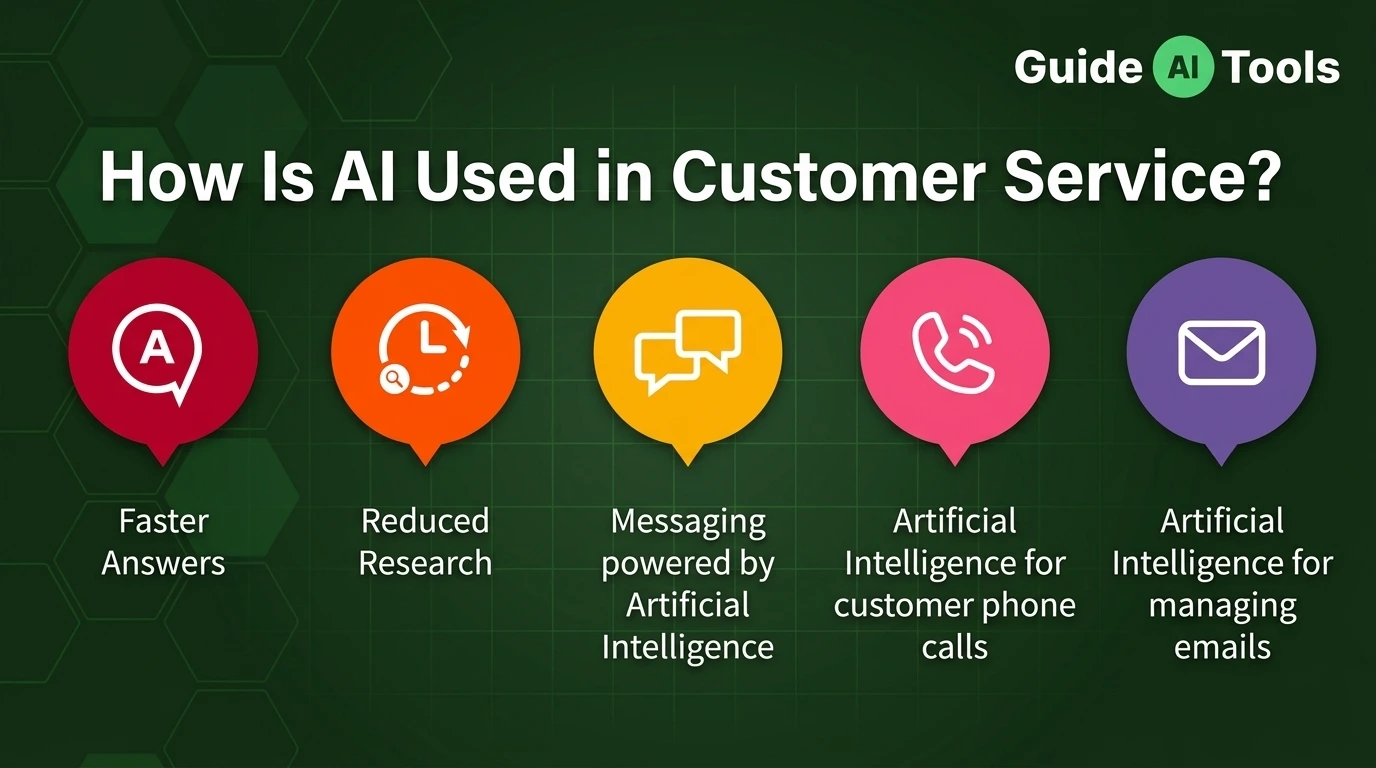
How Is AI Used in Customer Service?
AI in customer service means software that reads a customer’s message, works out what they need, and answers from the company’s own help content or account data. It can take simple actions, like tracking an order or resetting a password, and it passes the case to a person, with a summary, when it should not handle the case alone.
Picture the classic case. It is 2 a.m., a customer asks where a parcel is, and the answer lands in seconds. No queue. No ticket number. No waiting for office hours.
The same systems work behind the desk too. They draft replies for human agents, flag the customer who is about to lose patience, and mine old tickets for patterns. AI in customer support now touches almost every stage of a case, from first ping to final survey.
And the same software can invent a refund policy that never existed. One airline has already been ordered to pay for exactly that. Fast is easy. Right is the hard part.
What AI in Customer Service Actually Means
Strip away the marketing and the definition is plain. AI in customer service is software that understands what a customer is asking, finds or works out an answer, and acts or replies without a person writing every word.
Three forms get mixed up in most sales pitches. A rule-based chatbot follows scripts and button menus, and it breaks the moment you type something off script. An AI agent reads free text, pulls answers from company documents, and can act inside other systems, checking stock or filing a refund. Agent assist never speaks to the customer at all. It sits beside the human agent, drafting replies and fetching facts while the person keeps control of the conversation.
What changed is the engine. Old bots matched keywords. Current systems run on large language models grounded in the company’s own help content, which is why they can phrase a policy in plain words instead of pasting a link at you. We keep a deeper comparison of AI agents vs chatbots for the full split.
| Header Label | Rule-based chatbot | AI agent | Human agent |
|---|---|---|---|
| How it understands you | Matches keywords and menu buttons | Reads free text and works out intent | Reads the words, the tone and the history |
| What it can actually do | Answers scripted questions only | Answers, looks up accounts, takes actions like refunds or rebooking | Anything in policy, plus judgment calls |
| Memory of your case | Starts over each session | Carries the conversation and case notes | Remembers you across chats, calls and visits |
| Best at | Opening hours, addresses, simple FAQs | Routine cases with one clear right answer | Angry, complex or sensitive cases |
| Where it fails | Any question off the script | Confident wrong answers on edge cases | Slow at peak hours and costly to scale |
How AI Customer Service Works, Step by Step
Most AI support setups run the same four steps, whether the channel is chat, email or a phone call.
Step 1 is intent recognition. The system reads your message and sorts out what you want, how urgent it is, and whether you are calm or furious. That reading job runs on natural language processing, the technology that lets software work with everyday human language instead of keywords.
Step 2 is knowledge retrieval. The system searches the help center, the policy pages and your account before it writes a word. Teams call this setup retrieval augmented generation, and the grounding matters. An answer built from the company’s real refund page stays on policy. An answer built from the model’s memory is where invented rules creep in.
Step 3 is action. Connected to the order system or the calendar, the assistant does the task instead of describing it: tracking a parcel, resetting access, booking or moving an appointment. Clinics lean on the same pattern, as our guide to AI in healthcare shows.
Step 4 is the handoff. When confidence is low, money is disputed or the customer asks for a person, the case moves to a human agent with the full transcript and a short written summary attached. Done well, the customer never has to repeat the story. Done badly, they start from zero, and that is the moment trust dies.
The Main Ways AI Is Used in Customer Service Today
Six jobs account for nearly all of it, the same six that fill most of the support tools listed on GuideAITools. Some face the customer. Some face the agent. The honest way to judge them is to ask who does less work because the AI showed up.
Answering routine questions and tickets
Order status, delivery dates, password resets, return windows, the questions every help center answers a thousand times a week. An AI assistant pulls the answer from the help content or the order itself and replies in seconds, at any hour. For the customer, the win is not cleverness. It is not waiting.
Helping the human agent
This is agent assist at work. While the agent talks, the system drafts a reply, sums up the case so far, and fetches the one help article that fits. It can translate mid-chat when the customer writes in another language.
The agent edits, corrects and sends, or scraps the draft and writes fresh. Either way, the typing tax drops.
Sorting, routing and ticket admin
Before any answer exists, somebody has to read the ticket and decide whose problem it is. AI now does that reading: tagging the topic, spotting urgency, and routing billing to billing and breakage to tech support.
After a call, it writes the case notes agents used to type at midnight. Nobody misses that job.
Voice support and phone calls
The phone did not die, it got a robot at the front door. Voice bots answer simple spoken questions, smarter IVR menus route by what you say instead of what you press, and every call can be transcribed and summed up for the record.
A refund confirmed by voice at midnight beats a callback promised for Tuesday.
Proactive help before the customer asks
The cheapest ticket is the one never written. Airlines and delivery firms now send the delay alert before you check the app, stores warn about a stuck checkout, and services nudge you before a renewal payment fails.
Support and marketing drink from the same customer signals here, a pattern our guide to AI in marketing follows, and the delay alerts themselves run on the live systems covered in AI in transportation.
Learning from every conversation
Old quality review sampled a handful of calls and hoped they were typical. AI can read every chat and call transcript a team produces, then show the pattern: the refund wording that confuses people, the product fault behind a sudden spike, the question the help center never answers. The tickets stop being noise and start being evidence.
What the Numbers Actually Say
Support AI attracts big numbers, and most of them arrive with a sales team attached. At GuideAITools we sort every figure into three piles: measured research, analyst projection, and vendor claim. Here is what each pile actually holds.
| Measure | What the research reports | Source |
|---|---|---|
| Agent productivity with AI help | Issues resolved per hour rose 14 percent on average, and 34 percent for novice and low-skilled agents | NBER working paper, 2023 (research) |
| Contact center labor costs | Conversational AI projected to cut agent labor costs by 80 billion dollars in 2026, with about 1 in 10 agent interactions automated | Gartner projection, 2022 |
| Consumer worry about data | 53 percent of consumers worry that AI support puts their personal data at risk | Qualtrics, 2026 Consumer Experience Trends (research) |
| Deflection and payback claims | Vendors advertise high deflection rates and fast payback, measured on their own customers, with their own definitions | Vendor claims, not independent research |
The strongest evidence sits in the first row. In the National Bureau of Economic Research study of AI assistance in a real contact center, researchers tracked more than 5,000 agents at a large software firm. Newer agents gained the most: the tool handed them the working habits of the best agents on the floor.
Read the rest with care. Gartner’s 80 billion dollars is a projection, a forecast made in 2022, not money anyone has counted. And a deflected ticket only means the customer stopped asking. It does not mean the problem got solved. Repeat contact rate, the share of customers who come back about the same issue, is the number that tells the truth.
Where AI Customer Service Goes Wrong
The failure that matters most is the confident invented answer. A bot with weak grounding does not say it is unsure. It states a policy that does not exist, in perfect grammar, and the customer acts on it. These invented answers are a form of AI hallucinations, and they stop being a curiosity the moment money moves.
In 2022, Air Canada’s website chatbot told passenger Jake Moffatt he could buy a full-price ticket after his grandmother’s death and claim the bereavement fare back within 90 days. The airline’s real policy said no such thing. Air Canada then argued the chatbot was a separate legal entity, responsible for its own words. In February 2024, British Columbia’s Civil Resolution Tribunal rejected that argument, found the airline liable for the misleading answer, and ordered it to pay 812 Canadian dollars in damages, interest and fees. The lesson fits in one line: your bot speaks for your company.
Klarna taught the second lesson. In 2024 the payments firm said its AI assistant was handling two thirds of its support chats, the workload of about 700 agents. By May 2025 its chief executive admitted that the cost-first push had produced lower quality, and the company began hiring human agents again, promising customers a person whenever they want one. The AI stayed. The scope shrank. That is the pattern to copy.
Then there is the loop. You explain. The bot offers a help article you already read. You ask for a person. The bot apologizes and starts again. If you land in one, do three things. Ask plainly for an agent, in those words. Save the transcript and screenshots, with dates. And remember that a wrong answer from the bot is the company’s problem to fix, not yours to absorb.
Support chats carry addresses, order histories and payment problems, which is why privacy belongs here, not in a footnote. In the Qualtrics research above, over half of consumers worry about exactly that. Disclosure is becoming law, not etiquette: since August 2026, the EU AI Act has required companies to tell you when you are talking to an AI system, at the first interaction. The wider pattern sits in our guide to the risks of AI.
The Work That Still Needs a Human
Some conversations should never be automated, and good teams say so out loud. A complaint with real anger behind it. A customer who is ill, broke or recently bereaved. A dispute about money where fairness, not policy text, decides the answer. A safety problem, where the cost of a wrong reply is measured in harm, not refunds.
The working model is a split. AI takes the repeat work: the lookups, the drafts, the notes, the 2 a.m. questions with one right answer. People take the hard conversations, and the handoff between them is designed, tested like a product feature, and easy for the customer to trigger. A handoff is not the AI failing. It is the system working as it should.
One reality check for small teams. If you get twenty tickets a week and your help pages live in somebody’s head, AI has almost nothing to learn from and little to answer with. Your money is better spent writing the help content down first. A bot can only be as good as the answers it is allowed to read.
FAQs
What is AI in customer service in simple terms?
It is software that reads your message, works out what you need, and answers or acts using the company’s own information. Think of a tireless front desk for the simple questions, with a duty to pass anything hard, emotional or expensive to a person.
Can AI replace human customer service agents?
No. AI replaces tasks, not the whole job. It handles routine questions, drafts and admin well, and it still fails on judgment, emotion and edge cases. Even Klarna, the loudest automation story in support, rehired human agents in 2025 and kept the AI on the routine load.
What is the difference between a chatbot and an AI agent?
A chatbot follows scripts and answers questions inside one chat window. An AI agent understands free text, pulls facts from company systems, and can take actions, like rebooking a delivery or filing a refund, across those systems. The chatbot talks. The agent talks and does.
What are the disadvantages of AI in customer service?
The big ones are invented answers stated with total confidence, bot loops with no route to a person, privacy exposure when chats hold personal data, and quality that quietly slides when companies automate the hard tickets along with the easy ones. Each is a design and scope problem before it is a technology problem.
How much does AI customer service cost for a small business?
It depends on the pricing model more than the brand. Most tools charge per agent seat each month, per resolved conversation, or by usage volume. The true cost also adds setup time and the hours spent writing good help content. For a small team, that help content is usually the bigger investment.
Can AI understand how a customer feels?
It can detect signals of feeling, word choice, punctuation, speed, and label a message as frustrated or urgent. That is sentiment detection, not understanding. It is good enough to route an angry customer to a senior agent fast. It is not good enough to know what that customer actually needs to hear.
How do I reach a human when a company only offers a chatbot?
Ask directly, in plain words: I want a human agent. Many systems are built to escalate on exactly that request. If the bot stalls, try the phone line, the company email address, or its social channels, and keep your chat transcript and screenshots as your record.
Conclusion
Judge any AI support setup, as a customer or as the team running it, with two questions. Did it solve the problem, and could you reach a person fast when it could not? Everything else is decoration.
If you are comparing actual products, the GuideAITools roundup of AI customer service tools compares the current field. This guide is part of the GuideAITools series on AI at work, alongside AI in software development, AI in manufacturing and AI in scientific research, with more industries on the way.

Related Blog Posts