How Is AI Used in Marketing?
AI in marketing is how companies use software that learns from data to plan campaigns, write and test content, target and buy advertising, personalize messages for each customer, and read campaign results far faster than a team could manage by hand.
That is the short answer. The longer one is more interesting.
The biggest change is not the tools marketers bought. It is the decisions the ad platforms took over while everyone was watching the tools.
At GuideAITools we track thousands of AI tools, and the pattern is hard to miss. Start from what artificial intelligence is and then look at the work channel by channel.
This page covers where AI sits in marketing departments, brand examples with graded proof, the measurement problem, and the rules.
What AI in Marketing Actually Means
AI in marketing means software that learns patterns from customer and campaign data to predict, generate, or act. It is not one product. It is three kinds of systems doing three different jobs inside the same department.
Three kinds of AI doing marketing work
Predictive AI scores and forecasts. Built on machine learning, it ranks leads by how likely they are to buy, flags customers who look ready to leave, and picks each person’s usual email open time.
Generative AI drafts. It writes ad copy variants, subject lines, product descriptions, and early cuts of images and video. This is the generative AI layer most people met first, and it produces raw material, not finished campaigns.
Agentic AI runs multi-step tasks. An agent can pull campaign numbers, spot the weak ad set, draft a fix, and queue it for a human to approve. These AI agents work under review, across steps that once needed three tools and a person.
AI marketing is not the same as marketing automation
Marketing automation follows fixed rules a person wrote in advance: if a visitor downloads the guide, send email two on Thursday. It never judges anything, it just fires.
AI systems judge and generate. They decide which subject line this segment gets, or write a version nobody drafted. Most tools sold as AI are still the first kind, rule-based flows with a fresh label.
Ask what a product decides on its own. If the answer is nothing, it is automation wearing a costume.
Under all three kinds sits the same loop. First-party data goes in. Predictions and drafts come out.
A human approves before anything reaches a customer. Break that approval step and the risks stop being theoretical.
Where Marketing Teams Use AI Today
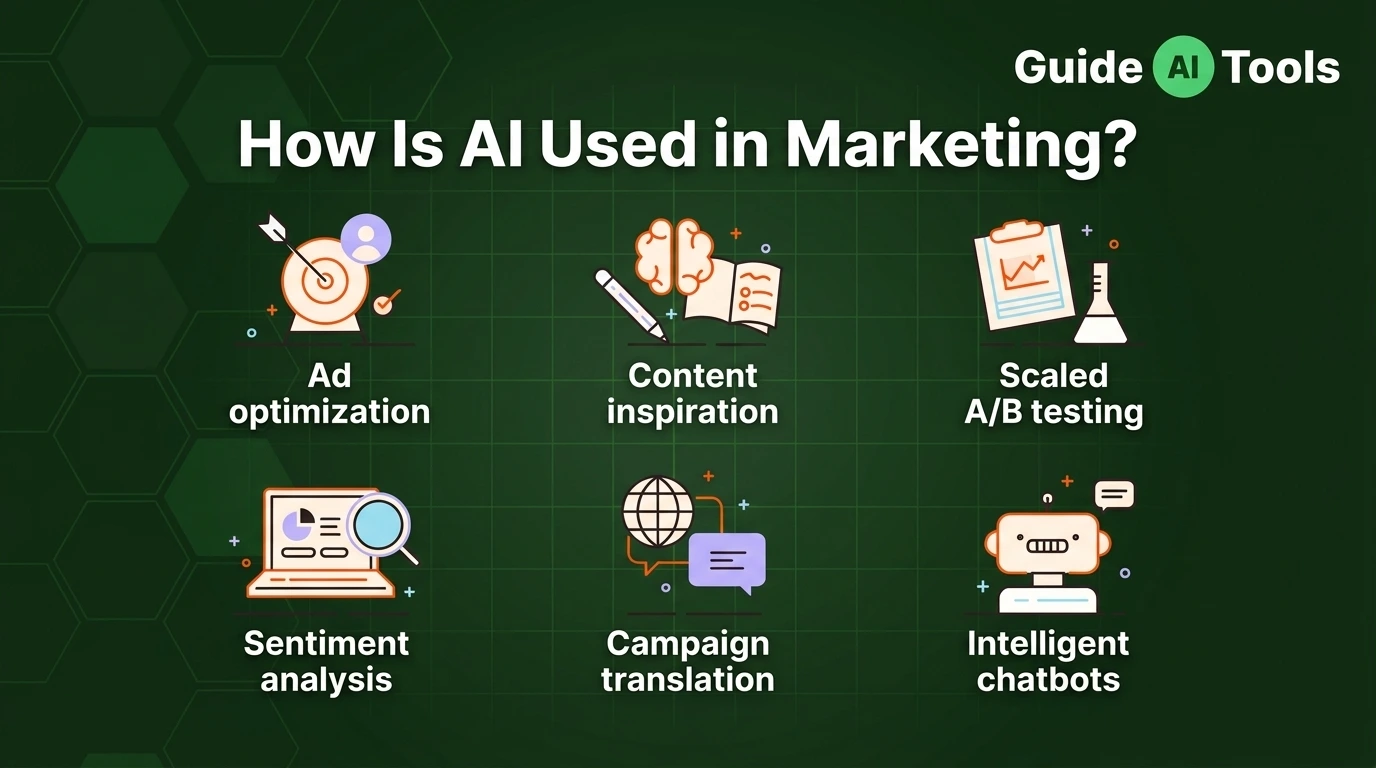
Ask a marketing team where AI saves them time and the benefits of AI in marketing show up in the same places: drafting, testing, targeting, and reading results. The work clusters into six areas, mapped below.
| Marketing area | What AI does | Named platform or tool examples | Human still owns |
|---|---|---|---|
| Content and SEO | Drafts articles and briefs, repurposes one asset into many | ChatGPT, Jasper, Surfer SEO | Final editing, fact checks, brand voice |
| Paid advertising | Bids on auctions, expands audiences, tests creative at volume | Google Performance Max, Meta Advantage+, TikTok Smart+ | Budget, the offer, conversion tracking |
| Email and lifecycle | Send-time optimization, subject line testing, flow targeting | Persado, Klaviyo | Strategy, list health, claims in copy |
| Social media | Listening, sentiment tracking, scheduling, trend spotting | Sprout Social, Brandwatch | Risky replies, community judgment |
| Personalization and recommendations | Product recommendations, content that changes per visitor | Recommendation engines, Algolia | Consent, merchandising calls |
| Chatbots and lead qualification | Answers questions, qualifies visitors, routes leads | Intercom, Drift | Escalations, pricing promises |
Content, SEO, and social
Content teams use AI as a drafting bench. A strategist sets the angle, the model produces a first draft or ten headline options, and a human edits hard. SEO teams get briefs, link suggestions, and title variants from the same bench.
Social teams lean on it differently. Listening tools read thousands of posts and sort them by sentiment, so a brand sees a complaint wave forming before it trends. Both used to eat afternoons.
Advertising and media buying
Paid media is where AI took the most ground. Smart Bidding prices each auction in real time against your conversion goal, and audience tools expand beyond the segments you picked, hunting for buyers who resemble your best customers. Creative testing now runs at volumes no studio could match.
The trade-off is control, and it gets its own section below.
Email, personalization, and service
Email looks quiet next to paid media, but the AI here touches revenue directly. Models pick each subscriber’s send time, test subject lines on small slices before the full send, and choose which products each person sees inside the message.
Personalization engines do the same job on the storefront itself, swapping banners and recommendations per visitor.
At the edge of marketing sits the service handoff: chatbots that answer questions, qualify visitors, and book sales calls. That border with support is its own field, covered in our guide to AI in customer service.
How the Big Ad Platforms Put AI in Charge
Performance Max does not ask which audience you want. It asks what a conversion is worth, then goes shopping for it.
That is the biggest shift in day-to-day marketing work.
Google’s Performance Max, Meta’s Advantage+, and TikTok’s Smart+ all run on the same bargain. You hand over a budget, your creative, and a conversion goal. The platform picks the audience, the placements, and the bids, and you do not see all of its reasoning.
What did the marketer lose? Audience control, for a start, and placement visibility too. Your ad may run somewhere you would never have chosen, and per-ad reporting depth thinned out as well.
Plenty stayed with the marketer:
- The budget, and the power to stop it
- Creative quality, which now decides more than targeting does
- Conversion tracking, the signal every platform model learns from
- The offer itself, which no model can invent
Why do platforms push this so hard? Two reasons, and only one is cynical.
The systems often perform well, because they see signals across millions of advertisers. And every campaign that runs this way keeps spend, data, and learning inside the platform’s walls.
How Is AI Used in Marketing by Real Brands?
Every vendor deck carries the same names, so at GuideAITools we read the examples like an auditor would: who published the number, and could anyone check it?
| Brand | What they did with AI | Reported result | How solid is the number |
|---|---|---|---|
| Netflix | Personalized recommendations and artwork for each member | Netflix researchers valued it at over 1 billion dollars a year in reduced churn | Company research paper, detailed but self-published |
| Sephora | Virtual Artist try-on and chatbots for advice and booking | Gains in engagement and bookings reported, no single audited figure | Trade press coverage, no hard public metric |
| Coca-Cola | Invited fans to generate art from brand assets on a platform built with OpenAI tools | Large volumes of fan-made art and earned media in 2023 | Platform and press reporting, counts not independently checked |
| JPMorgan Chase with Persado | AI rewrote and tested ad and card copy at scale | Up to 450 percent lift in click-through rates in pilots, against 50 to 200 percent for human copy | Company-reported pilot result, covered by trade press |
| Cosabella with Albert | Handed paid media buying across search and social to an AI platform | Return on ad spend up 336 percent in three months, revenue up 155 percent | Company press release figures, repeated by trade press |
| Michaels Stores | AI platform personalized email campaigns | Personalized share of email campaigns rose from 20 to 95 percent, email clicks up 25 percent, SMS clicks up 41 percent | Reported by McKinsey from the retailer’s own figures |
Look at what the strong rows share. Each job is narrow: pick the artwork, test the copy, buy the media. Each has a human review gate.
And each runs on clean, well-kept customer data, the unglamorous part.
The reading rule is simple. A number published by the company selling the tool is a claim, not a result. A number from a pilot is real but small.
A figure a research firm traced to the buyer’s own books sits in between. Grade the proof before you repeat the figure in a planning meeting. Your results will answer for it later.
What AI Changes Inside Marketing Teams
The work did not vanish. It moved up a floor.
Writers became editors and reviewers. Analysts spend less time building reports and more time arguing with what the reports claim. McKinsey research on AI agents in marketing and sales points the same way: value shows up when teams redesign work around the tools instead of bolting tools onto old work.
New failure work appeared too. Someone has to catch the invented product claim before the ad ships, check that the generated image shows the actual product, and read the transcript where a bot promised a discount that does not exist. At GuideAITools we count that review job as the hidden cost of every rollout.
Team size changes the shape of the gain. A three-person team gains production volume it could never hire. A three-hundred-person team gains coordination problems, because ten groups now generate faster than one brand team can review.
The gap between winners and losers is rarely budget. It is data quality and review habit.
So, will the headcount fall? The tasks inside the job go first, and any claim about whole jobs, in either direction, needs a source behind it.
The Measurement Problem: Proving AI Did It
One question almost no dashboard can answer: did the AI cause that lift, or did the market hand it to you?
Platform dashboards grade their own homework. When Google Ads reports a return on ad spend, the platform selling the ads is also the platform scoring them.
That number may be accurate, but it is not independent, and that matters when you move real budget on it.
The fix has a plain name: incrementality. You hold back a control group, a slice of audience or a set of regions that never sees the AI-run campaign, and you compare.
Holdout groups, geo tests, and conversion lift studies all run on this one idea. Bigger brands add marketing mix modeling on top, to estimate what each channel truly contributes.
AI washing is the practice of claiming AI you do not really have, and regulators now treat it as a false claim like any other. When a vendor’s miracle number has no control group behind it, assume you are reading a story, not a result.
Limits, Risks, and Rules Marketers Cannot Ignore
AI in marketing runs on customer data, and the rules around that data are not optional reading.
Start with consent. Personalization built on data people never agreed to share is a liability wearing a growth chart. GDPR in Europe and CCPA in California set the floor for collection and use, and a breach puts customer records and campaign data in the open, a risk we map in our guide to AI in cybersecurity.
Bias is quieter. Ad delivery systems can skew who sees housing, job, or credit ads even when the advertiser never asked for that skew, because the model optimizes toward whoever responds.
Major platforms place those categories under special rules for this reason. If you advertise in them, the settings are not a detail. They are the compliance work.
Claims risk lands fastest. AI-written copy invents things: a discount that ended, a feature the product lacks, an endorsement nobody gave.
The failure mode is the same one behind AI hallucinations, and the regulator’s position is blunt. The advertiser owns every claim in the ad. “The AI wrote it” is not a defense, and fake reviews or undisclosed AI endorsements break disclosure rules.
Brand safety closes the list. Generated creative can drift next to content you would never sponsor, and models can echo a competitor’s phrasing back into your copy.
None of this argues against using AI. It argues for review gates, consent records, and a person who answers for the output. The wider picture sits in our overview of the risks of AI.
FAQs
What is AI in marketing in simple terms?
It is software that learns from customer and campaign data, then helps plan, write, target, and measure marketing. It predicts what each group is likely to do, drafts content for them, and reports what worked, while people set goals and approve output.
Will AI replace marketers?
It replaces tasks first: first drafts, bid math, report building, subject line testing. Strategy, offers, brand judgment, and accountability stay human, because someone must own the claim and the budget behind it. Some teams shrink while review and data roles grow.
What are the biggest benefits of AI in marketing?
Speed and scale lead. Teams produce and test more content and creative, targeting improves because models read signals no person could scan, and personalization reaches audiences manual work could never cover. The gains are real, provided the measurement behind them is honest.
What are the risks of using AI in marketing?
The big four are privacy breaches from careless data use, biased ad delivery, invented claims in generated copy, and platform decisions you cannot explain. Each is manageable with consent records, review gates, and holdout testing. Ignored, each can cost money, trust, or a regulator’s letter.
How much does AI marketing cost a small business?
Less than most expect, because the strongest platform AI is bundled into ad spend you already pay. Standalone writing, email, and analytics tools run from free tiers to a few hundred dollars a month for a small team. The real cost is setup time and data cleanup.
What is the difference between AI marketing and marketing automation?
Automation follows fixed rules a person wrote: send this email when that trigger fires. AI marketing judges and generates: it picks the audience, writes the variant, or moves the budget based on patterns it learned. Many products mix both, so judge a tool by what it decides alone.
Which marketing tasks should stay human?
Keep the offer, pricing, and every factual claim about your product with people. Keep crisis replies, sensitive situations, and final approval of anything public. AI can draft all of it, but a named person should sign all of it, because accountability cannot be delegated to software.
Conclusion
AI in marketing is judged the way you would judge a new hire: by the job it does and the proof behind its numbers, not by the label on the box. The brands getting real value run narrow jobs, keep a human gate, and test against a control group. The brands getting burned bought the label.
Your next step is simple. Pick one channel, one job, and one honest test.
And keep reading the series: our guides to AI in software development, AI in manufacturing, AI in transportation, and AI in scientific research show the same pattern in four other industries. The marketing tool categories on GuideAITools let you compare the products behind the claims.

Related Blog Posts