What Is Responsible AI? From Principles to Practice
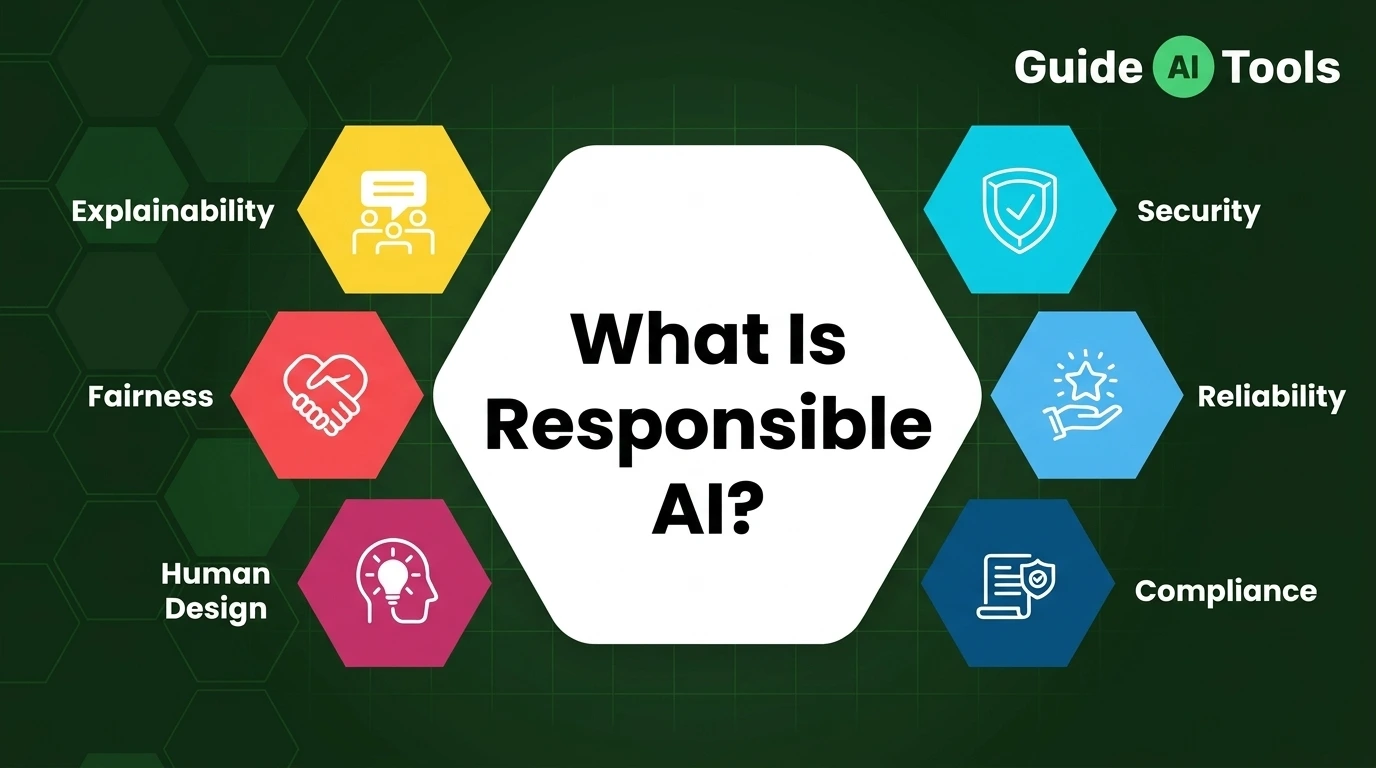
Responsible AI is the practice of building and using AI in ways that are fair, transparent, accountable, private and safe, with named humans answerable for what the system does. It is not a badge or a web page. It is the daily work of testing, documenting and watching a system, and being able to prove all three.
Nearly every AI company now has a page about it, and the pages all sound the same. Fair. Transparent. Human centered. Safe.
So here is the awkward question. If every company claims it, how would you ever know who means it?
You cannot judge a claim by its adjectives. You judge it by its artifacts. A company that means it can show you things: test results, documents, names, an appeal path. A company that does not can show you a paragraph.
This guide gives you the proof test: what the claim should mean, which artifacts back it, and how to check any claim in minutes.
What Responsible AI Actually Means
Responsible AI is a working practice, not a label. It covers the life of a system, from the design sketch to the day it is retired.
It is not a product you buy. It is not a certificate you earn once and frame. And it is not a synonym for AI ethics, the older debate about what we should value.
The short version is this. A team can explain its system, test it for harm, name the human who owns it, and fix it when it breaks. If a team cannot do those four things, the word responsible is decoration.
Start from the base if you need it: our explainer on what artificial intelligence is covers the ground this page builds on. The practice scales, too. A two person startup and a global bank owe the same four things, in different sizes.
At GuideAITools we use one test. Show me the artifact. Everything below follows from that.
The Core Principles, in Words and in Practice
The main principles of responsible AI are fairness, transparency, accountability, privacy, safety and human oversight. Every framework names some version of these six. What separates a real program from a poster is the proof sitting behind each word.
Fairness
Fairness means the system does not quietly treat one group worse than another. Teams test outputs across groups before launch, and again after, because live data drifts.
Here is the honest catch. There are several math definitions of fairness, and they cannot all hold at once. A team must pick one, name it, and own the tradeoff in public.
Skip this work and you get the Amazon story: Reuters reported its experimental hiring tool, trained on ten years of resumes, taught itself to downgrade applications containing the word women’s, and Amazon scrapped it. Our deeper guide to AI bias shows how the skew gets in.
Transparency
Transparency means people can see what the system is, what data shaped it, and where its limits sit. It answers one question: what is this thing?
Explainability answers a harder one: why did it make this single decision? A company can be transparent about a system and still unable to explain one output. Honest ones say so.
Ad platforms rarely do: AI in marketing now decides who sees which offer, and the person skipped gets no reason at all.
Accountability
Accountability means a named human owns each system and answers for it. Not a team. Not a department. A person, with a name, who can be asked what went wrong.
It also means the people affected can push back. An appeal path that reaches a human is part of the principle, not a bonus feature.
Privacy
Privacy means the system takes only the data it needs, keeps it only as long as it must, and never trains on it in secret. Consent is a real choice, not a pre-ticked box.
The failure modes are concrete, and our page on the privacy risks of AI walks through them.
Safety
Safety means the system holds up under misuse, attack and plain bad luck. Teams try to break it before strangers do, a practice called red teaming.
Attacks on the system itself, from poisoned data to prompt injection, are covered in our guide to AI in cybersecurity. The wider question, is AI safe, gets its own page, because the honest answer depends on the use.
Human Oversight
Human oversight means a person watches the decisions that matter and can stop the machine. The reviewer needs time, information and real authority to say no.
A reviewer who approves everything in seconds is not oversight. That person is set dressing, and the theater section below names the pattern.
| Principle | What companies say | What proof looks like |
|---|---|---|
| Fairness | Our AI treats everyone fairly | Published bias test results across groups, with the gaps stated |
| Transparency | We are open about how our AI works | A model card naming training data, intended use and known limits |
| Accountability | We take responsibility for our AI | A named owner per system and a public appeal path |
| Privacy | Your data is safe with us | A data policy with retention limits and a delete option, in writing |
| Safety | Our AI is safe and secure | A red team summary listing what was tested and what broke |
| Human oversight | A human is always in the loop | A review gate with override rights and override numbers to show |
The Frameworks That Give It Structure
The best known structure is the NIST AI Risk Management Framework, released by the US National Institute of Standards and Technology on January 26, 2023. It is voluntary. No company is forced to use it, which is exactly why using it says something.
The framework has four functions, and each one is a plain question. Govern: who is answerable here? Map: what could this system do to people?
Measure: how do we test that, in numbers? Manage: what do we do when it goes wrong?
NIST also publishes a free Playbook with the working detail, plus a Generative AI Profile for newer risks. A small team can start from the four questions alone.
Two older anchors matter too. The OECD AI Principles, adopted by governments in 2019, set five values based principles most national policies still copy. ISO/IEC 42001, published in 2023, turns the idea into a certifiable management system a company can be audited against.
Then there is law: the EU AI Act, in force since 2024, sorts AI into four risk tiers with duties attached. It is a big reason vendors suddenly care about documentation.
| Framework | Owner | Year | Type | Core structure |
|---|---|---|---|---|
| NIST AI Risk Management Framework | NIST | 2023 | Voluntary framework | Govern, Map, Measure, Manage |
| OECD AI Principles | OECD | 2019 | Values principles | Five values based principles |
| EU AI Act | European Union | 2024 | Binding law | Four risk tiers |
| ISO/IEC 42001 | ISO and IEC | 2023 | Certifiable standard | AI management system |
How Companies Actually Implement It
Companies implement responsible AI in five moves: assess, document, test, gate and monitor. The moves are boring. That is the point. Boring is what proof looks like.
It starts before any code. An impact assessment asks who is affected, what the worst realistic harm looks like, and whether this use should exist at all. A two person team writes this on one page. A bank writes a dossier.
While building, the team documents. A model card records what the system is for, what data trained it, and where it fails. Dataset records do the same for the inputs. When GuideAITools reviews a tool, these are the documents we ask about first.
Before launch comes testing. Bias tests compare outcomes across groups. Red teams try to make the system leak data or produce harmful output on purpose. Failure drills ask what happens when, not if, it gets something badly wrong.
At launch, human review gates decide which outputs a person must approve. Anyone who has dealt with AI in customer service has met the weak version: a bot with no route to a human. A real gate has named reviewers, override rights and an appeal path for the person affected.
After launch, monitoring takes over. Teams watch for drift, keep an incident log, and keep one named owner who can pause the system. This is also where fluent but wrong output gets caught, the problem our page on AI hallucinations explains.
None of this needs an enterprise budget. It needs a habit: write it down, test it, name the owner.
Responsible AI vs AI Ethics vs AI Governance
No, responsible AI is not the same as AI ethics, though the two get swapped constantly. Ethics asks what we should value. Responsible AI is the daily practice that delivers those values inside a real product.
Governance is the third piece. It is the structure of roles, rules and sign-offs that lets the practice survive staff changes and deadline pressure.
Trustworthy AI is not a fourth method. It is the outcome you get when the other three work.
AI alignment studies whether a model’s goals match human intent. Responsible AI is wider and duller: it is about the organization around the model. Both matter, and most of the risks of AI land on people long before alignment questions do.
Where It Turns Into Checkbox Theater
Ethics washing is what happens when public principles hide private shortcuts. The principles page is polished. The practice behind it is missing.
The tells are easy to spot once you know them: a principles page with no named owner, an ethics board that has never stopped a launch and maybe cannot, human review that approves everything in seconds, no published test results, and no appeal path for the people the system affects. Five tells, and most weak claims show at least three.
Why does it happen? Principles are cheap. Testing is slow. Launches have deadlines, and the quarter ends when it ends.
The pattern reaches the top of the industry. At Google, the two co-leads of the Ethical AI team were pushed out within three months of each other, in December 2020 and February 2021, after disputes with management became public. An ethics team that can be removed is a decoration, not a brake.
The fix is not more principles. The fix is published proof. If a company will not show its work, believe the silence, not the page.
The Honest Tradeoffs
Responsible AI costs time and money, and anyone who says otherwise is selling something. Reviews slow launches. Documentation eats hours. Testing finds problems you then have to fix.
Some limits run deeper than budget. Explanations of large models are approximations, not readouts of the machine’s mind. Some harms resist measurement entirely. And fairness forces a choice between definitions that clash.
The payoff for doing it anyway is real: fewer nasty surprises, and the benefits of AI without the cleanup bills. The sane answer is proportion. A photo tagger needs a light review. A loan tool needs the full weight.
The weight grows as systems start acting on their own. Once you know what AI agents are, a rubber stamp review stops looking harmless.
A 10 Minute Checklist for Judging Any Responsible AI Claim
You can judge most responsible AI claims in about ten minutes, using only public evidence. At GuideAITools we run these six questions on tools before we write about them.
- Can they show a model card or system documentation? Pass sign: a public document names purpose, data and limits. Fail sign: a marketing page is all you get.
- Is there a named owner or responsible team? Pass sign: a person or an office is named and reachable. Fail sign: “our team,” with no name attached.
- Do they publish bias or safety test results? Pass sign: results are public, with gaps admitted. Fail sign: “rigorously tested,” with no numbers anywhere.
- Is there a human review and appeal path? Pass sign: you can reach a person who can reverse a decision. Fail sign: the only contact is the bot that made the call.
- Do they say what data they keep, and for how long? Pass sign: retention limits and a delete option, in writing. Fail sign: a privacy page that never mentions your data at all.
- Have they ever published an incident or a fix? Pass sign: a changelog or postmortem admits a real failure. Fail sign: a spotless record, which usually means an unexamined one.
Documents and names mean the claim is real. Adjectives mean it is marketing.
FAQs
What is responsible AI in simple terms?
Responsible AI means using AI in ways that are fair, open, safe and answerable to a named human. In simple terms: test it, document it, watch it, and fix it when it harms someone.
What are the four functions of the NIST AI Risk Management Framework?
The four functions are Govern, Map, Measure and Manage. Govern assigns who answers for the system. Map finds what it could do to people. Measure tests that in numbers. Manage sets what happens when it goes wrong.
Is responsible AI the same as AI ethics?
No. AI ethics is the debate about what we should value, and responsible AI is the practice that carries those values into a shipped product. Ethics writes the principles. Responsible AI runs the tests, the documents and the appeal path.
What is a model card?
A model card is a short public document that travels with an AI model. It states what the model is for, what data trained it, how it was tested and where it fails. No card usually means nobody wrote the limits down.
What is ethics washing in AI?
Ethics washing is publishing warm principles while skipping the testing and proof behind them. The classic signs are an ownerless principles page, an ethics board with no power, and review steps that approve everything.
Does responsible AI slow down AI projects?
Yes, a little, by design. Reviews, tests and documentation add days to a launch. What they remove is the far slower work later: incident cleanup, regulator questions and lost trust. Low risk tools need only a light version.
How can a small team start with responsible AI?
Start with one page and four habits. Write down what your system does and who owns it. Test it on the groups it will affect. Give users a way to reach a human. Keep a log of what goes wrong, and read it monthly.
Conclusion
Principles are the cheapest part of AI. Proof is the expensive part, and the only part worth trusting.
So run the test. Pick one AI tool you rely on and put the six questions to it this week. If the answers come back as documents, results and names, the claim is real. If they come back as adjectives, you have your answer too.
GuideAITools asks the artifact question across this library. Now you can ask it too.

Related Blog Posts