What Is AI Audio? How Artificial Intelligence Creates, Understands and Generates Sound
AI Audio is the use of artificial intelligence to create, understand, transform and process sound. It includes technologies that can generate music, convert text into speech, recognize spoken words, clone voices, remove noise and create synthetic audio. Modern AI audio systems use machine learning models trained on large amounts of audio data to learn patterns in sound and produce new outputs.
Think about the last time you used a voice assistant, removed background noise from a recording, listened to an AI-generated song or converted text into a natural voice.
There is a good chance AI was involved somewhere.
But AI Audio is much broader than just AI voices.
It covers the entire relationship between artificial intelligence and sound.
A music generator creates a new track. A speech recognition system converts your voice into text. A voice cloning system learns the characteristics of a speaker and produces synthetic speech. An audio enhancement tool can clean a noisy recording.
Different tasks.
Same idea.
Using AI models to work with audio.
What is AI Audio?
AI Audio refers to artificial intelligence systems designed to understand, create, modify or analyze sound.
Unlike traditional audio software that mainly follows predefined instructions, AI audio systems can learn patterns from examples and use those patterns to generate or process audio.
For example:
A traditional audio editor gives you tools like equalizers, compressors and effects.
An AI audio tool can analyze a recording, identify unwanted noise and automatically improve the result.
A traditional music tool gives you instruments and editing controls.
An AI music generator can create melodies, rhythms and arrangements from a text prompt.
AI Audio combines several technologies, including:
| AI Audio Area | What It Does | Example |
|---|---|---|
| AI Music Generation | Creates songs and melodies | Suno AI, Udio |
| Text To Speech | Converts written text into speech | ElevenLabs, Murf AI |
| Speech Recognition | Converts speech into text | Whisper, Deepgram |
| Voice Cloning | Creates synthetic versions of voices | Fish Audio, ElevenLabs |
| Audio Enhancement | Improves recordings | Adobe Podcast |
| AI Dubbing | Translates spoken content into other languages | AI dubbing tools |
The important distinction is that AI Audio is not one single technology.
It is a collection of different AI systems working with sound.
How does AI Audio work?
At a basic level, AI Audio works by learning patterns from audio data and using those patterns to create or process sound.
A simplified workflow looks like this:
Audio Data → AI Model Training → Pattern Learning → Audio Processing or Generation → Output
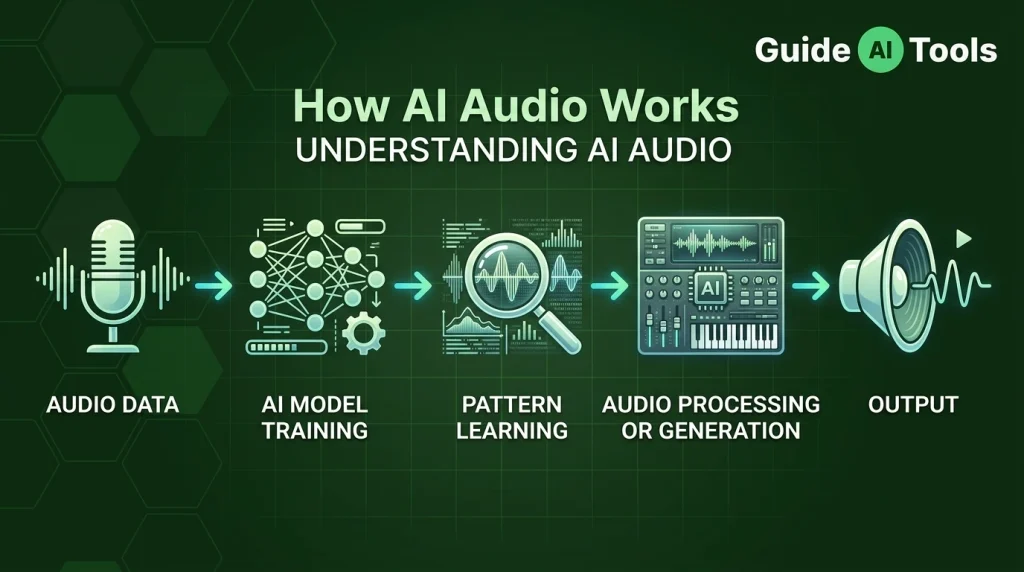
The exact process depends on the task.
A speech recognition system works differently from a music generator.
A voice cloning model works differently from an audio enhancement system.
But the foundation remains similar.
Google DeepMind’s research on audio generation explains how modern AI systems use techniques such as audio tokens, speech models and transformer-based architectures to create more natural generated audio.
How do AI Audio models learn sound patterns?
Sound is more complicated than a simple recording.
An audio file contains information about:
- Frequency
- Timing
- Pitch
- Rhythm
- Tone
- Volume
- Speech patterns
- Musical structures
AI models convert audio into mathematical representations that computers can process.
Instead of hearing a voice like a person does, the model analyzes patterns inside the audio signal.
For example, a voice model may learn:
- How a speaker pronounces words
- Their speaking speed
- Their pitch changes
- Their vocal characteristics
A music model may learn:
- Melody patterns
- Chord progressions
- Rhythm structures
- Instrument relationships
This does not mean AI understands music or speech like humans.
It identifies patterns that allow it to produce useful results.
What are the main types of AI Audio?
AI Audio can be divided into several major categories.
AI Music Generation
AI music generators create original music from prompts, lyrics or musical instructions.
A user can describe a style:
“Create a cinematic background track with emotional piano and orchestra.”
The model then generates audio based on learned patterns from musical examples.
Tools such as Best AI Music Generators use this type of technology.
Common uses:
- Background music
- Song creation
- Video soundtracks
- Game music
- Creative experiments
Popular tools include:
- Suno AI
- Udio
- AIVA
- Soundraw
- Beatoven AI
Text To Speech AI
Text To Speech, often called TTS, converts written text into spoken audio.
The process usually involves:
Text input
↓
Language processing
↓
Speech generation
↓
Audio output
Modern neural TTS systems can control:
- Voice style
- Emotion
- Accent
- Speed
- Tone
AI voice systems have improved because deep learning models can capture more details from human speech patterns.
For practical tools, explore Text To Speech AI Tools.
Speech Recognition
Speech recognition works in the opposite direction.
Instead of turning text into audio, it converts spoken audio into text.
A simplified process:
Audio input
↓
Feature extraction
↓
Speech model processing
↓
Text output
This technology powers:
- Voice typing
- Meeting transcription
- Subtitles
- Voice assistants
- Call analysis
Speech AI commonly combines automatic speech recognition with other language technologies to understand and respond to spoken input.
You can explore Speech Recognition Software for practical examples.
AI Voice Cloning
AI voice cloning creates a synthetic voice that resembles a real speaker.
The system studies voice characteristics from recordings and creates a voice model.
It can reproduce:
- Tone
- Accent
- Speaking style
- Vocal patterns
Modern voice cloning tools are used for:
- Narration
- Dubbing
- Games
- Audiobooks
- Virtual characters
For examples, see Best AI Voice Cloning Tools.
Voice cloning also creates important questions around consent, ownership and responsible use.
A person’s voice is part of their identity, so permission matters.
AI Audio vs Traditional Audio: What is the difference?
The biggest difference is how the system handles information.
| Traditional Audio Software | AI Audio Systems |
|---|---|
| Uses fixed tools and effects | Learns patterns from data |
| Requires manual adjustments | Can automate some tasks |
| Follows programmed instructions | Uses trained models |
| Human controls most changes | AI assists with analysis or creation |
| Limited by built-in functions | Can generate new outputs |
This does not mean AI replaces traditional audio software.
Professional creators still use manual editing, mixing and mastering.
AI often works as an assistant that speeds up specific tasks.
How is AI Audio used in real life?
AI Audio has moved beyond experiments.
It is now used across creative work, business, education and communication.
AI Audio for content creators
Creators use AI Audio for:
- YouTube narration
- Podcast production
- Short-form videos
- Voiceovers
- Background music
- Audio cleanup
A creator can write a script, generate a voiceover, create background music and improve audio quality without recording everything manually.
For video creators, AI audio tools can reduce production time.
AI Audio for businesses
Businesses use AI Audio in areas such as:
- Customer support
- Training materials
- Marketing videos
- Voice assistants
- Internal communication
AI voice systems can help companies create consistent audio experiences across different languages and regions.
AI Audio for education
Education is another growing area.
Examples include:
- Lecture transcription
- Language learning
- Accessibility tools
- AI tutors
- Audio summaries
Students can convert written material into audio or use speech systems for learning support.
AI Audio for entertainment
The entertainment industry uses AI Audio for:
- Music creation
- Film dubbing
- Game characters
- Sound effects
- Virtual performers
AI-generated audio is changing how creators approach production, but human creativity and direction remain important.
What technologies power AI Audio?
Several AI technologies work together inside modern audio systems.
Machine Learning
Machine learning allows systems to identify patterns from data.
It is used in:
- Speech recognition
- Audio classification
- Recommendation systems
Deep Learning
Deep learning uses neural networks with multiple layers.
It helps models process complex patterns in speech, music and sound.
Neural Audio Models
Neural audio models are designed specifically for sound-related tasks.
They can generate, enhance or transform audio.
Generative AI
Generative AI creates new content instead of only analyzing existing information.
In audio, this can mean:
- New songs
- Synthetic voices
- Generated sound effects
- AI narration
Research areas such as AudioGPT explore systems that combine language models with audio understanding and generation capabilities.
What is the future of AI Audio?
AI Audio is moving toward more natural, interactive and personalized experiences.
Future systems may improve:
- Real-time voice conversations
- AI music creation
- Personalized voices
- Multilingual dubbing
- Audio editing automation
- Voice-based applications
Voice AI systems are increasingly combining speech recognition, language models and text-to-speech technologies to create more natural interactions.
But quality is not the only challenge.
Trust, copyright, consent and authenticity will become bigger discussions as synthetic audio becomes harder to distinguish from human recordings.
What are the benefits of AI Audio?
AI Audio provides several practical advantages.
Faster creation
Creators can produce voiceovers, music and audio content faster.
Accessibility
Text can become speech. Speech can become text.
This helps people interact with information in different ways.
Localization
AI dubbing and voice generation can help content reach multiple languages.
Cost efficiency
Small teams can create professional-sounding audio without always requiring large production resources.
Creative exploration
Artists can experiment with sounds, voices and musical ideas quickly.
What are the limitations and risks of AI Audio?
AI Audio is powerful, but it has limitations.
Voice misuse
Voice cloning can create risks around impersonation and unauthorized use.
Copyright concerns
AI-generated music and audio raise questions about training data, ownership and commercial rights.
Quality problems
AI-generated audio can still contain unnatural pronunciation, incorrect emotion or unwanted artifacts.
Human expression
AI can imitate patterns in human voices and music, but human experiences, emotions and artistic decisions remain difficult to replicate.
FAQs
What is AI Audio?
AI Audio is the use of artificial intelligence to create, understand, modify and generate sound, including music, speech, voices and audio effects.
How does AI Audio work?
AI Audio systems learn patterns from audio data using machine learning models. They then use those learned patterns to generate or process new audio.
Is AI Audio the same as Voice AI?
No. Voice AI mainly focuses on spoken interaction, including speech recognition and synthetic voices. AI Audio is a broader category that also includes music generation, sound effects and audio editing.
Can AI create music?
Yes. AI music generators can create melodies, arrangements and complete tracks from text prompts or musical instructions.
How does AI voice cloning work?
AI voice cloning analyzes recordings of a speaker and creates a model that can generate new speech with similar vocal characteristics.
What is the difference between speech recognition and text to speech?
Speech recognition converts spoken audio into text. Text to speech converts written text into spoken audio.
Are AI voices replacing human voice actors?
AI voices are changing some workflows, but human voice actors remain important for emotion, performance, character development and creative direction.
Is AI-generated audio safe?
AI-generated audio can be useful, but responsible use requires attention to consent, copyright and transparency.
Final Thoughts
AI Audio is much bigger than artificial voices.
It includes systems that create music, understand speech, generate voices, remove noise and help people work with sound in new ways.
The easiest way to understand it is to think about three questions:
Can AI understand audio?
Can AI create audio?
Can AI transform audio?
Modern AI Audio systems are built around those abilities.
As the technology improves, sound creation and interaction will become easier for creators, businesses and everyday users.
The tools will continue changing.
But the foundation stays the same: AI learns patterns from sound and uses those patterns to create something new.

Related Blog Posts