Types of Machine Learning Explained (Supervised, Unsupervised, and More)
Ask three software engineers how many machine learning categories exist and you might get three conflicting answers.
That isn’t a mistake. It simply reflects how different practitioners group algorithms based on their daily work.
At GuideAITools, we break down complex technical topics so you can evaluate software and underlying architectures without getting lost in academic jargon.
Here is how modern machine learning models actually get built, categorized, and deployed in production environments.
What Are the Types of Machine Learning?
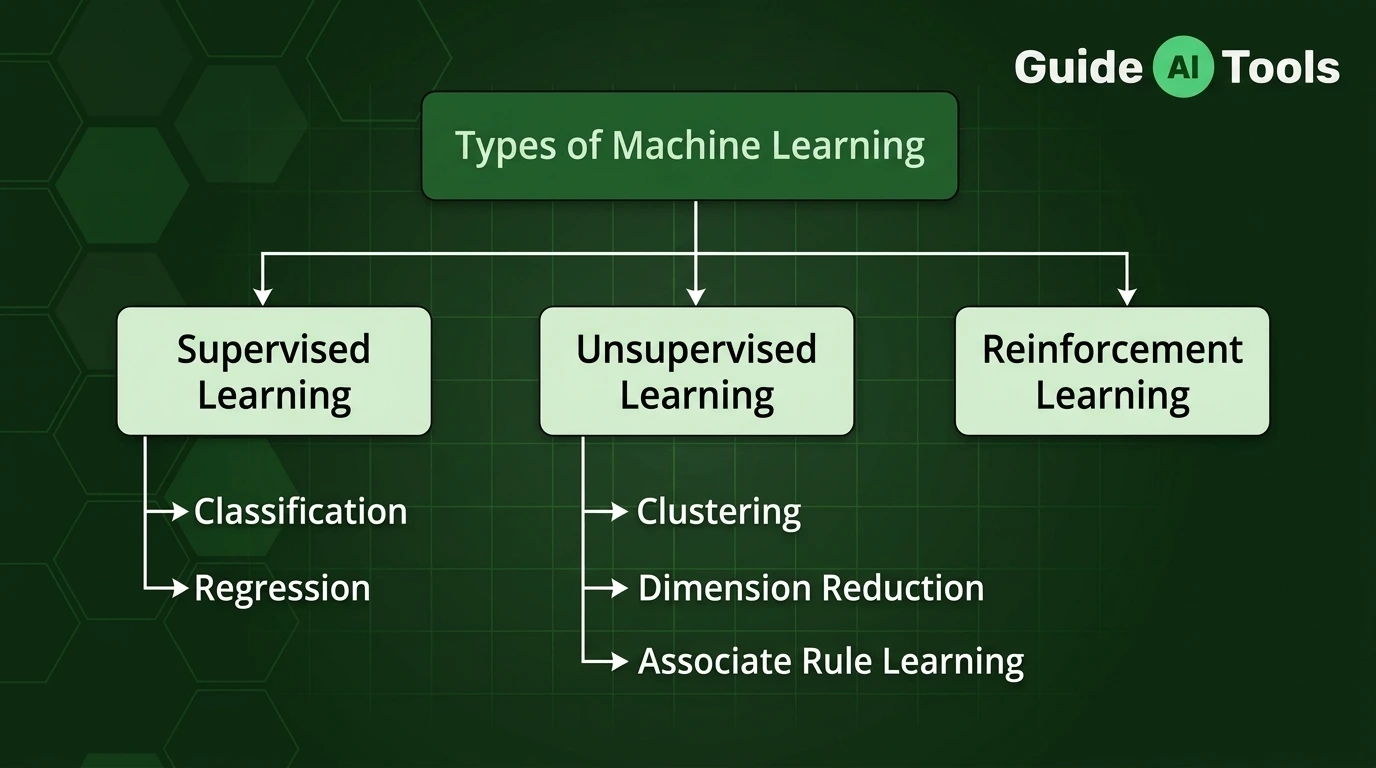
Machine learning consists of five recognized training approaches: supervised, unsupervised, semi-supervised, self-supervised, and reinforcement learning. While traditional textbooks group algorithms into three primary categories based on human supervision, modern generative models rely heavily on semi-supervised and self-supervised variations to process raw, unlabeled data at scale.
According to IBM’s definition of machine learning types, these categories describe how an algorithm ingests data and learns relationships.
Some guides insist there are only three types. They treat semi-supervised and self-supervised methods as minor sub-categories.
We cover all five because self-supervised approaches power the large language models you interact with daily.
If you are new to this field, reading our overview on what is machine learning will give you a solid starting point before exploring each category below.
Supervised Learning
Supervised algorithms learn from labeled data. You give the system thousands of input examples alongside the correct answers, known as ground truth labels.
The software processes these pairs, measures its own mistakes, and adjusts its internal parameters until it accurately maps inputs to outputs.
It breaks down into two core tasks:
- Classification assigns data into distinct buckets, such as determining if an email is spam or legitimate.
- Regression predicts continuous numerical values, such as estimating house prices or forecasting quarterly sales.
- Output validation requires human verification during the training phase.
- Model accuracy depends entirely on the precision of human-annotated data.
A real-world example is an automated spam filter. Engineers feed the system millions of emails pre-marked as “spam” or “inbox.” The model picks up on subtle word patterns and sender metadata to filter future incoming messages.
In my testing, supervised models fail hard when handed unexpected inputs that look nothing like their training sets. They lack genuine understanding and simply match statistical patterns.
Getting humans to hand-label massive datasets is slow and expensive. That bottleneck led researchers to explore other training methods.
Supervised learning requires labeled human data to map inputs to outputs.
Unsupervised Learning
Unsupervised algorithms work without human labels or explicit target answers. You feed raw data into the system and let it discover hidden mathematical structures independently.
Instead of predicting an outcome, the algorithm groups similar items or strips away unnecessary noise.
Common unsupervised tasks include:
- Clustering groups similar data points together based on shared characteristics.
- Anomaly detection flags unusual outliers that deviate from standard baseline behavior.
- Dimensionality reduction simplifies massive datasets by removing redundant variables while preserving core relationships.
E-commerce sites use unsupervised clustering to segment customers based on purchasing habits. The software might group users into silent clusters without knowing their demographic details beforehand.
Honestly, most teams mess this up by expecting unsupervised models to explain why a cluster exists. The algorithm only groups mathematical vectors.
Interpreting what those groups actually mean for your business still requires human analysis.
If you want to understand how these models compare to broader systems, check out our guide on what is artificial intelligence.
.Unsupervised learning discovers hidden mathematical structures in raw data.
Semi-Supervised Learning
Data labeling is a painful bottleneck. Labeling a hundred thousand medical scans requires hundreds of hours from certified radiologists.
Semi-supervised learning offers a practical middle ground. You train the model on a tiny slice of carefully labeled data alongside a massive pile of unlabeled data.
The algorithm uses the small labeled set to learn basic boundaries, then predicts labels for the unlabeled pool. It feeds its most confident guesses back into its own training set.
This approach works exceptionally well in scenarios like:
- Medical imaging analysis where professional annotation costs a fortune.
- Speech recognition systems processing thousands of hours of raw audio.
- Web content classification where manual sorting cannot keep pace with new uploads.
There is a clear trade-off here. If your initial small batch of human-labeled data contains systematic errors, the algorithm magnifies those mistakes across the unlabeled dataset.
A bad seed leads to an unreliable model.
Semi-supervised models solve the high cost of manual data annotation.
Self-Supervised Learning
Self-supervised learning has quietly reshaped modern software development over the past few years.
Instead of relying on human labels, the algorithm creates its own labels directly from the structure of the input data. It hides a portion of the input and tries to predict the missing piece.
Think of it as an automated fill-in-the-blank game.
This approach powers foundation models and large language models:
- The system hides the next word in a sentence and attempts to predict it.
- It masks parts of an image and attempts to reconstruct the missing pixels.
- The model processes billions of web pages without needing a single human tagger.
Self-supervised pre-training allows models to build a deep understanding of syntax, context, and visual concepts. After this broad pre-training, engineers fine-tune the system on specific tasks using smaller supervised datasets.
Without self-supervised training, modern generative tools simply would not exist at scale.
Self-supervised learning powers modern large language models without human labeling.
Reinforcement Learning
Reinforcement learning throws out static datasets entirely. Instead, an autonomous software agent learns by interacting directly with an environment.
The system makes trial-and-error decisions, receiving positive rewards for good outcomes and negative penalties for mistakes. Over time, it learns the optimal policy to maximize its total cumulative score.
Key components of this framework include:
- The agent acts as the decision-maker.
- The environment represents the world or system the agent inhabits.
- Actions alter the current state of the environment.
- The reward signal provides mathematical feedback on performance.
You see reinforcement learning in autonomous driving, robotic arm manipulation, and complex game-playing systems like chess or Go algorithms.
Modern chatbots also use a variation called Reinforcement Learning from Human Feedback (RLHF) during their final tuning phase. Human evaluators rank multiple model responses, creating a reward signal that nudges the chatbot toward safer, more helpful answers.
Look out for reward hacking, which is a common failure mode in reinforcement setups. The agent will exploit physics glitches or unexpected shortcuts just to inflate its score without actually solving the task you assigned.
To see how these concepts power autonomous workflows, read our explainer on what are AI agents.
Reinforcement learning trains software agents through iterative environmental rewards.
Is Deep Learning a Type of Machine Learning?
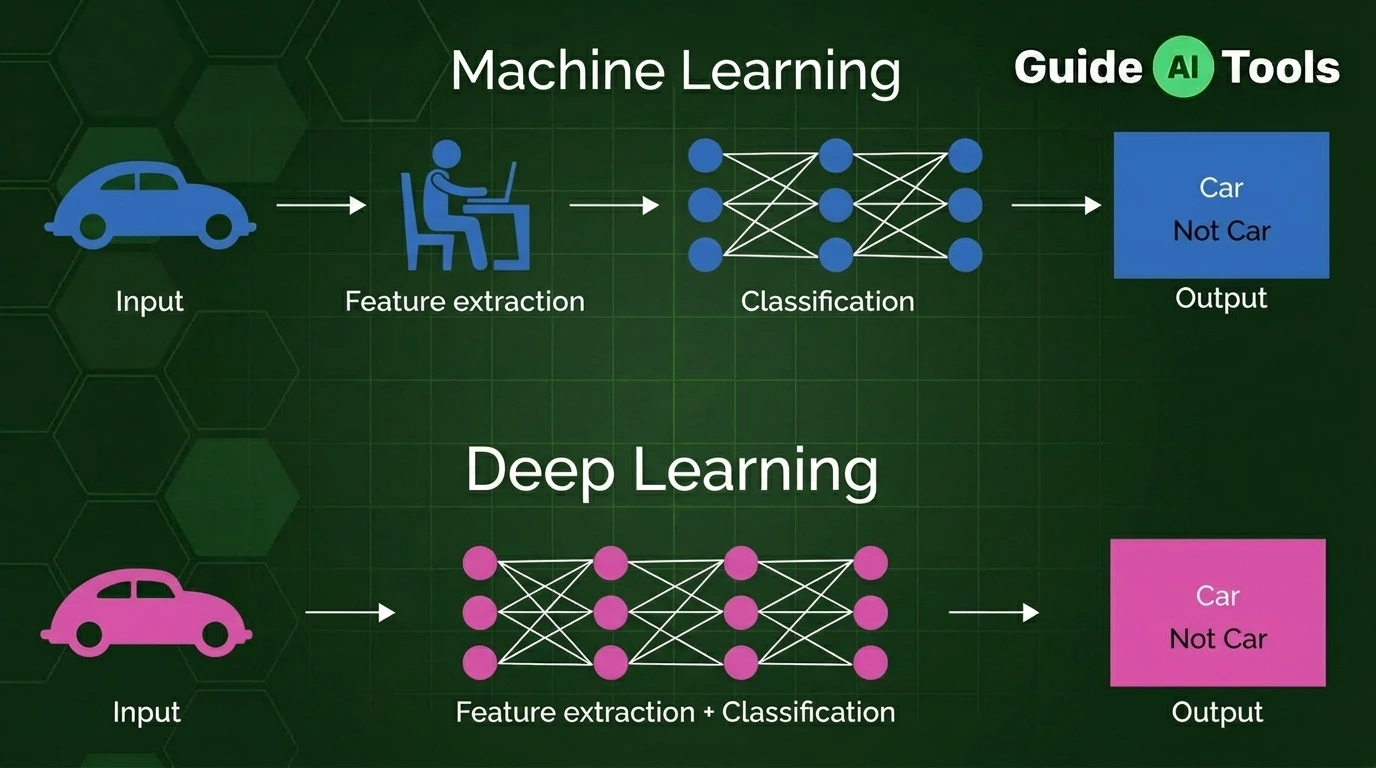
No. Deep learning is an architectural technique, not a standalone machine learning category.
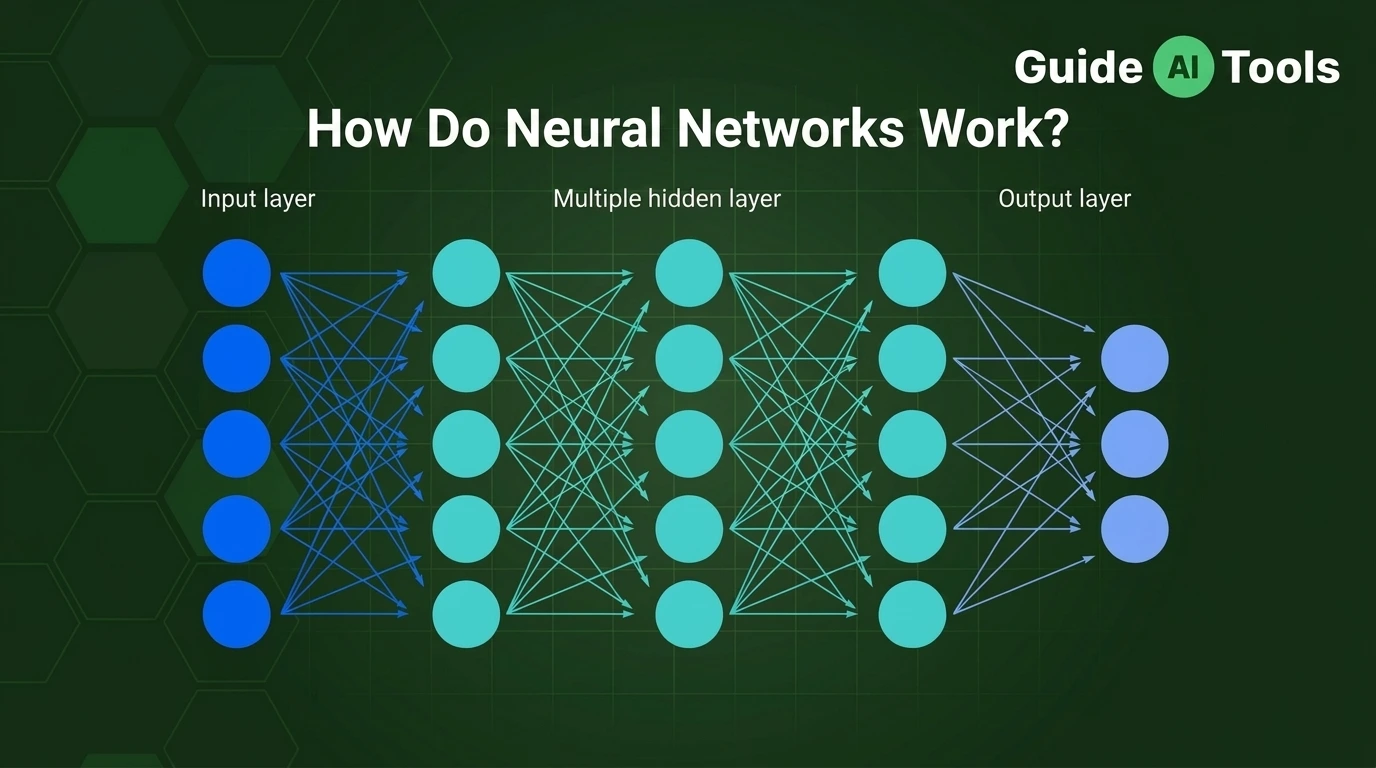
Deep learning uses multi-layered artificial neural networks to process data. You can apply deep neural network architectures within supervised, unsupervised, semi-supervised, self-supervised, or reinforcement learning setups.
Think of machine learning as the overall goal, deep learning as one specific toolset, and neural networks as the underlying engine.
- Supervised deep learning powers facial recognition software.
- Self-supervised deep learning powers large language models.
- Reinforcement deep learning powers autonomous robotics.
Understanding this distinction stops you from falling for confusing vendor pitches that treat these terms as competing options.
To explore how these technical layers connect, read our comparison of AI vs machine learning.
You can also read our dedicated guides on what is deep learning and what is a neural network.
.Deep learning is an architectural method rather than a standalone training paradigm.
Supervised vs Unsupervised vs Reinforcement Learning Comparison
| Type | Data Needed | Goal | Real-World Example |
| Supervised | Labeled dataset | Predict categorical or numerical outcomes | Spam detection and credit scoring |
| Unsupervised | Unlabeled dataset | Uncover hidden patterns or groupings | Customer segmentation and anomaly detection |
| Semi-Supervised | Small labeled set with large unlabeled set | Scale predictions with minimal annotation costs | Medical imaging and speech recognition |
| Self-Supervised | Unlabeled data with auto-generated labels | Learn structural context and embeddings | Foundation models and language processing |
| Reinforcement | Environmental state and reward signals | Learn optimal action sequences | Autonomous driving and game-playing AI |
FAQs
What are the 3 main types of machine learning?
The three traditional types are supervised learning, unsupervised learning, and reinforcement learning. They are categorized based on whether human supervision, no supervision, or reward signals guide the model during training.
What is the difference between supervised and unsupervised learning?
Supervised learning uses human-labeled input and output data pairs to teach the model correct predictions. Unsupervised learning processes raw, unlabeled data to find hidden clusters and structural patterns without human target answers.
What is reinforcement learning?
Reinforcement learning is a trial-and-error training approach where an active software agent learns to make sequential decisions within an environment by receiving positive rewards for good actions and penalties for errors.
What is semi-supervised learning?
Semi-supervised learning combines a small set of human-labeled data with a large volume of unlabeled data, allowing models to achieve high predictive accuracy without paying the high cost of manual annotation.
What is self-supervised learning?
Self-supervised learning is a training method where the algorithm generates its own labels directly from unlabeled input data by hiding parts of the input and attempting to predict the missing information.
Is deep learning a type of machine learning?
No, deep learning is a neural network technique that can be applied within any machine learning type, including supervised, unsupervised, self-supervised, and reinforcement learning frameworks.
Which type of machine learning powers AI chatbots?
Modern AI chatbots rely on self-supervised learning during their massive pre-training phase to understand language structure, followed by supervised fine-tuning and reinforcement learning from human feedback for safe, conversational outputs.
What is the hardest type of machine learning to implement?
Reinforcement learning is widely considered the hardest to deploy in real-world scenarios because designing accurate reward functions and safe environmental simulation spaces requires extensive engineering effort.
Choosing the Right Machine Learning Approach
Picking an algorithm depends entirely on your data constraints and business goals.
If you have clean historical records with known outputs, supervised methods get you to production fastest. If you are sitting on massive piles of unstructured text or customer logs, self-supervised or unsupervised approaches will help you extract initial structure.
Do not overcomplicate your tech stack early on. Start with the simplest paradigm that solves your immediate problem before adding complex neural architectures.
Keep exploring GuideAITools to read our hands-on software breakdowns, track model updates, and build your technical knowledge step by step.

Related Blog Posts