AI Agents vs Chatbots: Key Differences, Architecture, and Use Cases
Nearly every software vendor labels their conversational bot an AI agent. But returning a knowledge base link is not agency.
Understanding the difference between AI agent and chatbot systems matters when building enterprise workflows. Traditional chatbots respond to prompts, whereas autonomous AI agents execute multi-system goals without human intervention.
We will unpack how ai agents vs chatbots compare across system architecture, memory storage, and task resolution benchmarks. According to Gartner enterprise AI research , over 33% of enterprise software will incorporate agentic capabilities by 2028.
What Is the Main Difference Between an AI Agent and a Chatbot?
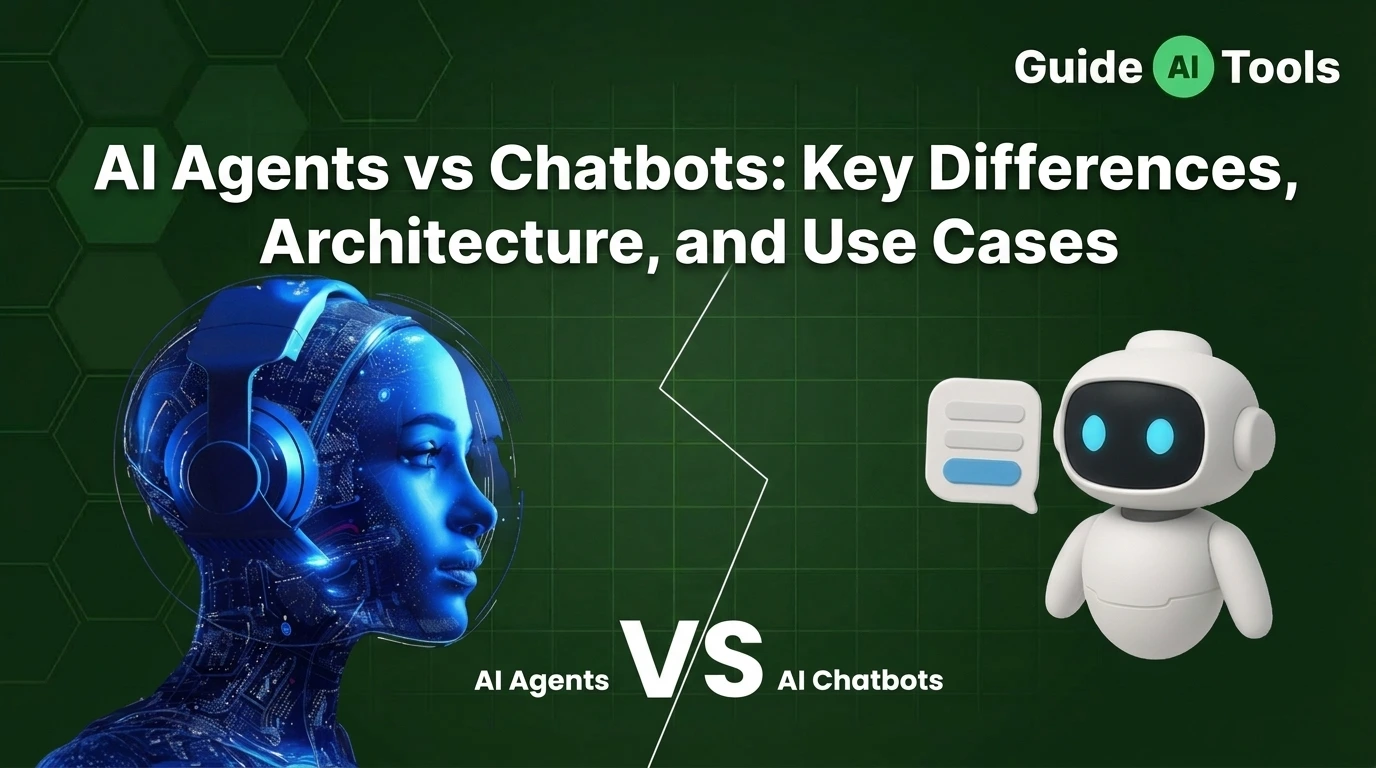
An AI agent is an autonomous goal-driven system that uses reasoning loops and read-write tool access to execute complex workflows. A chatbot is a conversational text interface that generates text responses to single prompts using pre-trained memory or static search retrieval.
Look, the fundamental split comes down to execution authority. Chatbots operate as passive information retrieval engines.
AI agents function as digital employees. They break high-level goals into smaller sub-tasks, call external APIs, and iterate until the objective is complete.
In my testing with enterprise operations teams, chatbots leave human workers to do the actual task. Connecting read-write API access turns a conversational prompt into completed work. You can review core concepts in our overview of artificial intelligence fundamentals.
AI agents execute multi-step system actions autonomously while chatbots only generate text responses.
Architectural Comparison: Chatbots vs AI Agents
The structural gap between these two systems goes far deeper than the chat window. Chatbots rely on stateless prompt-response pairs.
Agents run continuous execution loops that maintain state across external applications. When a chatbot encounters an error, it stops and asks the user for clarification.
An agent reads the error code, checks database logs, and attempts an alternative approach. Our team at GuideAITools analyzed how different system architectures handle complex workflows under stress.
| Dimension | Traditional / RAG Chatbot | Autonomous AI Agent |
| Primary Goal | Generate conversational text reply | Complete complex multi-step objective |
| System Interaction | Read-only (Knowledge base search) | Read-write (APIs, CRM, ERP, Database updates) |
| Execution Loop | Reactive (Single prompt turn) | Proactive (ReAct loop: Observe-Think-Act) |
| Memory Retention | Short-term context window (Session-based) | Persistent memory (Episodic & Semantic) |
| Human Oversight | High (Human must perform recommended action) | Low/Bounded (Human-in-the-Loop for approvals) |
| Resolution Rate | 10% – 20% end-to-end task completion | 40% – 60%+ end-to-end task resolution |
The resolution numbers highlight why companies are moving away from simple conversational interfaces. Standard Retrieval-Augmented Generation (RAG) bots give great advice, but they cannot execute state changes in your database.
Read-write system access allows autonomous agents to resolve tickets rather than just routing them to human support.
How AI Agents Work: The ReAct Loop and Agent Stack
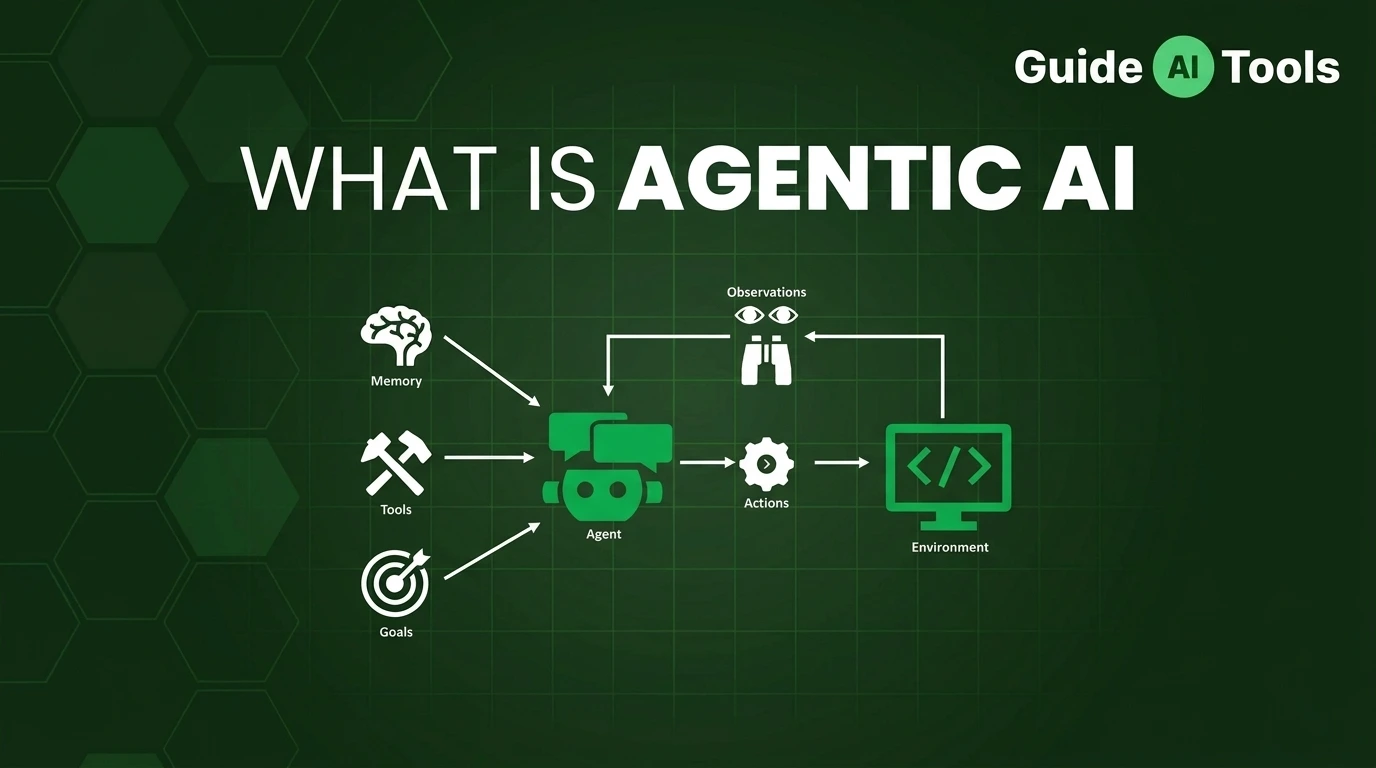
Modern agents rely on structured reasoning frameworks to navigate complex environments. The most common pattern is the ReAct loop, which stands for Reason and Act.
First, the agent observes the current state of a system. Next, it thinks through the next logical step and executes an action using function calling.
The agent stack combines four core layers:
- Reasoning core powered by foundation models that plan multi-step action sequences.
- Tool integration layer using REST APIs, function calling, and the Model Context Protocol (MCP) to interact with external databases.
- Persistent vector memory that stores past conversation history alongside long-term semantic context.
- Orchestration frameworks like LangGraph, AutoGen, or CrewAI that manage multi-agent coordination and state persistence.
Developers using AI coding tools like Cursor build these tool execution loops to automate software testing. From what I have seen, agents break down when tool definitions lack strict validation schemas.
The ReAct loop enables agents to evaluate system outputs and self-correct when an API call fails.
The 4 Maturity Levels of AI Systems (Exposing Agent-Washing)
Software vendors frequently market basic conversational bots as fully autonomous agents. We call this market trend agent-washing.
To evaluate real capabilities, developers use a four-level maturity framework. Most popular tools, including basic conversational ChatGPT models , operate at lower maturity tiers unless configured with custom tool bindings.
- Level 1 Scripted Bots follow strict rule-based decision trees with hardcoded fallback responses.
- Level 2 RAG Chatbots combine language models with vector search to retrieve relevant documentation chunks without modifying data.
- Level 3 Tool-Augmented Agents execute specific API calls like creating a Jira ticket under explicit human supervision.
- Level 4 Autonomous Agent Swarms feature goal decomposition, multi-agent collaboration, and automatic error recovery across enterprise software systems.
Honestly, most teams mess this up by purchasing Level 2 bots while expecting Level 4 operational autonomy. Building a true agent requires giving the system bounded decision authority.
Understanding agent maturity levels protects enterprise teams from vendor hype and incomplete automation software.
Real-World Scenario: Chatbot vs AI Agent in Action
Consider how both systems handle a routine enterprise IT support issue. A user submits a ticket stating their monthly data export failed with a database timeout error.
A standard customer support chatbot scans the company wiki. It sends a link titled How to Troubleshoot CSV Exports and closes the conversation ticket.
The user must still open the database console, locate the failed job, and restart the query manually. The chatbot saved zero operational time for the technical team.
An autonomous AI agent approaches the same ticket with goal-oriented agency:
- It logs into the database monitoring tool to fetch error logs for the specific user ID.
- It identifies an API rate limit bug introduced in version 3.2.
- It triggers a temporary memory increase script via webhooks to process the stuck job.
- It sends the finished export file to the user over Slack and logs the issue in Jira for the engineering team.
This contrast shows why GuideAITools focuses on tracking agentic workflow tools. The agent resolved the underlying problem end-to-end without human intervention.
Autonomous agents fix root technical issues across software systems instead of sending static help articles.
When to Use a Chatbot vs When to Deploy an AI Agent
Choosing between these technologies depends on task complexity, risk tolerance, and infrastructure cost. You do not need an autonomous agent for simple information lookup.
Chatbots excel at low-stakes internal queries where users only need quick text summaries. They cost significantly less to run because they avoid recursive model calls.
Deploy an AI agent when workflows require multi-system coordination or real-time database updates. High-volume operational tasks like customer onboarding or automated code reviews benefit from agentic autonomy.
- Use chatbots for static FAQ pages, basic policy lookup, and simple content drafting.
- Deploy AI agents for database administration, complex customer service resolutions, and cross-platform data syncs.
- Apply strict human-in-the-loop controls when agents handle financial transactions or production code deployments.
Testing different prompt engineering techniques helps determine if your task requires a full reasoning agent or a simpler prompt chain.
Deploy AI agents for multi-system read-write workflows while keeping chatbots for simple information retrieval.
FAQs
What is the main difference between an AI agent and a chatbot?
An AI agent autonomously plans and executes multi-step tasks across external systems using read-write tools, while a chatbot generates conversational text responses to single prompts.
Can a chatbot become an AI agent?
Yes, a chatbot becomes an AI agent when you equip it with reasoning loops, persistent memory, and read-write tool access to execute system actions independently.
Is ChatGPT an AI agent or a chatbot?
Standard ChatGPT functions primarily as an LLM chatbot, but its Custom GPTs and function-calling features allow it to act as a Level 3 tool-augmented agent.
What is agentic AI vs generative AI?
Generative AI focuses on creating text, images, or code based on prompts, whereas agentic AI focuses on autonomous goal pursuit, planning, and taking actions across digital environments.
What are the 4 maturity levels of AI agents?
The four levels are Level 1 Scripted Bots, Level 2 RAG Chatbots, Level 3 Tool-Augmented Agents, and Level 4 Autonomous Agent Swarms.
Why do AI agents resolve more support tickets than chatbots?
AI agents resolve more tickets because they possess read-write access to update databases, reset accounts, and process refunds directly rather than just offering advice.
When should a business use a chatbot instead of an AI agent?
A business should use a chatbot for low-stakes, informational tasks like answering static HR questions or guiding visitors through a public website.
What tools and frameworks are needed to build an AI agent?
Building an AI agent requires a foundation language model, orchestration frameworks like LangGraph or CrewAI, vector databases, and API integrations via protocols like MCP.
Conclusion: The Shift From Conversational to Agentic AI
The transition from conversational chatbots to autonomous agents marks a major shift in enterprise software. Passive search interfaces are giving way to digital workers that plan, execute, and adapt across systems.
Organizations that embrace agentic workflows will eliminate operational bottlenecks and automate repetitive engineering tasks. Explore the directory at GuideAITools to discover top-rated frameworks, vector stores, and tools for building your next generation of autonomous AI agents.

Related Blog Posts