What Is AGI? Artificial General Intelligence Explained
Artificial general intelligence, or AGI, is a hypothetical form of AI that could learn, reason, solve problems and apply knowledge across many unfamiliar tasks at roughly human-level ability or beyond. Unlike most current AI systems, AGI would not stay limited to a particular skill, domain or narrow set of tasks.
That sounds simple.
It isn’t.
Researchers still don’t share one universal definition of AGI, one agreed test for proving it, or even one fixed meaning of “human-level intelligence.” Stanford HAI explicitly notes this lack of agreement.
And as of September 2026, no system is universally recognized as AGI.
To understand why, we need to look beyond the idea of simply building a “smarter” version of artificial intelligence.
What Is AGI in Simple Terms?
Think of today’s AI as a collection of unusually capable specialists.
A chess engine can outperform the best human chess players. An image model can recognize objects. A language model can write, summarize, translate and answer questions.
Those abilities can be impressive.
But being exceptional at one task, or even many related tasks, isn’t the same as being generally intelligent.
A hypothetical AGI would be expected to take knowledge learned in one area and use it when facing a different, unfamiliar problem.
Imagine a system that learns accounting, then studies biology, picks up a new software tool, understands an unfamiliar business problem and adapts its approach without being rebuilt for each job.
That’s the difference researchers are trying to capture.
AGI is about generality, not simply being extremely good at one task.
Google Cloud currently describes AGI as hypothetical intelligence capable of understanding or learning intellectual tasks that humans can perform.
There Is No Single Definition of AGI
Here’s where AGI becomes surprisingly messy.
Different organizations use the same term while emphasizing different capabilities.
| Organization | What Its AGI Definition Emphasizes |
|---|---|
| Stanford HAI | Human-level or greater learning, reasoning and knowledge use across many domains |
| Google Cloud | Ability to understand or learn intellectual tasks a human can perform |
| IBM | Human-level or greater cognitive abilities across tasks |
| OpenAI | Highly autonomous systems outperforming humans at most economically valuable work |
| Google DeepMind | Breadth and depth of capability, with autonomy considered separately |
Stanford points directly to the problem. People disagree about what “human-level intelligence” means, and there is no universally accepted AGI test.
IBM makes a similar point. Its July 2026 update describes AGI as hypothetical and says there is no academic consensus about exactly what would qualify.
OpenAI uses a more economic definition in its Charter, describing AGI in terms of highly autonomous systems outperforming humans at most economically valuable work.
These aren’t identical definitions.
That’s the part people often skip.
What counts as intelligence? Which human should be the comparison point? Does physical skill count? Does autonomy matter? Does consciousness matter?
Until those questions have shared answers, AGI remains partly an engineering goal and partly a definition problem.
What Would an AGI Be Able to Do?
There is no universal AGI checklist, but most descriptions share several themes.
| Proposed Capability | What It Would Mean |
|---|---|
| Generalization | Apply existing knowledge to unfamiliar problems |
| Cross-domain learning | Learn across unrelated areas rather than one specialty |
| Reasoning | Work through new problems and relationships |
| Adaptation | Adjust when circumstances or tasks change |
| Continual learning | Keep learning new skills without full retraining |
| Common-sense reasoning | Apply broad practical knowledge appropriately |
| Planning | Work toward goals across multiple steps |
| Knowledge transfer | Reuse one skill or idea in another context |
The key word here is transfer.
A system might solve thousands of programming problems because it has seen similar patterns during training. That is useful.
An AGI would be expected to go further.
It should handle genuinely unfamiliar tasks, connect knowledge across domains and keep adapting when its environment changes.
That’s a much higher bar.
And researchers still disagree on how reliably a machine would need to demonstrate these abilities before the AGI label makes sense.
AGI vs Today’s AI
Today’s systems can already perform a surprisingly broad range of tasks. That makes the old idea of “narrow AI does one thing” less tidy than it used to be.
Still, broad capability doesn’t automatically mean general intelligence.
| Feature | Current AI | Hypothetical AGI |
|---|---|---|
| Scope | Broad or specialized, but still bounded | General across many domains |
| Unfamiliar tasks | Often depends on training, prompting or existing tools | Expected to adapt more generally |
| Knowledge transfer | Powerful but uneven | Broad cross-domain transfer |
| Common sense | Can fail unpredictably | Expected to be much stronger |
| Continual learning | Limited in many deployed systems | Often treated as a core capability |
| Reliability | Can vary sharply by task | Expected to remain capable across changing problems |
| Existence | Yes | No universally accepted AGI |
Understanding how AI works helps explain the gap.
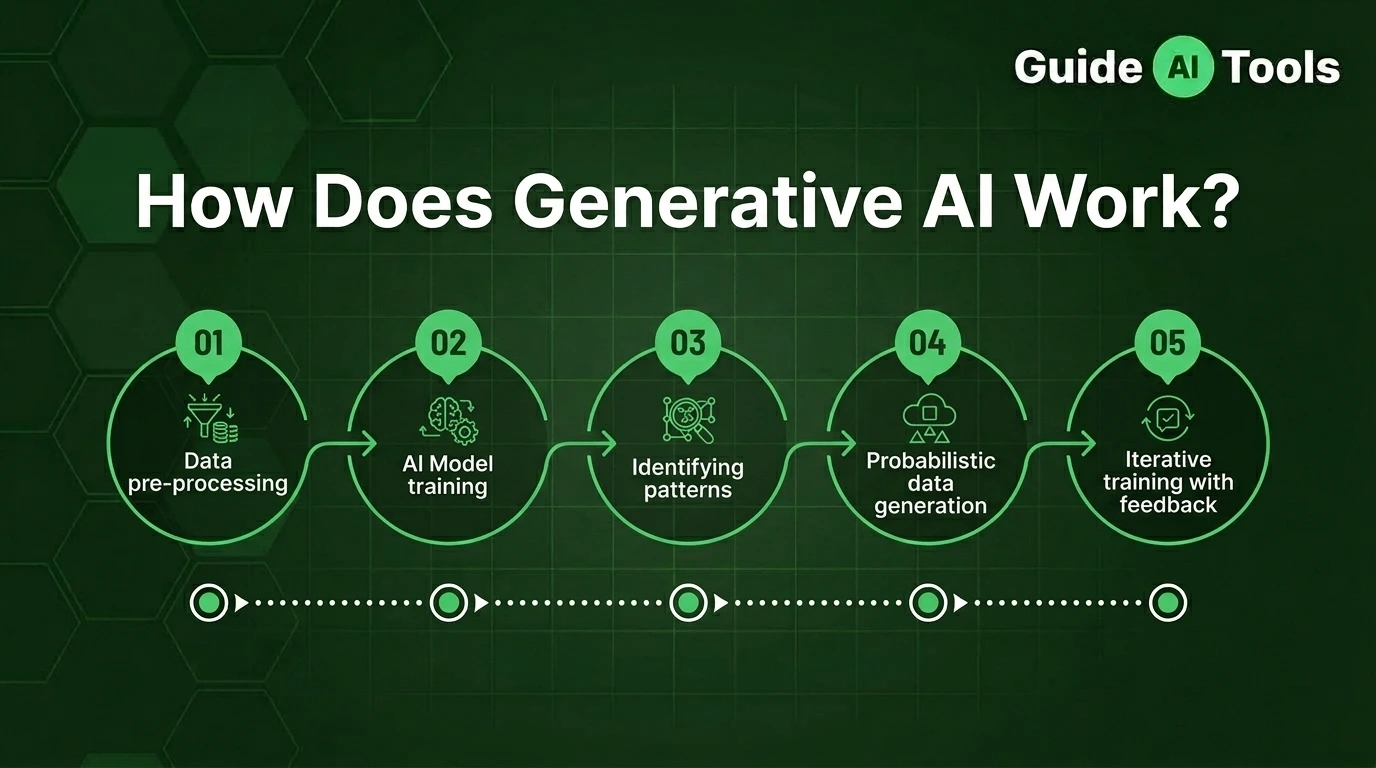
Current systems learn statistical patterns from data and training processes. They can display remarkable abilities without necessarily possessing the kind of broad, adaptive intelligence AGI definitions describe.
Microsoft Research captured this tension well in 2026, noting that modern systems can show impressive cross-domain fluency while still struggling with compositional generalization, object tracking and truth reliability.
Impressive isn’t the same as general.
Are LLMs, Generative AI and AI Agents AGI?
No. These concepts overlap with AGI research, but none of them means AGI by definition.
Generative AI
Generative AI creates new content such as text, images, audio, video and code.
A system can generate across several media types and still fall short of general intelligence.
Content generation describes what a system does.
AGI describes a proposed level of general cognitive capability.
Large language models
Large language models can answer questions, write code, analyze documents, translate languages and work with external tools.
That breadth can look general.
But IBM’s current AGI guidance says present LLMs are not considered AGI, pointing to remaining gaps in broad adaptability, real-world understanding and general problem solving.
Handling many prompts isn’t enough by itself.
The harder question is whether those abilities transfer reliably when the task, context or environment changes.
AI agents
AI agents can plan steps, call tools, browse information and perform actions toward a goal.
That gives them autonomy.
It doesn’t automatically give them general intelligence.
IBM explicitly distinguishes agentic AI from AGI. Agentic systems can act with limited human intervention while still operating inside defined capabilities and domains.
Autonomy and general intelligence are separate questions.
Does AGI Exist Today?
No current AI system is universally accepted as AGI.
That’s the safest factual answer as of September 2026.
Google Cloud states that true AGI does not currently exist and describes it as an ongoing research goal.
IBM still calls AGI hypothetical in its July 2026 update.
Stanford adds another reason to be cautious with dramatic AGI claims. There isn’t a universally accepted test that could settle the question for everyone.
This is why claims such as “AGI has already arrived” need a second question attached:
Under which definition?
A system can outperform humans at coding benchmarks, mathematics or another demanding task without proving human-comparable general intelligence across everything else.
The opposite claim also needs care.
Saying current AI is “nowhere near AGI” sounds precise, but distance is hard to measure when researchers don’t share one finish line.
How Would We Know If AGI Had Been Achieved?
This may be harder than it sounds.
Passing one difficult benchmark proves something about that benchmark. It doesn’t automatically prove general intelligence.
The old Turing Test illustrates the problem.
If a machine can hold a conversation convincingly enough that someone mistakes it for a human, that tells us something about conversational behavior.
It doesn’t test every form of reasoning, learning, planning, perception, adaptation or real-world problem solving.
Modern AGI evaluation needs a wider view.
Researchers might examine how broadly a system performs, how well it handles novel tasks, whether it can transfer knowledge, how reliably it reasons and whether performance survives major changes in context.
Google DeepMind’s Levels of AGI framework takes a useful approach.
Instead of treating AGI as one yes-or-no milestone, the researchers separate breadth, or generality, from depth, or performance. They also discuss autonomy as a related but separate deployment dimension.
That framing makes sense.
A system might reach expert-level performance in a handful of areas while remaining weak elsewhere.
Another system might handle a much broader range of tasks but only at an average level.
Which one is “more AGI”?
That’s exactly why the evidence needed to prove AGI is still part of the AGI problem itself.
Does AGI Need to Be Conscious?
Nobody knows, and many AGI definitions don’t require consciousness at all.
This is one of the places where science fiction can muddy the technical conversation.
A capability-based definition asks whether a system can learn, reason, generalize and adapt.
It doesn’t necessarily ask whether that system feels anything.
Other traditions around “strong AI” connect genuine machine intelligence more closely with self-awareness, understanding or consciousness.
IBM notes that these questions remain debated. Its AGI material distinguishes capability questions from unresolved philosophical issues about cognition and consciousness.
There is also no established evidence that current AI systems possess subjective awareness.
Intelligence and consciousness are not automatically the same claim.
An AGI discussion should keep them separate unless the definition being used explicitly combines them.
How Might Researchers Build AGI?
Nobody knows which technical route, if any, will produce AGI.
Current research explores several pieces that could contribute to more general systems.
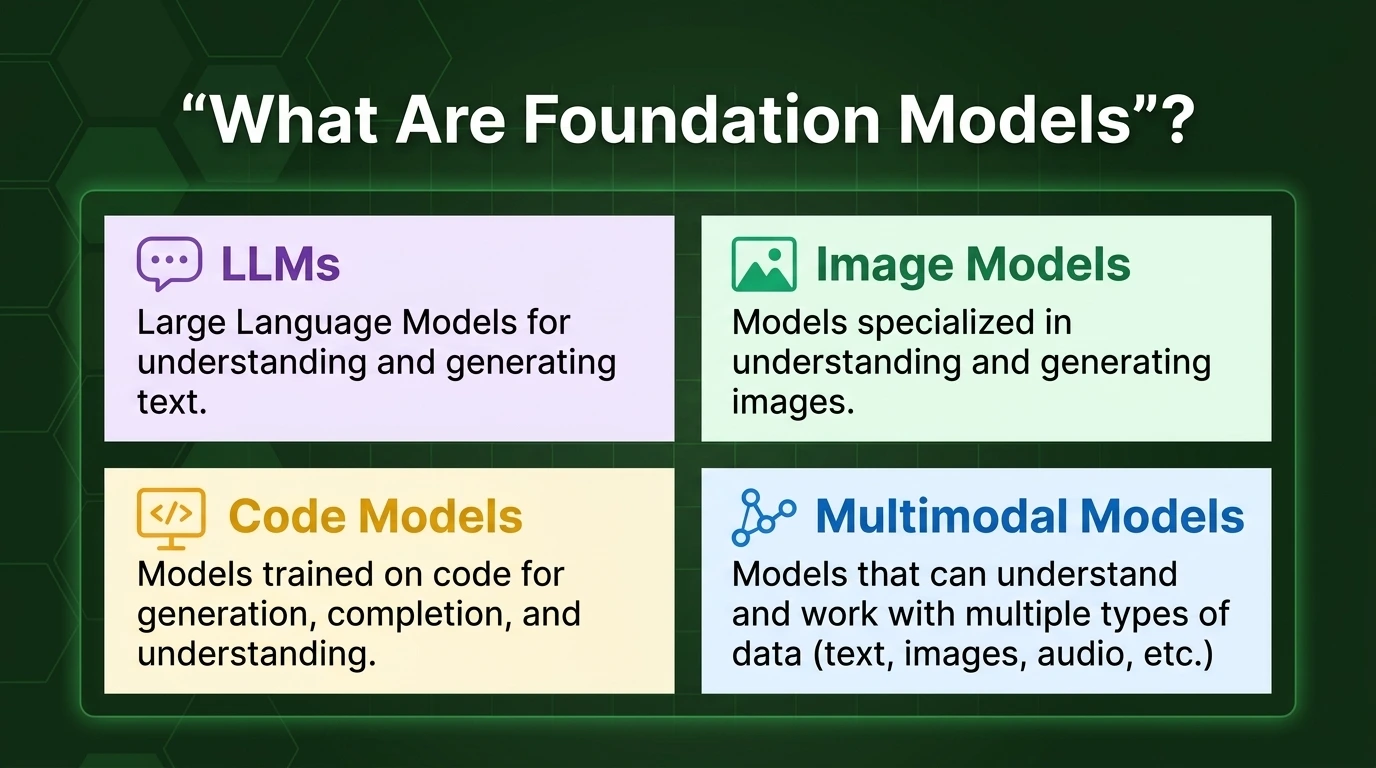
Foundation models provide broad pretrained capabilities. Multimodal systems connect language with images, audio and other information. Reinforcement learning can train systems through feedback.
Researchers are also working on long-term memory, continual learning, tool use, planning, reasoning and robotics.
Agents add another piece by allowing models to interact with software and environments.
Embodied systems explore what happens when intelligence must deal with physical space rather than text alone.
But putting all those pieces together doesn’t automatically create AGI.
Microsoft Research continues to study open-ended intelligence, compositional generalization and systems that can adapt to problems different from their training environments. Its 2026 work shows that generalization itself remains an active research problem, not a solved engineering detail.
The honest answer is simple.
We don’t yet know which architecture gets us there.
Why Is AGI So Difficult to Build?
Modern AI creates an odd impression.
A model can write competent software, explain advanced mathematics and summarize a scientific paper.
Then it can fail on a problem that seems embarrassingly simple.
That inconsistency matters more than people think.
AGI would need more than occasional flashes of expert performance. It would need broad ability that remains useful when tasks become unfamiliar.
Generalization is one challenge.
Continual learning is another. Humans can learn new information without rebuilding their entire brain from scratch. Many deployed AI systems don’t learn that way.
Memory matters too.
So do common sense, long-term planning, truth reliability and the ability to understand changing environments.
Microsoft Research’s 2026 work highlights persistent failures in compositional reasoning, object tracking and distinguishing truth from plausible fiction despite the impressive abilities of current systems.
The hard part isn’t only making AI score higher. It’s making capability transfer reliably when the problem changes.
What Could AGI Be Used For?
If AGI were achieved, its generality could make it useful across areas that currently require many different specialized systems.
It might assist scientists with research across several disciplines, help engineers work through unfamiliar technical problems or move between planning, coding and analysis without needing a separate model for every task.
Education could be another area.
A genuinely general system might adapt not only to a subject but to the student’s changing needs, reasoning style and gaps in understanding.
The same idea could apply to software development, health research, business planning and robotics.
But keep the wording careful.
These are possible uses of a hypothetical technology.
AGI has not been deployed in these roles because no universally accepted AGI exists.
What Are the Risks of AGI?
Some AGI risks would extend problems we already see with current AI.
Misuse, unreliable output, concentration of power and economic disruption don’t require AGI to exist.
Other concerns depend on capabilities that remain hypothetical, such as highly autonomous systems pursuing complex goals across many environments.
Alignment becomes especially relevant here.
If a system becomes more capable and more autonomous, mistakes in goals, instructions or oversight could matter more.
That doesn’t mean every extreme scenario will happen.
It means capability changes the consequence of failure.
Our separate guide to the risks of AI covers current reliability, bias, privacy, misuse and safety problems in more depth.
AGI vs Artificial Superintelligence
AGI and artificial superintelligence are not synonyms.
| AGI | Artificial Superintelligence |
|---|---|
| Broadly human-comparable general intelligence | Broad intelligence beyond human capability |
| Expected to work across many domains | Expected to outperform humans across many domains |
| Human-level performance may qualify under many definitions | Human-level performance would not be enough |
| Hypothetical | Hypothetical |
An AGI doesn’t need to outperform every person at everything.
IBM explicitly says superintelligence is not required for AGI. A generally capable system with roughly human-comparable intelligence could qualify under many definitions without being superintelligent.
ASI is the next conceptual step.
Not another name for the same thing.
When Will AGI Happen?
Nobody knows.
You can find confident predictions ranging from very soon to many decades away. None should be treated as a verified arrival date.
Even OpenAI’s Charter says the timeline to AGI remains uncertain.
And timeline debates contain a hidden problem.
Different people may be predicting the arrival of different things because they aren’t using the same AGI definition.
A company focused on economic work may set one threshold.
A researcher focused on general reasoning may use another.
Someone who believes consciousness matters may set the bar somewhere else entirely.
Research progress is uneven too. A system can improve dramatically in coding while making much smaller gains in long-term memory or reliable reasoning.
So asking when AGI will arrive is partly a forecasting question and partly a definition question.
FAQs
What does AGI stand for?
AGI stands for Artificial General Intelligence.
It refers to a hypothetical form of AI with broad learning, reasoning and adaptation abilities across many tasks rather than one restricted specialty.
Is AGI real?
No system is universally recognized as AGI as of September 2026.
Current systems continue to gain broader capabilities, but major reference sources still describe AGI as hypothetical or lacking a universally accepted definition and test.
Is ChatGPT AGI?
ChatGPT is not universally accepted as AGI.
Modern language models can perform many different tasks, but that doesn’t by itself settle questions about reliable generalization, continual learning, common sense and adaptation to genuinely unfamiliar problems.
Is AGI the same as generative AI?
No.
Generative AI refers to systems that create content. AGI refers to a proposed level of broad intelligence that could learn and operate across many unrelated domains.
A generative model could contribute to an AGI system without being AGI itself.
Is AGI the same as agentic AI?
No.
Agentic AI describes systems that can plan and take actions toward goals, often using software tools.
AGI is about breadth and adaptability of intelligence. A system can act autonomously while remaining limited to a defined set of capabilities.
Does AGI need consciousness?
Not under every definition.
Some strong-AI theories connect general intelligence with consciousness or self-awareness. Many operational AGI definitions focus instead on measurable abilities such as reasoning, learning and generalization.
There is no consensus that consciousness is required.
What are examples of AGI?
There are no universally accepted real-world examples.
Current chatbots, language models, agents and robotics systems may demonstrate capabilities relevant to AGI research, but calling them AGI would require adopting a specific definition and showing that they meet it.
Is AGI smarter than humans?
Not necessarily.
Many definitions place AGI around broad human-level capability. Artificial superintelligence is the term usually used for hypothetical systems that broadly exceed human intelligence.
Is AGI possible?
It remains an open research question.
Researchers continue to work on more general learning, reasoning and adaptive systems, but no one can currently verify that a particular technical route will produce AGI.
How will we know when AGI exists?
There is no universally agreed test.
Convincing evidence would likely need to show broad learning, reliable reasoning, adaptation and knowledge transfer across many unfamiliar tasks rather than exceptional results on one benchmark.
The Threshold Matters More Than the Label
The useful way to think about AGI isn’t as a bigger chatbot.
It’s a proposed shift from systems that perform a collection of learned capabilities toward intelligence that can transfer knowledge, adapt and solve unfamiliar problems much more generally.
Modern AI keeps making that boundary harder to describe.
That makes evidence more valuable, not less.
When someone says a new model is “basically AGI,” ask what the system can generalize to, where it still fails, how reliably it learns unfamiliar tasks and which AGI definition is being used.
Until those questions have convincing answers, the label alone doesn’t tell us much.

Related Blog Posts