Machine Learning vs Deep Learning: Key Differences Explained
Deploying deep learning when simple machine learning will do is one of the fastest ways to burn through a cloud infrastructure budget. While deep learning powers headline-grabbing breakthroughs like ChatGPT and Midjourney, traditional machine learning still handles the quiet, critical tasks that run modern business backends.
In my testing across different data pipelines, I’ve noticed that engineers frequently default to complex neural networks when a basic linear model or decision tree would deliver faster results at a fraction of the cost.
Choosing between these two approaches isn’t about picking the newest tool. It comes down to data structure, compute limits, and how much transparency your business requires.
Machine Learning vs Deep Learning: What Is the Core Difference?
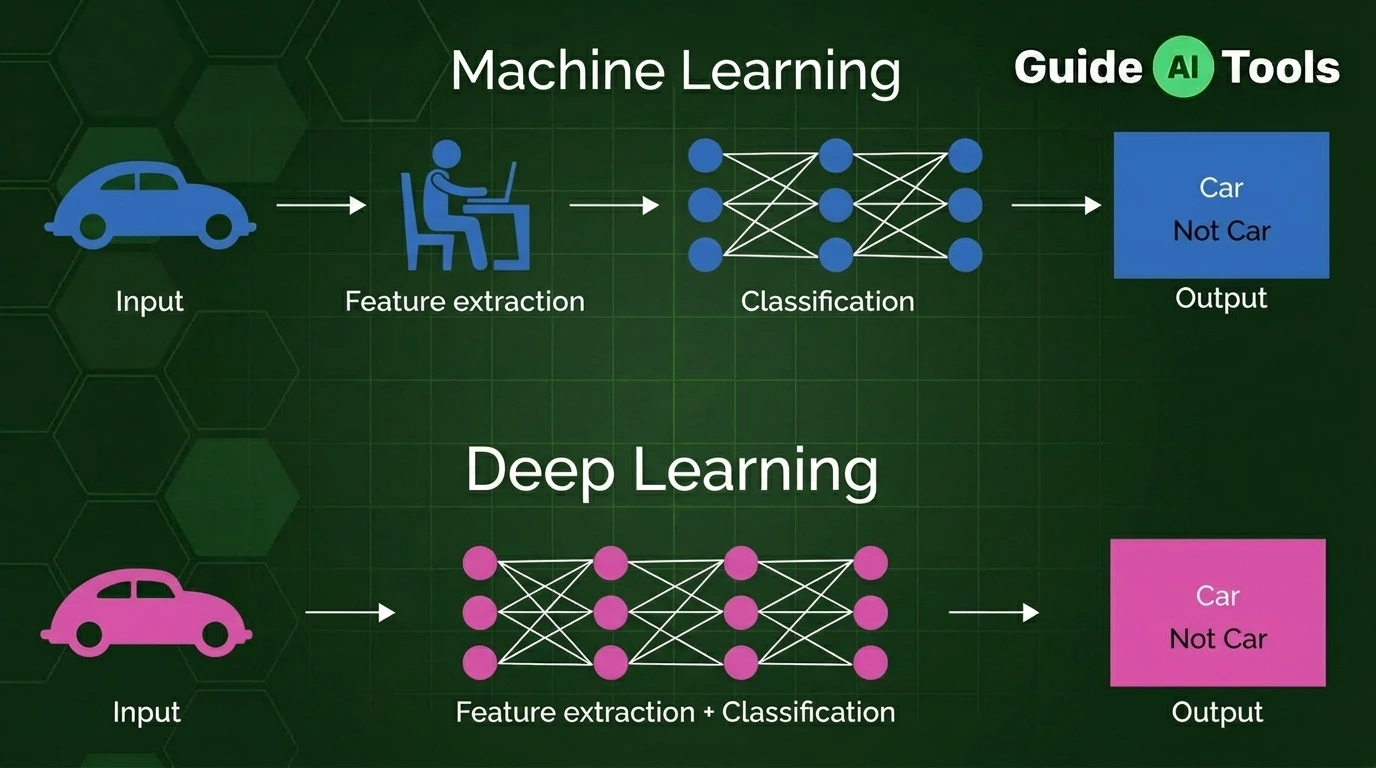
Machine learning is a broad field of artificial intelligence where algorithms learn patterns from data to make predictions. Deep learning is a specialized subset of machine learning that uses multi-layered artificial neural networks to automatically extract features from raw, unstructured data without manual human intervention.
Look at how these paradigms process information. Traditional models rely on humans to structure inputs, while deep networks learn hierarchical representations on their own.
To understand how foundational algorithms process basic inputs, explore our guide on what is machine learning for a complete breakdown of core principles.
The fundamental relationship is nesting, not competition. Deep learning sits directly inside machine learning, which sits inside artificial intelligence.
If you want to see how these categories split further up the chain, read our comparison on ai vs machine learning to clarify high-level definitions.
Deep learning trades higher compute costs for automated feature extraction. That trade-off forms the exact line where project teams choose one framework over the other.
Understanding the Hierarchy: AI, ML, and Deep Learning
People often throw these terms around as if they compete with each other. They do not.
Artificial intelligence is the overarching umbrella that covers any machine displaying intelligent behavior. Machine learning sits inside that umbrella as the statistical engine driving predictions. Deep learning lives inside machine learning as a specialized approach built on deep neural networks.
Artificial Intelligence
└── Machine Learning
    └── Deep Learning
Think of artificial intelligence as vehicle technology. Machine learning represents combustion engines, while deep learning represents turbo-charged V8 engines.
From what I have seen in production environments, teams waste months because they confuse these boundaries. They try to apply deep neural networks to simple tabular CSV files when standard machine learning models would run circles around them.
Nested architecture determines how models absorb data, so keeping this hierarchy in mind prevents unnecessary technical debt.
Feature Engineering: The Defining Technical Divide
Feature engineering is the exact point where classic machine learning and deep learning split ways.
In traditional machine learning, human domain experts must manually identify, clean, and format data attributes before an algorithm can process them. You cannot just throw raw files into a decision tree and expect it to work.
If you give a classic model a customer spreadsheet, an engineer must normalize columns, remove outliers, and create synthetic variables like purchase frequency or churn probability scores.
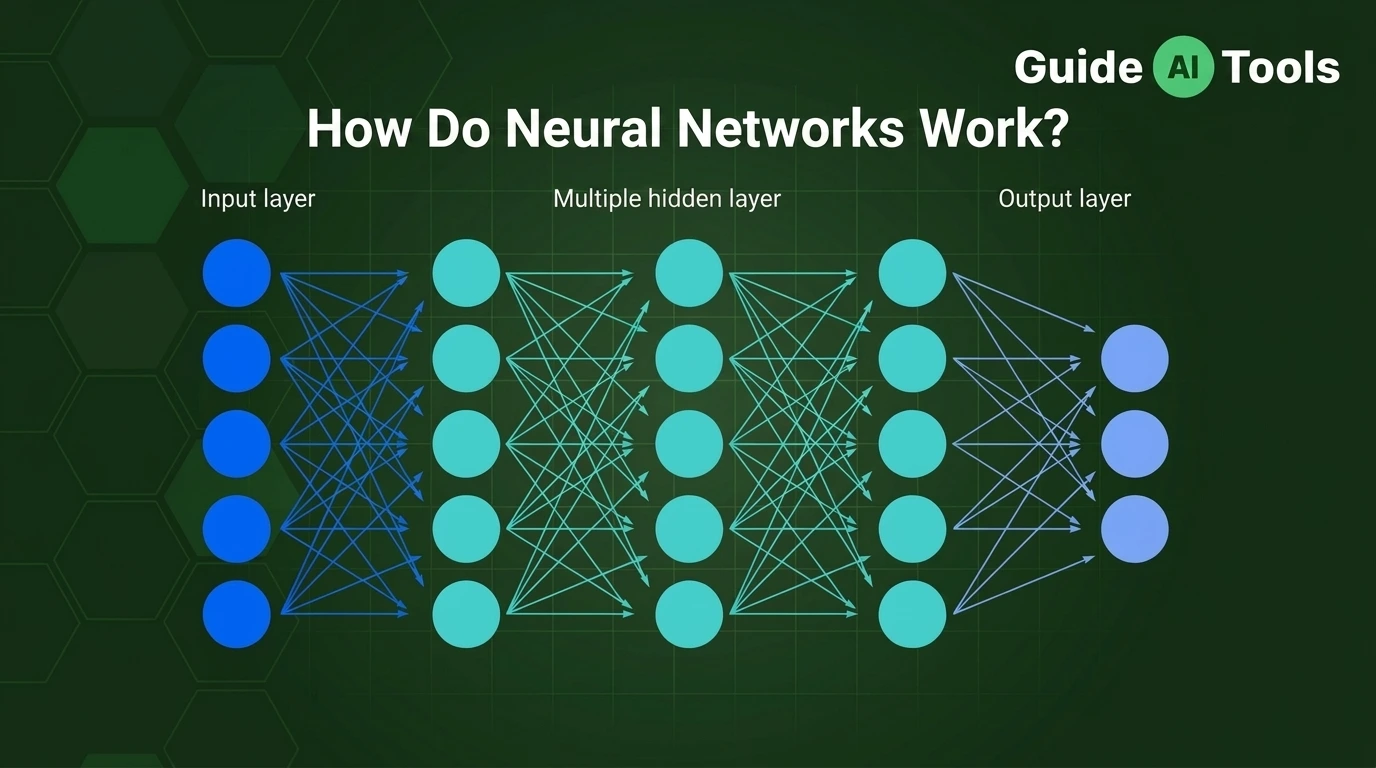
Deep learning handles this workload differently. Multi-layered neural networks extract features automatically as data passes through hidden layers.
Lower layers detect simple patterns like edges or pixel transitions. Middle layers combine those edges into shapes or textures. Higher layers assemble shapes into complex representations like human faces or handwritten letters.
According to MIT Computer Science and Artificial Intelligence Laboratory research, representation learning inside deep networks removes human bias from feature selection entirely.
Try feeding a raw 4K video stream into a traditional support vector machine. It fails completely because the model cannot process millions of unorganized pixels without human assistance.
Deep neural networks process that exact same raw video stream with ease. They figure out spatial relationships, motion vectors, and visual context across hidden layers on their own.
Automated representation learning eliminates manual feature extraction at the expense of massive training data requirements.
Data and Hardware Requirements: Where the Tipping Points Lie
Resource requirements create sharp tipping points between classic algorithms and deep networks.
Traditional machine learning models perform exceptionally well on small to medium datasets containing thousands of rows. Increasing data volume past a certain point yields diminishing returns. Performance plateaus quickly.
Deep learning architectures behave in the opposite way. Small datasets cause deep neural networks to overfit terribly, memorizing noise instead of learning patterns.
Give a deep neural network millions of training samples, however, and its performance scales continuously. It keeps getting accurate as data volume grows.
Compute hardware requirements diverge just as sharply. Classic algorithms run efficiently on standard multi-core central processing units (CPUs).
Deep learning relies heavily on matrix multiplication and tensor calculus. Running deep networks requires specialized parallel processors like graphics processing units (GPUs) or tensor processing units (TPUs).
Training duration reflects these hardware demands. A complex random forest model might train on CPUs in two minutes. Pretraining a vision transformer or a large language model takes thousands of GPU hours over several weeks.
| Resource Factor | Traditional Machine Learning | Deep Learning |
| Minimum Training Samples | Thousands of rows | Hundreds of thousands to millions |
| Primary Data Type | Structured tabular data (CSV, SQL) | Unstructured data (Images, Text, Audio, Video) |
| Optimal Hardware | Standard Multi-Core CPUs | Dedicated GPU / TPU Clusters |
| Training Duration | Seconds to minutes | Hours to weeks |
| Feature Extraction | Manual domain-expert engineering | Automated representation learning |
| Model Interpretability | High (Decision trees, Linear models) | Low (Complex black-box architectures) |
Honestly, most teams mess this up by purchasing expensive GPU cloud instances before verifying their data volume. Hardware investments must match data scale or your infrastructure costs will skyrocket without benefit.
Direct Comparison: ML vs Deep Learning
Evaluating both paradigms side by side highlights where each framework succeeds.
Traditional machine learning relies on linear models, decision trees, kernel methods, and gradient-boosted trees like XGBoost. These architectures excel at processing structured databases and relational tables.
Deep learning relies on multi-layer artificial neural networks containing millions or billions of trainable weights.
To see how neural network layers process information step by step, check out our guide on what is a neural network to examine internal node connections.
If you need to explore multi-layer network mechanics further, read our overview on what is deep learning for technical context.
Model explainability marks a critical divide between the two approaches. Traditional models provide clear audit trails, making it easy to explain why a decision tree rejected a loan application.
Deep neural networks operate as black boxes. Tracing why a multi-layer model reached a specific output across billions of internal parameters is nearly impossible.
| Comparison Factor | Machine Learning | Deep Learning |
| Algorithmic Structure | Linear models, trees, kernel methods | Multi-layer artificial neural networks |
| Feature Dependency | Requires hand-crafted features | Learns representations directly from raw input |
| Data Scalability | Plateaus on massive datasets | Scales continuously with larger data volumes |
| Hardware Dependency | Low compute demands (CPU) | High compute demands (GPU / TPU clusters) |
| Explainability | Easy to audit decision paths | Hard to interpret internal layer weightings |
| Best For | Fraud scoring, churn prediction, sales forecasts | Computer vision, LLMs, voice synthesis, translation |
Auditing capabilities often outweigh pure accuracy when building software for regulated commercial environments.
Practical Decision Guide: When to Choose Which
Choosing the right algorithmic model depends on four practical criteria.
Choose traditional machine learning when working with structured tabular datasets stored in relational databases or CSV files. It delivers top-tier accuracy on customer metrics, transaction logs, and financial spreadsheets.
Opt for classic models when you operate under strict regulatory constraints. Banks, healthcare providers, and legal teams choose decision trees because auditors can trace every rule.
Pick traditional algorithms when compute budgets are tight or deployment timelines require fast iteration. You can train and deploy a gradient-boosted model on basic hardware in an afternoon.
To review how algorithms divide by learning style, read our breakdown of types of machine learning to evaluate supervised and unsupervised setups.
Choose deep learning when building applications around unstructured data like raw audio, video streams, high-resolution photos, or free-form text passages.
Select deep architectures when building modern generative systems or conversational assistants. Neural networks form the foundation of modern media tools and text generation models.
To examine how neural architectures generate synthetic content, read our guide on what is generative ai for a full breakdown.
Unstructured data formats demand deep learning because manual feature extraction cannot capture complex visual or temporal patterns.
Limitations and Real-World Trade-Offs
Every algorithmic choice brings real-world trade-offs that impact long-term operations.
Deep learning models demand huge amounts of electrical power and costly hardware infrastructure. Running continuous GPU clusters drives up cloud hosting expenses significantly over time.
Overfitting presents a major hazard when using deep architectures on limited datasets. A deep network will memorize small noise patterns easily, resulting in poor performance when deployed to live users.
The interpretability problem creates real friction in commercial software. When a deep learning model makes an incorrect prediction in medical diagnosis or credit scoring, identifying the root cause inside hidden layers is extremely difficult.
- Massive electricity consumption and GPU hosting fees
- High vulnerability to overfitting on small data collections
- Lack of explainability in safety-critical applications
- Vulnerability to adversarial attacks that trick neural network weights
Traditional machine learning faces its own breaking points when scaling to modern media inputs. Manual feature engineering requires endless domain expertise, and classical models completely fail on complex natural language tasks.
No single framework solves every problem, so matching model architecture to your exact data type is critical.
FAQs
What is the main difference between machine learning and deep learning?
Machine learning requires human engineers to manually structure features from data, while deep learning uses multi-layer neural networks to automatically extract features from raw inputs.
Is deep learning better than machine learning?
No, deep learning is not universally better because traditional machine learning outperforms neural networks on structured tabular data while requiring significantly less compute power.
Does deep learning require more data than machine learning?
Yes, deep learning requires hundreds of thousands or millions of training samples to learn accurate representations, whereas traditional machine learning works effectively on smaller datasets.
What is feature engineering in machine learning vs deep learning?
Feature engineering in machine learning involves human domain experts selecting and formatting variables, while deep learning automates this process through hidden neural network layers.
When should you use machine learning instead of deep learning?
You should use machine learning when working with structured tabular data, limited compute budgets, fast deployment deadlines, or when strict regulatory auditability is required.
Are neural networks machine learning or deep learning?
Neural networks are machine learning models, but deep neural networks containing multiple hidden layers specifically define the subfield of deep learning.
Why does deep learning require GPUs?
Deep learning requires GPUs because multi-layer neural networks rely on millions of simultaneous matrix multiplications that parallel processing hardware handles much faster than traditional CPUs.
Is ChatGPT machine learning or deep learning?
ChatGPT relies on deep learning because it is built on deep Transformer neural networks trained on massive unstructured text datasets.
Final Thoughts
Matching your software architecture to your specific data type prevents costly technical rewrites later.
If you are evaluating AI tools, infrastructure platforms, or development frameworks for your next project, choosing the right stack saves time and compute costs.
Explore our full directory at GuideAITools to compare the top development platforms, machine learning libraries, and commercial AI tools available today. Test different model services, evaluate hosting prices, and build the ideal tech stack for your team.

Related Blog Posts