History of Artificial Intelligence: From Turing to AI Agents
The term is older than the personal computer, the computer mouse, and the microchip. Yet most people felt like AI appeared out of nowhere when ChatGPT launched in late 2022.
The real history of artificial intelligence spans more than seven decades of bold promises, catastrophic funding crashes, and quiet engineering breakthroughs.
At GuideAITools, we track how software evolves so you can make sense of modern tools without getting caught up in marketing noise. Understanding where these models come from makes it much easier to predict where they are heading next.
Here is the story of how logic puzzles and room-sized computers became the intelligent systems sitting on your phone today.
What Is the History of Artificial Intelligence?
The history of artificial intelligence is the story of humanity trying to build machines that learn, reason, and solve problems like a human mind. It began as a academic quest in the 1950s, moved through two severe funding collapses called AI winters, and revived through deep learning and statistical data analysis.
Today, the field has moved beyond simple pattern recognition into autonomous reasoning models and real-time systems.
| Era | Primary Approach | Key Milestone | Major Shift |
| 1950 to 1956 | Theoretical foundations | Turing Test proposed (1950) | Moved from philosophy to engineering |
| 1956 to 1974 | Symbolic rules & logic | ELIZA chatbot (1966) | Hand-written rules met compute limits |
| 1974 to 1993 | Expert systems & winter | Lisp machine crash (1987) | Specialized hardware collapsed |
| 1993 to 2011 | Machine learning | Deep Blue beats Kasparov (1997) | Shifted from rules to data-driven math |
| 2012 to 2020 | Deep learning | AlexNet wins ImageNet (2012) | GPUs and multi-layer neural networks took over |
| 2020 to 2024 | Generative AI | ChatGPT release (2022) | Large language models went consumer-scale |
| 2025 to 2026 | Reasoning models & agents | Autonomous system execution | Shifted from next-token guessers to multi-step reasoning |
If you are new to the field, reading our foundational guide on what is artificial intelligence will give you a quick baseline before reading the timeline below.
Before 1950: Myths, Logic and the First Computers
People dreamed about mechanical minds centuries before electrical power existed. Greek myths told stories of Talos, a giant bronze automaton built to guard Crete. In 1921, Czech playwright Karel Čapek published R.U.R., coining the word robot from the Czech term for forced labor.
Beyond fiction, mathematicians built the real foundation. Thomas Bayes developed probability theorems in the 1760s that power modern data predictions. In 1936, Alan Turing designed the mathematical model of a universal computer, proving that a single machine could run any logical calculation if given enough instructions and memory.
By the 1940s, researchers built the first working electronic computers. In 1943, Warren McCulloch and Walter Pitts published a mathematical model of an artificial neuron, proving that simple connected logic gates could mimic biological brain functions.
1950–1956: Turing, Neural Nets and the Dartmouth Workshop
What Was the Turing Test?
The Turing Test was a thought experiment proposed by Alan Turing in 1950 to decide if a computer can imitate human conversation convincingly. Published in his paper Computing Machinery and Intelligence, Turing replaced the vague question “Can machines think?” with a practical game where an evaluator chats with a human and a machine through text, trying to tell which is which.
Who Invented Artificial Intelligence?
No single person invented artificial intelligence. John McCarthy, Marvin Minsky, Nathaniel Rochester, and Claude Shannon organized the field by writing the Dartmouth Summer Research Project proposal in August 1955. John McCarthy coined the phrase artificial intelligence in that document to describe machines that simulate human intelligence.
The famous Dartmouth workshop took place during the summer of 1956 in Hanover, New Hampshire. Ten researchers spent two months discussing language processing, neural nets, and computational complexity. That meeting officially launched AI as an independent academic discipline.
Honestly, most people get this wrong by claiming AI was invented at the conference itself. The term appeared in the 1955 proposal document, a full year before the 1956 summer meeting began.
1956–1974: The First Golden Age
After the Dartmouth meeting, research funding poured in. Government agencies like DARPA funded projects with almost no restrictive conditions. Researchers made rapid early progress on narrow logic problems, leading to massive public excitement.
Allen Newell and Herbert Simon built the Logic Theorist in 1956, a program that proved 38 of the first 52 theorems in Whitehead and Russell’s Principia Mathematica. In 1958, John McCarthy created Lisp, a programming language that remained the standard for software development in AI for three decades.
That same year, Frank Rosenblatt built the Perceptron at Cornell, an early hardware-based neural network that could learn simple visual patterns. In 1966, Joseph Weizenbaum created ELIZA at MIT, a simple program that rephrased user inputs as questions to simulate a psychotherapist.
Despite using simple pattern matching, ELIZA tricked users into attributing real human empathy to the software. Early researchers mistook quick success on small toy problems for easy scaling, predicting that fully human-level intelligent machines were only twenty years away.
The AI Winters: Why AI Stalled Twice
An AI winter is a period of reduced funding, public disappointment, and stalled academic research caused by over-promising what software can actually deliver.
The first winter hit in the mid-1970s. In 1969, Marvin Minsky and Seymour Papert published their book Perceptrons, proving mathematically that single-layer neural networks could not solve simple non-linear logical problems like XOR gate operations. The publication effectively killed neural network research for a decade.
In 1973, Sir James Lighthill delivered a report to the British Parliament stating that AI algorithms failed completely when scaled to real-world problems. Government funding was cut sharply across the United States and the United Kingdom through 1974.
The field revived in the 1980s through expert systems, software that encoded human specialist knowledge into thousands of strict IF-THEN rules. Corporations spent billions building specialized Lisp computers to run these rule engines.
By 1987, specialized Lisp hardware proved too expensive to maintain compared to cheap desktop PCs from IBM and Apple. The market for specialized AI computers collapsed, triggering the second winter.
| Factor | The First AI Winter (1974–1980) | The Second AI Winter (1987–1993) |
| Primary Trigger | Perceptrons book (1969) and the Lighthill Report (1973) | Collapse of the specialized Lisp machine hardware market |
| Failed Technology | Early single-layer neural nets and simple logic solvers | Rigid rule-based expert systems |
| Impact | DARPA and UK government research grants cancelled | Hundreds of specialized software startups went bankrupt |
| What Survived | Backpropagation algorithm development in academia | Early probability methods and decision tree research |
1990s–2000s: Machine Learning Takes Over
In the 1990s, researchers stopped trying to hand-code human intelligence into thousands of rigid rules. They turned to probability, statistics, and pattern processing instead.
Instead of teaching a computer what a dog looks like by writing strict code, engineers fed algorithms thousands of labeled dog photos and let the software learn statistical patterns independently. To understand this shift, read our explainer on machine learning.
In 1989, Yann LeCun used convolutional neural networks and backpropagation to read handwritten ZIP codes for the US Postal Service. Sepp Hochreiter and Jürgen Schmidhuber proposed Long Short-Term Memory (LSTM) networks in 1997, giving systems a way to process sequential data like speech and text without losing context.
Public attention returned to competitive gaming milestones. IBM built Deep Blue, a custom chess supercomputer capable of evaluating 200 million positions per second.
Garry Kasparov beat Deep Blue in their first match in February 1996. IBM upgraded the hardware, and Deep Blue won the six-game rematch in May 1997.
In 2009, Fei-Fei Li launched ImageNet at Princeton, a dataset containing over 14 million annotated images. ImageNet provided the raw training data needed to test deep neural networks at scale, setting the stage for the modern era.
2012–2019: The Deep Learning Revolution
In 2012, Alex Krizhevsky, Ilya Sutskever, and Geoffrey Hinton entered AlexNet into the ImageNet visual recognition competition. AlexNet used a deep convolutional neural network trained on graphics cards (GPUs) originally designed for video games. It won the competition by cutting the image recognition error rate from 26% down to 15%.
GPUs proved thousands of times faster at running parallel matrix math than standard computer processors. If you want to understand how artificial neural structures mirror this hardware, read our breakdown of deep learning.
A wave of major architectural breakthroughs followed in rapid succession.
- 2014: Ian Goodfellow introduced Generative Adversarial Networks (GANs), letting two networks compete to create realistic synthetic images.
- 2016: DeepMind’s AlphaGo beat world champion Lee Sedol at the complex board game Go, executing unexpected creative moves that surprised master players.
- 2017: Google researchers published “Attention Is All You Need”, introducing the Transformer architecture. Transformers replaced old sequential processing with self-attention mechanisms, letting models evaluate entire documents at once.
- 2018: OpenAI released GPT (Generative Pre-trained Transformer), proving that unsupervised pre-training on vast text datasets produced adaptable language models.
2020–2024: Generative AI Goes Mainstream
The 2020s marked the jump from academic research laboratories straight to consumer apps. OpenAI released GPT-3 in June 2020 with 175 billion parameters, demonstrating that expanding model scale improved output coherence significantly.
DeepMind solved a 50-year-old biological mystery in late 2020 with AlphaFold, predicting 3D protein structures down to atomic accuracy. In early 2021, DALL-E introduced text-to-image generation, converting simple English prompts into detailed visuals.
On November 30, 2022, OpenAI launched ChatGPT as a free web research preview. ChatGPT reached 100 million active monthly users within two months, making it the fastest-growing consumer application in internet history up to that time.
You can read our guide explaining generative AI to see how these creation models construct original outputs.
In March 2023, OpenAI released GPT-4, demonstrating strong performance on human standardized exams like the Uniform Bar Exam. By March 2024, the European Union formally passed the EU AI Act, establishing the world’s first comprehensive legal rulebook for commercial risk classification and systemic model safety.
Later that year, the 2024 Nobel Prizes in Physics and Chemistry were awarded to John Hopfield, Geoffrey Hinton, Demis Hassabis, and John Jumper for fundamental contributions to neural networks and protein structure prediction.
2025–2026: Reasoning Models and AI Agents
By late 2024, standard model scaling began hitting diminishing returns. Training larger models on raw web text produced modest improvements while computational training costs exploded.
The industry shifted toward inference-time compute and reasoning models. OpenAI introduced the o1 series in September 2024, giving models time to run internal chain-of-thought processing steps before outputting a final answer.
In January 2025, DeepSeek released R1, an open-weights reasoning model that achieved competitive reasoning benchmark performance at a tiny fraction of conventional training costs. OpenAI launched GPT-5 on August 7, 2025, consolidating reasoning chains into unified multimodal workflows.
In my practical testing of modern workflows, software has shifted away from simple chat interfaces toward autonomous execution systems. Instead of answering a single prompt, modern systems act as real-time agents that plan, write code, run terminal commands, and correct their own errors.
To see how these systems execute multi-step goals autonomously, explore our guide on AI agents. You can also keep up with current product releases across the industry inside our guide on AI Trends 2026.
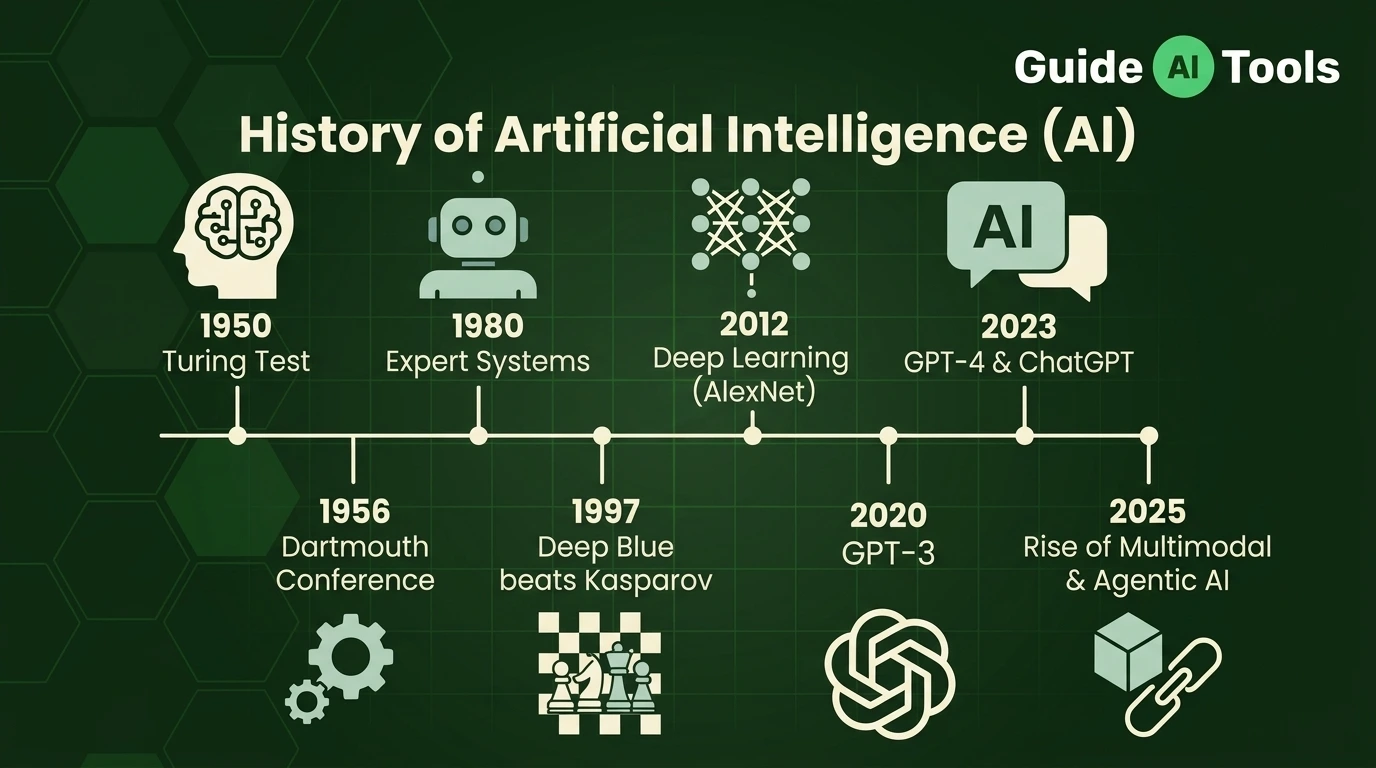
AI Timeline: Key Milestones at a Glance
| Year | Milestone | Key Figures or Organizations | Why It Mattered |
| 1950 | Turing Test proposed | Alan Turing | Shifted the focus from abstract philosophy to practical conversational benchmarks |
| 1955 | Term “Artificial Intelligence” coined | John McCarthy | Defined the discipline in the Dartmouth project proposal |
| 1956 | Dartmouth Workshop held | McCarthy, Minsky, Shannon, Rochester | Established AI as a dedicated academic field |
| 1958 | Lisp created & Perceptron built | John McCarthy, Frank Rosenblatt | Created the core language and early hardware neural network |
| 1966 | ELIZA chatbot created | Joseph Weizenbaum (MIT) | Demonstrated that simple software could fool humans into assuming empathy |
| 1969 | Perceptrons book published | Marvin Minsky, Seymour Papert | Proved single-layer networks were limited, halting neural net research |
| 1973 | Lighthill Report released | Sir James Lighthill | Triggered government funding cuts across the UK and US |
| 1980 | Expert systems boom begins | R1 / XCON at Digital Equipment Corp | Brought commercial rule-based software into corporate production |
| 1987 | Lisp machine market crashes | Symbolics, Lisp Machines Inc. | Marked the start of the second major funding collapse |
| 1989 | Backpropagation applied to CNNs | Yann LeCun (AT&T Bell Labs) | Proved neural networks could reliably read real-world handwritten numbers |
| 1997 | Deep Blue beats Garry Kasparov | IBM | Proved brute-force search hardware could defeat world-class human chess strategy |
| 2009 | ImageNet dataset launched | Fei-Fei Li (Princeton/Stanford) | Provided the massive image training dataset required for modern computer vision |
| 2012 | AlexNet wins ImageNet | Krizhevsky, Sutskever, Hinton | Proved deep learning on GPUs outperformed hand-crafted visual algorithms |
| 2014 | GANs introduced | Ian Goodfellow | Enabled generative models to synthesize hyper-realistic synthetic media |
| 2016 | AlphaGo defeats Lee Sedol | DeepMind | Proved deep reinforcement learning could master intuitive board games |
| 2017 | Transformer architecture published | Vaswani et al. (Google Brain/Research) | Replaced recurrent networks with self-attention, enabling modern language models |
| 2020 | GPT-3 released & AlphaFold 2 | OpenAI, DeepMind | Scaled parameter size to 175B and solved 3D protein structure folding |
| 2022 | ChatGPT launched | OpenAI | Made natural language interfaces accessible to mainstream consumers |
| 2023 | GPT-4 released | OpenAI | Demonstrated multi-modal reasoning and professional exam competency |
| 2024 | EU AI Act passed | European Parliament | Set the world’s first formal regulatory rules for risk-based deployment |
| 2025 | DeepSeek R1 & GPT-5 launched | DeepSeek, OpenAI | Proved open reasoning models and inference-time compute scaling worked |
5 Patterns That Repeat Through AI History
Looking across seven decades of technological development, the same structural cycles repeat.
- Overhyped claims outpace reality. Researchers make bold promises based on initial success with small test cases. When software meets complex real-world conditions, progress stalls.
- Scaling walls force architectural shifts. Every paradigm hits a hard limit. Expert systems ran out of human logic rules, and modern language models ran out of human-written text data. Engineers must invent new methods to keep progressing.
- Hardware dictates software feasibility. Concepts like backpropagation and neural nets sat underutilized for decades. They only became useful when cheap parallel computing GPUs caught up to the math.
- Funding follows hype, then crashes. Financial capital rushes into the field during breakthrough phases, creates a bubble around weak business models, and withdraws sharply when expectations are missed.
- Abandoned concepts return to win later. Neural networks were dismissed as an academic dead end during the 1970s and late 1980s. Decades later, the exact same mathematical ideas became the backbone of modern technology.
Common Myths and Date Errors in AI History
Historical accounts of technological progress often contain repeated factual errors. Here are the most common mistakes corrected against primary records.
- Myth: The Dartmouth workshop took place in 1955.Fact: The project proposal was written in August 1955. The actual workshop ran during the summer of 1956.
- Myth: Deep Blue beat Garry Kasparov on its first attempt in 1996.Fact: Kasparov defeated Deep Blue 3.5 to 2.5 in their 1996 match. Deep Blue won the upgraded rematch in May 1997.
- Myth: The Lighthill Report was published in 1974.Fact: Sir James Lighthill presented his report to the British Science Research Council in 1973. Funding cuts followed across 1974.
- Myth: AI winters completely halted all research.Fact: Funding dropped dramatically, but core foundational work on backpropagation, decision trees, and reinforcement learning continued inside universities during winter periods.
- Myth: ChatGPT was the first large language model.Fact: Google, OpenAI, Meta, and university labs built and deployed large language models for years prior. ChatGPT was simply the first to add a fine-tuned conversational web interface.
Then vs Now: How Early AI Ideas Became Today’s Tools
Every modern consumer application traces its technical roots directly back to an early research experiment.
| Early Academic Project | Modern Commercial Tool | Category on GuideAITools |
| ELIZA conversational script (1966) | Interactive assistants and custom GPTs | Chatbots & Assistants |
| Dragon System & Harpy speech recognition (1970s) | Real-time audio transcription services | Speech Recognition Tools |
| Shakey the Robot visual processing (1969) | Object detection and visual inspection software | Computer Vision Software |
| Arthur Samuel’s checkers program (1952) | Self-improving automated workflow agents | AI Agents & Automation |
| Perceptrons & multi-layer mathematical models (1958) | High-speed code completion engines | AI Coding Assistants |
FAQs
What is the history of artificial intelligence?
The history of artificial intelligence is the multi-decade development of software systems capable of performing tasks that typically require human reasoning, moving from 1950s symbolic logic rules to modern statistical deep learning models.
Who invented artificial intelligence?
John McCarthy, Marvin Minsky, Nathaniel Rochester, and Claude Shannon established artificial intelligence as a formal research field by drafting the Dartmouth Summer Research Project proposal in 1955 and hosting its founding workshop in 1956.
When was artificial intelligence invented?
Artificial intelligence was formally founded as an academic discipline in 1956 at the Dartmouth Summer Research Project, though foundational papers like Alan Turing’s test appeared earlier in 1950.
What was the first AI program?
The Logic Theorist, written by Allen Newell, Herbert Simon, and JC Shaw in late 1955 and demonstrated in 1956, is widely considered the first working AI program because it proved mathematical theorems using symbolic logic.
What caused the AI winters?
AI winters were caused when researchers made grand public promises that current hardware and algorithms could not deliver, leading to public disappointment and severe government and corporate funding cuts.
What was the Turing Test?
The Turing Test was a conversational benchmark proposed by Alan Turing in 1950 where a human judge chats with an unseen human and a computer to determine if the machine can imitate human conversation convincingly.
When did ChatGPT come out?
OpenAI officially released ChatGPT as a free public research preview on November 30, 2022.
What is the difference between the Dartmouth proposal and workshop?
The Dartmouth proposal was a written document authored in August 1955 that first coined the term artificial intelligence, while the Dartmouth workshop was the actual two-month research meeting held in the summer of 1956.
Understanding the Long Arc of AI Development
The story of artificial intelligence shows that progress rarely moves in a straight line. The field alternates between periods of intense hype and quiet structural refinement.
The software running on your phone or laptop today is not magic. It is the cumulative result of seven decades of trial and error, mathematical proofs, hardware scaling, and open-source research.
If you are evaluating modern tools for work or personal projects, do not focus only on short-term marketing claims. Look at the underlying architecture, test tools on real tasks, and keep learning.
Keep exploring GuideAITools to read our hands-on software reviews, track industry releases, and build your technical knowledge.

Related Blog Posts