What Are AI Hallucinations?
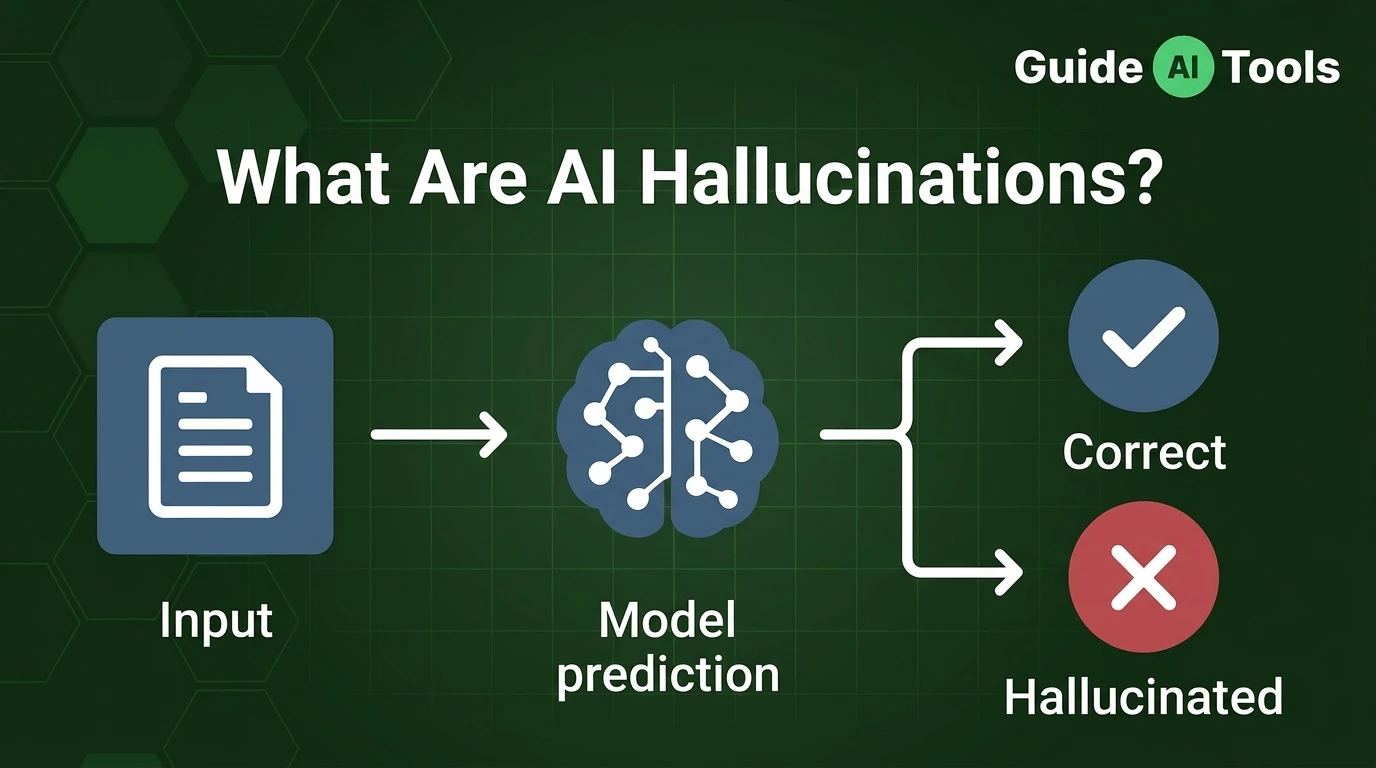
An AI hallucination is a wrong or invented answer that a chatbot delivers with total confidence. The model never checks the fact. It predicts the most likely next words in a sentence, so a fake court case, a wrong date, and a real one all come out in the same calm voice.
That calm voice is the trap. A hallucinated answer rarely looks broken. It reads clean, it names sources, it quotes people. And none of it happened.
Most people meet their first one at work. A policy that never existed. A statistic nobody published. A reference that dissolves the moment you search for it.
Below: the main types, the famous cases, and a checking routine you can run in under two minutes.
What Is an AI Hallucination?
In working terms, a hallucination is any output that presents something false, invented, or unsupported as if it were fact. It is not a glitch in one answer. It is a standing risk in every answer a generative model gives you.
Picture a small one. You ask a chatbot for background reading on a narrow topic and it hands you five books. Four exist. The fifth has a believable title, a plausible author, a sensible year. It was never written.
Hallucination is a failure mode of generative AI, the kind of AI that creates text, images, audio, and video instead of sorting existing content into boxes. Creation is the job. Invention slips in through the same door.
Many researchers prefer the word confabulation. A person who confabulates fills gaps in memory with invented detail and believes every word of it. The comparison fits the behavior better than hallucination, which hints at senses and perception, things a text model simply does not have.
The naming debate matters little at your desk. What matters is the output, and which parts of it deserve your trust.
Why AI Hallucinates
AI models hallucinate because they are built to produce likely language, not verified truth. Their training data holds gaps, errors, and contradictions. On top of that, the way models are scored rewards a confident guess over an honest admission of doubt, so invention becomes a habit rather than an accident.
It predicts text, it does not look facts up
A large language model works token by token. It reads your prompt, picks the next small piece of text that best fits everything it learned in training, then picks the next one. And the next. At no point does it open a reference shelf. There is no shelf.
For the full mechanics of that process, see how generative AI works. The setting called temperature steers it. Low temperature keeps the picks safe and predictable. High temperature lets the model roam further from the common patterns, which is where the creative answers live. Fresh inventions live there too.
Gaps and errors in training data
Training data is the open web plus books, code, and licensed text, and it is full of holes. Some facts appear once or never. Others appear often and are wrong.
A model that has read a claim twice cannot weigh it the way you would. It has no sense of which source deserved trust. Where the data runs thin, the model fills the space with whatever pattern surrounds the gap. The result reads smooth. It is still a guess wearing the clothes of a fact.
The pressure to always answer
Confidence is baked into the format. The model learned from text written by people who mostly sounded sure of themselves, and nothing inside it separates “I know this” from “this sounds right.” Both arrive in identical grammar and identical tone. Fluency is the product. Doubt never learned to speak.
OpenAI researchers made the deeper point in their paper Why Language Models Hallucinate. The tests used to grade models score a blank answer, or an honest “I do not know,” the same as a wrong answer, while a lucky guess can earn the point. Training and scoring push models to guess like students in an exam hall, even when the honest move is to stop.
Types of AI Hallucinations
The most common types are fabricated facts stated as settled truth, fake citations to papers and cases that do not exist, wrong numbers and dates given with false precision, context errors where the answer drifts away from your source, and visual errors inside generated images and video.
Once you can name the shape, you spot it faster. Every type below has shown up in real work, and one of them has already cost lawyers real money.
| Type | What it looks like | Example |
|---|---|---|
| Fabricated fact | A false claim stated as settled truth | An invented founding date for a real company |
| Fake citation | Sources, papers, or cases that do not exist | The court cases invented in the 2023 lawyer case below |
| Wrong number or date | Precise figures with no real source | A market size quoted to two decimal places that no report ever published |
| Context error | The answer ignores or twists the prompt | A summary that adds claims the source document never made |
| Visual error | Images or video with impossible details | Extra fingers, warped text, objects that change between frames |
Notice the shared trait. Every type arrives dressed as normal work. No typo, no glitch, no warning color. Your only signal is the checking habit you build, which is why spotting gets its own section further down.
Real Examples That Made Headlines
The most famous example is the 2023 case of Mata v. Avianca in New York. Lawyer Steven Schwartz used ChatGPT for research and filed a brief citing six cases that sounded perfect. Names, quotes, docket details. None of the six existed, and the judge was not amused.
Opposing lawyers could not find the cases anywhere. Schwartz then asked ChatGPT whether the cases were real, and it told him they were. Judge P. Kevin Castel fined Schwartz, his colleague Peter LoDuca, and their firm 5,000 dollars, and ordered them to write to their client and to every judge falsely named as the author of a fake opinion. The money was minor. The reputation hit was not.
Google’s own launch hurt more. In February 2023, a promotional demo for its Bard chatbot answered a question about the James Webb Space Telescope by claiming the telescope took the very first picture of a planet outside our solar system. Astronomers flagged the error within hours. The first exoplanet image was taken back in 2004 by the Very Large Telescope in Chile. Alphabet lost roughly 100 billion dollars in market value in a day. One wrong sentence, priced instantly.
Then there is the quieter case that may matter most to you. After his grandmother died, Jake Moffatt asked Air Canada’s website chatbot about bereavement fares. It told him he could fly at full price and claim the discount afterward, within 90 days. The airline’s real policy, on a page the chatbot itself pointed to, allowed no such claim after travel. A British Columbia tribunal ruled that Air Canada was responsible for its chatbot’s words and ordered it to pay him 812.02 Canadian dollars in damages, interest, and fees. The airline had argued the chatbot was a separate legal entity responsible for its own actions. The tribunal member called that argument remarkable, and rejected it.
How to Spot a Hallucination
You can tell an answer may be hallucinated when the details feel too neat, the citations cannot be opened, or the answer changes shape when you ask the same question again. Hallucinations love precision. A date given to the day, a quote with page numbers, a statistic with decimals should raise your guard, not lower it.
Watch for these warning signs:
- Details that are oddly specific for a casual question
- Citations, links, or paper titles that lead nowhere when you search them
- A different answer when the same question is asked in a fresh chat
- Sources the model describes warmly but cannot quote or link
Students meet the citation problem first. A bibliography entry that looks perfect and leads nowhere is the classic tell, a pattern we return to in our guide to AI in education.
So run this routine on anything that matters. First, test one citation: open it, or search its exact title. Second, cross-check the single claim your decision depends on against a primary source, the official page, the filing, the manual. Third, ask the model where the answer came from, and watch whether it produces checkable sources or more fog. Fourth, paste the question into a fresh chat and compare. Where the two answers agree, you have something. Where they wander apart, you have a warning.
The cost of skipping this is not embarrassment alone. A trusted false answer can move money, break a policy, or put wrong advice in front of a customer, which is why we cover the same ground inside the wider risks of AI.
How to Reduce AI Hallucinations
You cannot switch hallucination off. You can make it rarer, and you can make it harmless. Those are two different jobs.
Habits for everyday users
Before trusting an AI answer at work, check three things. Check that every named source actually exists. Check the one claim your decision depends on against the original document. And check that names, dates, and figures stay the same when you ask again. If a claim fails any check, treat the whole answer as a draft.
Ask narrow questions. A model asked for one rule invents less than a model asked for everything about the rules. Paste your own source material into the chat and instruct the model to answer from that text alone, and to say plainly when the answer is not in it. That single instruction changes the job from recall to reading, and reading is what these models do best.
Grounding and RAG
No, RAG does not stop hallucinations. It cuts them sharply on questions its sources cover, and it hands you citations you can actually check. But retrieval can fetch the wrong passage, the model can ignore good context sitting right in front of it, and it will still improvise when your question falls outside the documents it was given.
The technique is retrieval augmented generation, or RAG for short. Instead of answering from memory alone, the system first searches a document set you control, then writes from what it found. Grounding is the same instinct in plain form: pin the answer to given sources, and make the tool show them. When a tool answers only from your uploaded files and ties each claim back to a page, invention has far less room to hide.
Human review for high-stakes work
Some output should never ship unchecked. Legal filings, medical guidance, money advice, and anything a customer will act on belong in that pile.
In our guide to AI in healthcare, the pattern repeats: the model drafts, the professional decides. Money work follows the same rule, as our guide to AI in finance shows, because an invented figure in a spreadsheet rarely stays in the spreadsheet. Think of AI output as a fast first draft from a confident junior colleague. Useful. Quick. Never the final signature.
Can Hallucinations Ever Be Fully Fixed?
No, not with the way today’s models work. Hallucination is not a bug sitting on top of the system. It grows out of the same next-word prediction that makes the answers useful in the first place, so builders can shrink it a great deal and still never honestly promise zero. Anyone who does promise zero is selling something.
Newer models do tend to score better. OpenAI’s GPT-5 system card reports a hallucination rate 26 percent lower than GPT-4o for its main model, and 65 percent lower for its thinking model than the o3 model before it, both on OpenAI’s own factuality tests. Better is real. But the tests change between releases, the rates never reach zero, and a better average says nothing about the one answer sitting in front of you.
So plan around the flaw. Build the check into the workflow, and the flaw loses most of its power.
FAQs
Can AI hallucinations be dangerous?
Yes, when the answer feeds a decision. A wrong drug interaction in a health answer. A fake case in a court filing. A discount policy that does not exist in a support chat. Each of those has already happened, some in the cases above. The danger scales with the stakes, which is why casual drafts can go unchecked and clinic, court, and customer answers cannot.
Do all AI chatbots hallucinate?
Yes. Every large language model can hallucinate, because every one of them generates text the same basic way. Some models do it far less often, and tools that answer only from your own documents do it least on the topics those documents cover. But no current chatbot carries a guarantee, whatever its marketing page says. Assume the ability is always there.
Is a hallucination the same as a wrong answer?
Not quite. A wrong answer can come from a bad source the model repeated faithfully, or from a question it misunderstood. A hallucination is invented content: a case, a quote, or a fact the model constructed on the spot and presented as real. The distinction matters because the fixes differ. Bad sources call for better data. Invention calls for checking.
Why do AI models make up citations?
Citations are patterns. A real reference has an author rhythm, a year, a journal name, a volume number, and the model has seen millions of them during training. When you ask for support it cannot actually recall, it assembles the pattern anyway. The result looks exactly like scholarship. It just points at nothing.
Can RAG completely stop hallucinations?
No. RAG grounds answers in documents you choose, and that removes a large share of invention on covered questions. It still fails when retrieval pulls the wrong passage, when the model leans on memory instead of the context it was given, or when the answer simply is not in your documents. RAG is a strong leash. It is not a lock.
Conclusion
The useful way to think about all of this is simple. A chatbot is a drafting partner with a perfect memory for patterns and no memory for truth. Work with it that way and you keep the speed without swallowing the inventions.
Your checking routine is the real product here. The model is just the draft. If you want the wider map before the details, start with what artificial intelligence is and work outward from there.

Related Blog Posts