How Is AI Used in Healthcare?
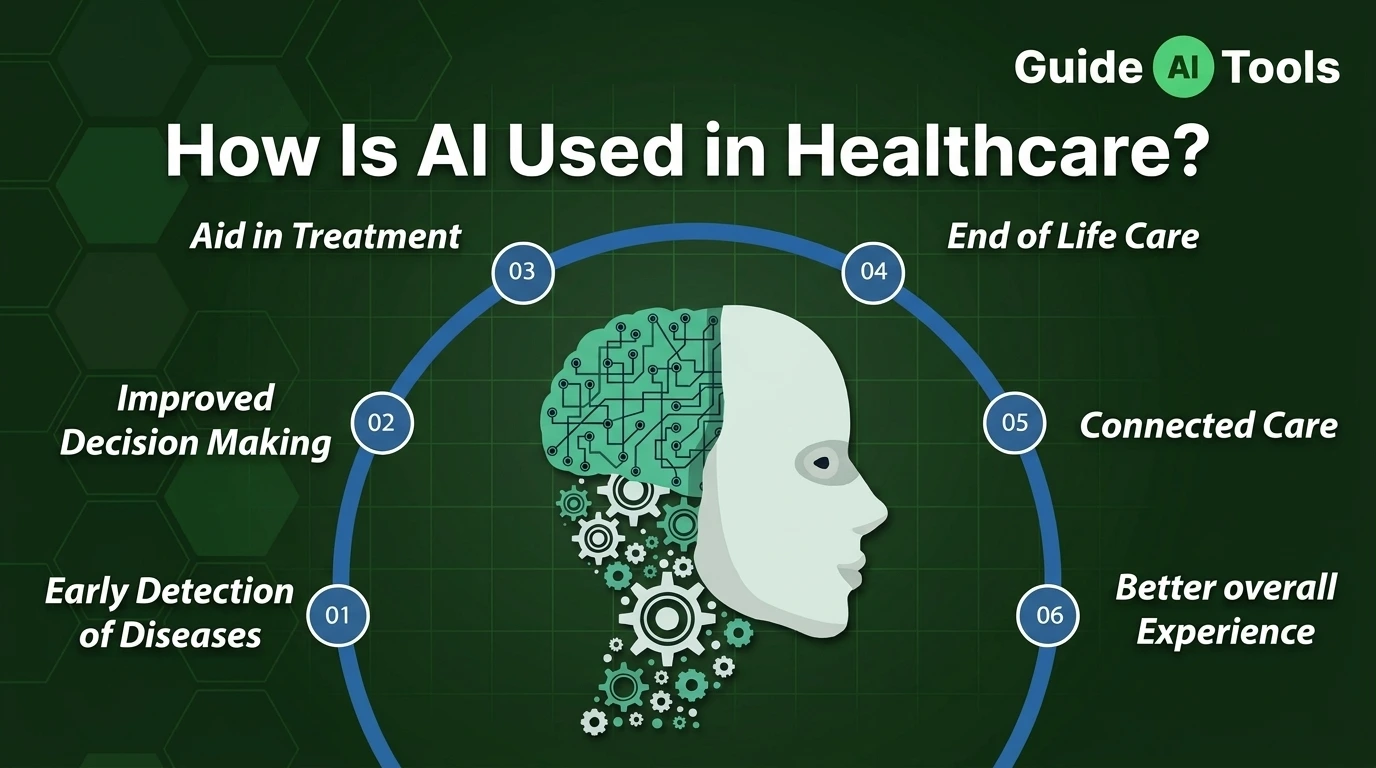
AI in healthcare is software that reads medical scans, flags patients at risk, drafts clinical notes, and searches patient records so care teams can act sooner. Most of it works as decision support, software that advises a clinician. Very little of it makes the final call on its own.
Picture a crowded emergency department. A head scan lands in the queue, software spots a possible brain bleed, and the case jumps the line while an alert reaches the stroke team. That scene already plays out in real hospitals, powered by triage tools that sort scans by urgency, not by arrival time.
Not all of it is proven, though. Some tools here carry years of testing. Some are demos with good marketing. This guide keeps the two apart: what is cleared for patient care, what is still research, and who stays in charge when the software is wrong.
The Main Ways AI Is Used in Healthcare Today
Read this field by job, not by brand. Vendors sell products, but hospitals buy work: reading images, watching for decline, writing notes, hunting for drug candidates, and answering patients. Here is where each job stands today, grouped by the work the software does for the care team.
Medical imaging and radiology
AI reads medical images by hunting for patterns it learned from millions of earlier scans. In practice it sorts the worklist, pushing suspected strokes, brain bleeds, lung clots, and fractures to the top, and it acts as a second reader in screening, such as mammograms (breast X-rays) and retinal photos for diabetic eye disease. A radiologist still signs the report.
This is computer vision doing clinical work, the branch of AI that interprets images and video, covered in our guide to what computer vision is. Radiology accounts for roughly three quarters of every AI device the FDA has authorized.
Aidoc holds FDA clearance for software that flags large vessel occlusions (artery blockages behind the most severe strokes) and brain bleeds on CT scans. Viz.ai won FDA permission in 2018 for a tool that spots the same blockages and messages the stroke team directly. In pathology, Paige flags suspicious areas of prostate biopsy slides.
Diagnosis support and risk prediction
On narrow questions, AI can be strikingly accurate, often matching specialists in controlled tests. It scores well when the job is fixed, such as spotting one disease in one kind of scan. Open-ended diagnosis, where symptoms, history, and examination collide, is a different contest, and there the tools assist rather than decide.
Most hospital tools in this group watch and warn. They read vital signs, lab results, and chart notes, then alert staff when a pattern starts to look like sepsis (a life-threatening reaction to infection) or quiet deterioration. Readmission scores flag patients likely to bounce back after discharge, so follow-up calls happen first. These systems run on machine learning models that learn risk patterns from years of hospital records, then score each new patient against them.
Notes, coding, and admin work
An ambient AI scribe is software that listens to a medical visit, with the patient’s permission, and drafts the clinical note before the appointment ends. The doctor reviews, edits, and signs the draft instead of typing it from memory later. It is now the most common way doctors meet AI at work.
The scribe works because of natural language processing, the technology that turns speech and messy chart text into structured records. In the American Medical Association’s survey of nearly 1,200 physicians, two in three used health AI in 2024, up from 38 percent a year earlier, and documentation sat among the most common uses.
The same systems suggest billing codes, scan claims for errors, and draft replies to portal messages. Unglamorous work, and where the hours are.
Drug discovery and research
AI shortens the slowest part of drug research: the search. Models screen vast libraries of compounds for ones likely to hit a target, predict how proteins fold into the shapes that drive disease, and match patients to trials they qualify for.
DeepMind’s AlphaFold mapped predicted structures for hundreds of millions of proteins, work that once took years for a single protein. Keep this in the research column, though. These tools speed up early work. They do not approve medicines, and any drug they help find still faces years of human trials.
Patient-facing tools
Patients meet AI at the edges of care, often without a clinic visit at all:
- Symptom checker apps that ask questions and suggest whether to seek care
- Chatbots that book appointments, handle refill requests, and answer billing questions
- Remote monitoring that reads data from wearables and home devices and alerts a care team
- Medication and follow-up reminders between visits
Useful, but read the label. A symptom checker is not a diagnosis, and the chatbots on your phone hold no FDA clearance to diagnose anything. When the answer matters, a human clinician is the check that counts.
FDA-Cleared AI Versus Research-Stage AI
Two products can both call themselves AI in healthcare and sit at opposite ends of the evidence scale. One holds FDA authorization for a named medical task. The other is a research demo with a polished video. A cleared tool and a research prototype are not the same thing, and the table below keeps them apart.
| Category | What it means | Examples | Human oversight |
|---|---|---|---|
| FDA-cleared device | Tested and authorized for a stated medical use | Imaging triage tools, IDx-DR eye screening | Clinician reviews output in almost all cases |
| Cleared decision support | Authorized to assist, not to decide | Risk scores, coding aids | Clinician makes the final call |
| Workflow software | Not a medical device, handles admin | Ambient scribes, scheduling tools | Staff check every note and message |
| Research stage | In studies or company testing only | General diagnostic chatbots, many LLM tools | Not approved for patient care decisions |
How Accurate Is AI in Healthcare?
Accuracy is not one number. Accuracy lives at the level of one task, one hospital, one patient mix, and it can move a lot between settings. A model that shines in its launch study may look ordinary in your local hospital.
Narrow tools can post striking results in controlled studies. The Swedish MASAI trial, a randomized mammography study, found AI-supported reading detected more cancers than standard double reading and cut screen-reading workload by about 44 percent.
Then the tool travels. Tested at Michigan Medicine, Epic’s sepsis model scored 0.63 for accuracy, well below the 0.76 to 0.83 the vendor had reported. It missed two thirds of sepsis cases while alerting on nearly one in five patients. Different scanners, different patients, different habits. Performance follows the setting.
The deeper gap is outcomes. A PLOS Digital Health analysis of all 1,357 AI devices the FDA had authorized by the end of 2025 found only 34 tied to registered prospective trials, and just 3 tested on patient outcomes such as deaths, readmissions, or quality of life. Clearing proves a device performs as described. It rarely proves patients do better.
So judge every claim by task and by site. Ask what was measured, detection or outcomes, and treat any accuracy figure without a setting attached as marketing.
The Benefits Doctors and Hospitals Actually Report
The benefits doctors and hospitals report cluster around speed and workload. Urgent scans reach a specialist sooner, sepsis and readmission warnings arrive earlier, notes and coding take minutes instead of hours, and screening holds steady on night shifts. The common thread is time returned to patient care.
Triage speed shows up in hard numbers. In an evaluation at the University of Rochester Medical Center, turnaround time for emergency brain bleed cases fell by 36.6 percent after triage AI started reordering the scan queue. The sickest patients stopped waiting behind routine cases.
The paperwork relief is measurable too. A JAMA Network Open study of 263 clinicians across six health systems found burnout dropped from 51.9 percent to 38.8 percent after 30 days with an ambient AI scribe, alongside less after-hours documenting.
Consistency is the third gain. In the study behind Paige’s prostate tool, pathologists using the software improved cancer detection on biopsy slides by 7.3 percentage points, with the biggest lift for general pathologists, who reached specialist level. For the wider picture, our guide to the benefits of AI makes the general case. Here the pattern is narrower: minutes saved, warnings sent earlier, fewer misses on tired shifts.
Limits and Risks, Stated Plainly
The risks are specific, not abstract. Models can inherit bias from training data, records can leak or be reused, staff can lean on a suggestion too hard, and when something goes wrong, who answers for it is unclear. None of these are reasons to ban the tools. All of them are reasons to supervise them, and our breakdown of the risks of AI covers the wider pattern.
Bias has a name and a case study. In a 2019 study in Science, researchers examined a care management algorithm used on roughly 200 million people a year. Because it predicted future costs instead of actual need, it judged Black patients as healthier than equally sick white patients. Fixing the target would have raised the share of Black patients flagged for extra care from 17.7 percent to 46.5 percent. The model was not broken. It was answering the wrong question, at national scale.
Your data is protected by law, and it is still worth asking hard questions. HIPAA rules govern how US hospitals and their vendors store and share health records, and breaches still happen. Ask who processes your recordings, where data is stored, and whether it trains future models. Hospitals are also targets themselves, and our guide to AI in cybersecurity shows how these systems defend networks and attack them.
Over-reliance is the quiet risk. A scribe draft can contain invented details stated as fact, and a chatbot can answer with total confidence and be wrong. That failure mode has a name, and our guide to AI hallucinations explains why models invent and how to catch it. A human has to check the output every time, which is exactly the step busy teams skip.
Accountability and cost close the list. The clinician and the hospital stay responsible when a tool contributes to an error, whatever the software suggested. Setup, training, and uneven results mean the same product can pay off in one hospital and disappoint in another.
Who Regulates AI in Healthcare?
In the United States, the Food and Drug Administration (FDA) treats most medical AI as a medical device, much of it under Software as a Medical Device (SaMD), software built for a medical purpose.
Here is how the routes work. Most AI devices reach the market through 510(k) clearance, where the maker shows the product is substantially equivalent (close enough in design and purpose) to one already on sale. New device types with no predecessor use the De Novo path. The highest-risk products need premarket approval, the strictest review.
One word matters here. Most of these products are cleared or authorized, not approved, and approved is reserved for that toughest premarket route. The agency keeps a public list of authorized AI-enabled medical devices, and it now runs to more than 1,600 entries.
Outside the US, the European Union’s AI Act classifies most medical device AI as high risk, bringing strict duties on testing, record keeping, and human oversight. The direction is the same on both sides of the Atlantic: more proof, more paperwork, more named humans in charge.
Will AI Replace Doctors?
There is no sign of that in the hiring data or the device data. AI is absorbing tasks inside the job (note writing, coding, first-pass scan sorting), while diagnosis, treatment calls, and accountability stay with clinicians. Hospitals are buying relief for overloaded staff, not replacements.
The exceptions are real but narrow. IDx-DR, now sold as LumineticsCore, was authorized in 2018 to screen photos of diabetic eyes and return a result with no specialist reading the image, after a trial of 900 patients at 10 primary care sites. One question, one condition. That is the shape of autonomy in medicine so far, one tight job at a time.
FAQs
What is the most common use of AI in healthcare today?
By daily volume, paperwork. Ambient scribes draft visit notes, software suggests billing codes, and AI drafts replies to patient portal messages. In the AMA survey, documentation sat at the top of the physician use list, ahead of diagnostic help.
Is AI used in hospitals right now or is it still experimental?
Both happen at once. FDA-cleared triage, screening, and documentation tools run in hospitals every day, and the FDA list of authorized AI devices now tops 1,600 entries. Meanwhile, general diagnostic chatbots and many newer language model tools remain research stage, not cleared for care decisions.
Can AI diagnose better than a doctor?
Sometimes, on one narrow task, inside one study. AI has matched specialist benchmarks in set-piece tests such as reading certain scans, and it also missed two thirds of sepsis cases in one large hospital check. Doctors combine images, history, examination, and context. No cleared tool does all of that.
Are AI medical tools safe?
Cleared tools passed FDA review for a stated use, a real safety bar, and not a guarantee. Most were cleared without trials measuring patient outcomes, and performance can slip at a new hospital. Safety depends on the tool, the task, and the humans checking its work.
Does AI in healthcare need FDA approval?
If software claims to diagnose, detect, or guide treatment, it generally needs FDA clearance or authorization before sale for that use. Pure admin software, such as scheduling or note drafting tools, often sits outside device rules. The intended use decides the category, which is why vendors choose words carefully.
Will AI take over nursing and admin jobs too?
AI already does pieces of admin work, scheduling, coding, and drafting messages, and nurses work with its alerts and dashboards daily. The pattern so far is task shifting, not job removal. Staff spend less time typing and more time with patients, while headcounts follow patient demand more than software.
Conclusion
So where does that leave you? AI in healthcare works best as a fast assistant under human control, strongest today in imaging triage and paperwork, weakest where the evidence is still thin. Believe a claim only when it names the task, the test, and the setting.
If the base ideas are new to you, start with our explainer on what artificial intelligence is, then come back with sharper questions. Ready to compare actual products? Browse the AI tool categories on GuideAITools and hold each one against the cleared and research line this page drew.

Related Blog Posts